Edmond in Oklahoma County, Oklahoma — The American South (West South Central)
Gower Memorial Cemetery
⎯⎯⎯
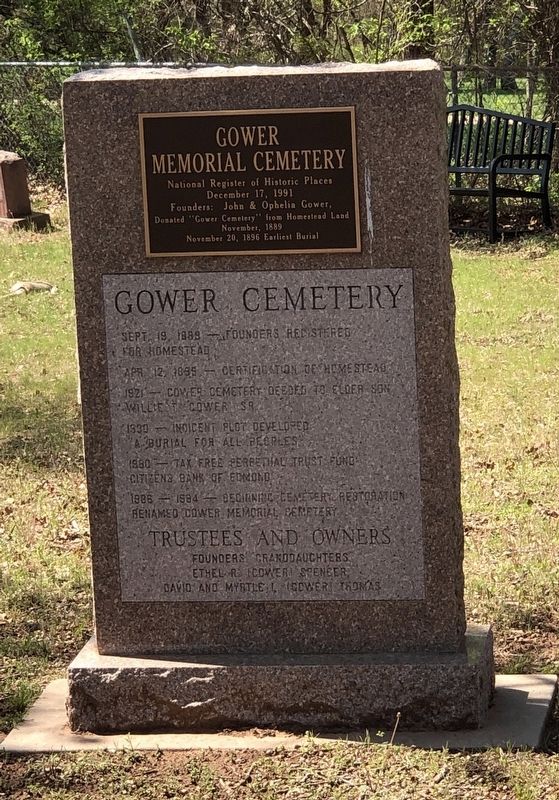
Gower Cemetery
Photographed by Duane and Tracy Marsteller, April 10, 2025
1. Gower Memorial Cemetery / Gower Cemetery Marker
National Register of Historic Places
December 17, 1991
Founders: John & Ophelia Gower,
donated “Gower Cemetery” from homestead land
November, 1889
November 20, 1896 earliest burial
Gower Cemetery
Apr 12, 1895 – Certification of homestead
1921 – Gower Cemetery deeded to elder son Willie T. Gower Sr.
1930 – Indigent plot developed: “A burial for all peoples”
1980 – Tax-free perpetual trust fund, Citizens Bank of Edmond
1986-1994 – Beginning cemetery restoration; renamed “Gower Memorial Cemetery”
Founders' granddaughters
Ethel R. [Gower] Spencer
David and Myrtle L. [Gower] Thomas
Topics and series. This historical marker is listed in these topic lists: African Americans • Cemeteries & Burial Sites • Settlements & Settlers. In addition, it is included in the National Register of Historic Places (NRHP) series list. A significant historical month for this entry is November 1889.
Location. 35° 40.9′ N, 97° 21.635′ W. Marker is in Edmond, Oklahoma, in Oklahoma County. It is on East Covell Road 0.6 miles east of North
this page online

Regionally, this marker is in Central Oklahoma—Frontier Country and in Greater Oklahoma City. It is also in the American South, specifically on the prairies, and on the Southern Plains. Globally, it is in North America, the Western Hemisphere, the Western World, and the Anglosphere. Historically, it finds itself in what was once the territory of the Mississippian Culture and also the Louisiana Purchase.
Other nearby markers. At least 8 other markers are within 3 miles of this marker, measured as the crow flies: Arcadia Round Barn, Arcadia, Oklahoma (approx. 2.3 miles away); Everybody Had One (approx. 2.3 miles away); Luke and Anna Robison (approx. 2.4 miles away); Frank and Katie Vrana (approx. 2.4 miles away); Tuton's Drugstore (approx. 2.4 miles away); Beverly and Karl White (approx. 2.4 miles away); Route 66 (approx. 2.4 miles away); Washington Irving's Camp (approx. 2.6 miles away).
Regarding Gower Memorial Cemetery / Gower Cemetery. Excerpt
Photographed by Duane and Tracy Marsteller, April 10, 2025
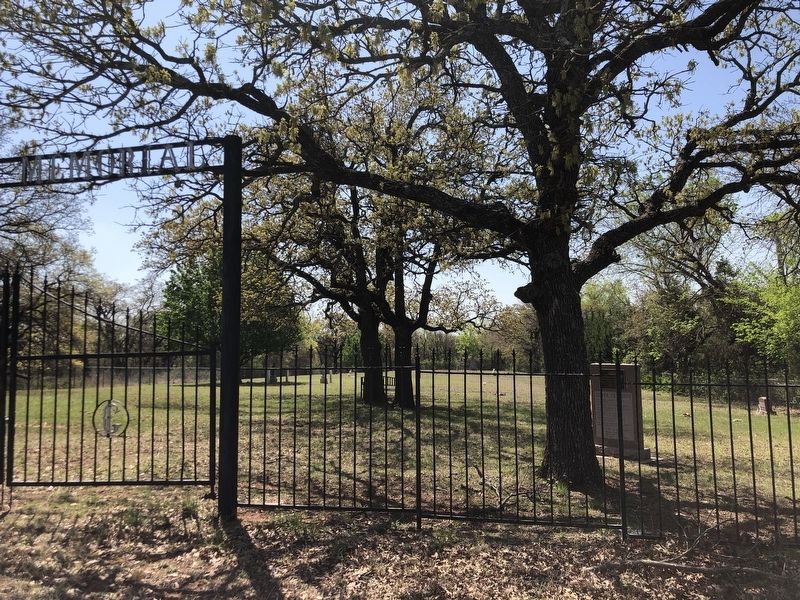
2. Gower Memorial Cemetery / Gower Cemetery Marker
The Gower Cemetery is significant for its association with the African American settlers who moved into the rural area northeast of Edmond and west of Arcadia in north Oklahoma County during and shortly after the Run of 1889. The cemetery was one of three properties associated with the black homesteaders which lived in a four- to six-square-mile area around Covell Road and Post Road. A church and a school, no longer extant, were also built and used by the African American homesteaders. The period of significance extends from 1896,when the first recorded burial took place, until 1940, seven years after the close of the church and near the time the school was closed. In addition to its association with the early settlement of African Americans, the cemetery is also significant because of its age and significance to Oklahoma's territorial period and for its distinctive physical features: the handmade and locally constructed monuments and markers.
Also see . . .
1. Gower Cemetery (PDF). National Register nomination for the burial ground, which was listed in 1991. (Prepared by Maryjo Meacham; via National Park Service) (Submitted on May 21, 2025, by Duane and Tracy Marsteller of Murfreesboro, Tennessee.)
2. African Americans in Early Edmond. The Gowers created the cemetery to enable their African American neighbors to bury their relatives, though they did not exclude anyone who was in need of a burial plot or those who could not pay for a plot. (Edmond History Museum) (Submitted on May 21, 2025, by Duane and Tracy Marsteller of Murfreesboro, Tennessee.)
3. ‘Don’t let weeds grow on my grave’: Poems on Gower Memorial Cemetery. The Gower Memorial Cemetery, in Edmond, is a living testimony to a family’s compassion that crossed racial barriers. The cemetery of more than 500 plots became a free burial site for the poor who could not afford a burial elsewhere. (James Coburn via NonDoc.com, Sept. 5, 2020) (Submitted on May 21, 2025, by Duane and Tracy Marsteller of Murfreesboro, Tennessee.)
Credits. This page was last revised on May 21, 2025. It was originally submitted on May 21, 2025, by Duane and Tracy Marsteller of Murfreesboro, Tennessee. This page has been viewed 139 times since then and 23 times this year. Photos: 1, 2. submitted on May 21, 2025, by Duane and Tracy Marsteller of Murfreesboro, Tennessee.
