Bellaire in Belmont County, Ohio — The American Midwest (Great Lakes)
Symbolism Of The Arch
Photographed by Craig Doda, April 26, 2025
1. Symbolism Of The Arch Marker
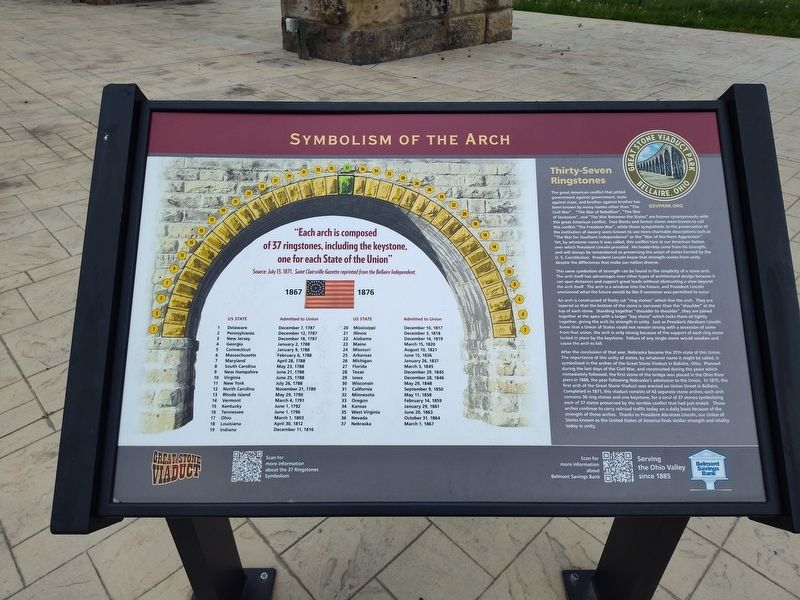
"Each arch is composed of 37 ringstones, including the keystone, one for each State of the Union"
Source: July 13, 1871, Saint Clairsville Gazette reprinted from the Bellaire Independent.
1 Delaware December 7, 1787 • 2 Pennsylvania December 12, 1787 • 3 New Jersey December 18, 1787 • 4 Georgia January 2, 1788 • 5 Connecticut January 9, 1788 • 6 Massachusetts February 6, 1788 • 7 Maryland April 28, 1788 • 8 South Carolina May 23, 1788 • 9 New Hampshire June 21, 1788 • 10 Virginia June 25, 1788 • 11 New York July 26, 1788 • 12 North Carolina November 21, 1789 • 13 Rhode Island May 29, 1790 • 14 Vermont March 4, 1791 • 15 Kentucky June 1, 1792 • 16 Tennessee June 1, 1796 • 17 Ohio March 1, 1803 • 18 Louisiana April 30, 1812 • 19 Indiana December 11, 1816 • 20 Mississippi December 10, 1817 • 21 Illinois December 3, 1818 • 22 Alabama December 14, 1819 • 23 Maine March 15, 1820 • 24 Missouri August 10, 1821 • 25 Arkansas June 15, 1836 • 26 Michigan January 26, 1837 • 27 Florida March 3, 1845 • 28 Texas December 29, 1845 • 29 Iowa December 28, 1846 • 30 Wisconsin May 29, 1848 • 31 California September 9, 1850 • 32 MinnesotaMay 11, 1858 • 33 Oregon February 14, 1859 • 34 Kansas January 29, 1861 • 35 West Virginia June 20, 1863 • 36 Nevada October 31, 1864 • 37 Nebraska March 1, 1867
Click or scan to see
this page online
Thirty-Seven Ringstones
The great American conflict that pitted government against government, state against state, and brother against brother has been known by many names other than "The Civil War". "The War of Rebellion", "The War of Secession", and "The War Between the States" are known synonymously with this great American conflict. Free Blacks and former slaves were known to call this conflict "The Freedom War", while those sympathetic to the preservation of the institution of slavery were known to use more charitable descriptions such as "The War for Southern Independence" or the "War of Northern Aggression" Yet, by whatever name it was called, this conflict tore at our American Nation over which President Lincoln presided. His leadership came from his strength, and will always be remembered as preserving the union of states formed by the U.S. Constitution. President Lincoln knew that strength comes from unity despite the differences that make our nation diverse.
This
Photographed by Craig Doda, April 26, 2025
2. Symbolism Of The Arch Marker
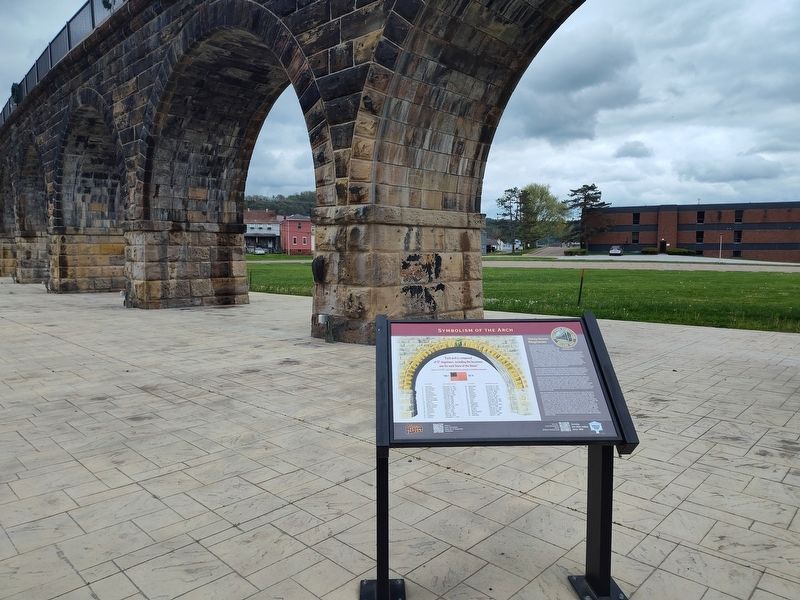
After the conclusion of that war, Nebraska became the 37th state of this Union. The importance of this unity of states, by whatever name it might be called, is symbolized in the arches of the Great Stone Viaduct in Bellaire, Ohio. Planned during the last days of the Civil War, and constructed during the years which immediately followed, the first stone of the bridge was placed in the Ohio River piers in 1868, the year following Nebraska's admission to the Union. In 1870, the first arch of the Great Stone Viaduct was erected on Union Street in Bellaire. Completed in 1871, this viaduct consists of 43 separate stone arches; each arch contains 5 ring stones and one keystone, for a total of 37 stones symbolizing each of 37 states preserved by the terrible conflict that had just ended. Those arches continue to carry railroad traffic today on a daily basis because of the strength of those arches. Thanks to President Abraham Lincoln, our Union of States known as the United States of America finds similar strength and vitality today in unity.
Topics. This historical marker is listed in these topic lists: Government & Politics • Railroads & Streetcars • War, US Civil. A significant historical date for this entry is January 2, 1788.
Location. 40° 0.805′ N, 80° 44.801′ W. Marker is in Bellaire, Ohio, in Belmont County. It can be reached from the intersection of Hamilton Street and 31st Street, on the right when traveling north. Touch for map. Marker is at or near this postal address: 3125 Hamilton St, Bellaire OH 43906, United States of America. Touch for directions.

Regionally, this marker is in the High Valley. It is also in the American Midwest, in the Ohio River Valley, in Appalachia, and specifically in Northern Appalachia. Globally, it is in North America, the Western Hemisphere, the Western World, and the Anglosphere. Historically, it finds itself in what was once the Haudenosaunee (Iroquois) Confederacy, the territory of the Mississippian Culture, and the Northwest Territory.
Other nearby markers. At least 8 other markers are within walking distance of this marker: Veterans Arch (about 300 feet away, measured in a direct line); 1855-1871 Planning A City For A Railroad (about 300 feet away); Imperial Glass (approx. 0.2 miles away); The Great Stone Viaduct (approx. ¼ mile away); War Memorial (approx. 0.3 miles away); World War II Memorial (approx. 0.3 miles away); Colonel John H. Sullivan (approx. 0.3 miles away); Cornelius D. Battelle, Methodist Circuit Rider / The First United Methodist Church, Bellaire (approx. 0.3 miles away). Touch for a list and map of all markers in Bellaire.
Credits. This page was last revised on May 21, 2025. It was originally submitted on May 21, 2025, by Craig Doda of Napoleon, Ohio. This page has been viewed 112 times since then and 13 times this year. Photos: 1, 2. submitted on May 21, 2025, by Craig Doda of Napoleon, Ohio. • Devry Becker Jones was the editor who published this page.
