Sandwich in Kent, England, United Kingdom — Northwestern Europe (the British Isles)
Sandwich

Photographed by Ray Gurganus, March 31, 2025
1. Sandwich Marker
The town grew as a prosperous trading and fishing port from the 7th century. The River Stour, on which Sandwich stands, was then far wider and deeper than today; a thriving trading and fishing fleet found safe- harbour and formed, with other ships from the south-east, the nucleus of the English Navy, which led to the confederation of the Cinque Ports. Each member had to provide, when required, a number of fully-crewed ships, for use by the Crown in the defence of England. In return, the Cinque Ports were given many privileges which led to control of the Channel and its trade.
The town has many famous associations - Samuel Pepys was briefly a member of Parliament for the town in 1685; John Montagu, 4th Earl of "Sandwich, invented the "sandwich" in 1762. Loth to leave the gambling tables, he asked for meat to be served between slices of
this page online
In Malory's 'Le Morte d'Arthur', written in the 15th century, it is Sandwich that figures as the greatest port of England, King Arthur had his triumphant homecoming after slaying the Emperor of Rome with Excalibur. Many British Monarchs have visited the town, most notably Richard, Coeur de Lion, on his return from the crusades, Edward III, Henry VIII and Elizabeth I. In 1170, Thomas Becket returned from his exile in France to a raptuous welcome in Sandwich before being martyred at Canterbury.
The town suffered heavily at the hands of invaders The Vikings carried out many raids in the 9th, 10th and 11th centuries, ending in 1016, when Canute landed his army at Sandwich on his way to take the English throne. The French also inflicted much damage in raids, notably in 1216-7, and again in 1457 when 4,000 men from Honfleur (now Sandwich's twinned town) almost burnt it to the ground.
Between the 11th and 15th centuries, the town reached the height of its fame and prosperity. Maritime trade flourished with ships
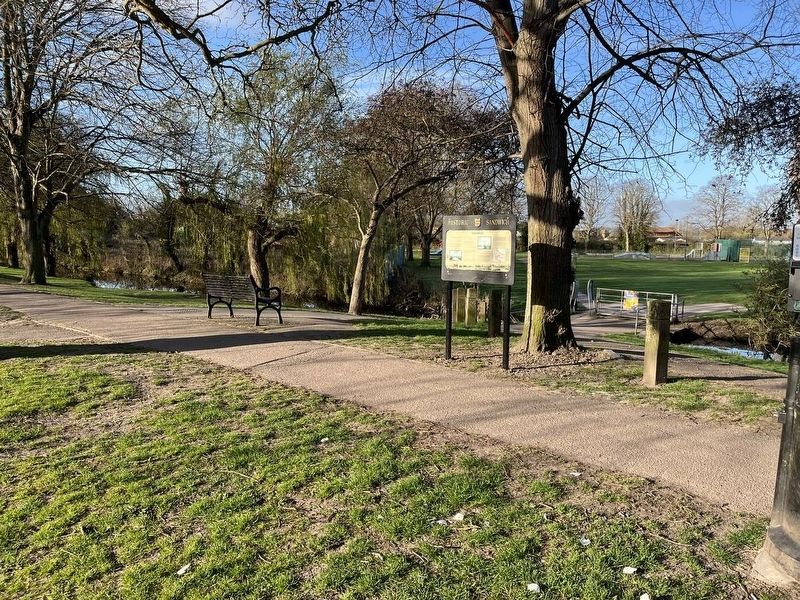
Photographed by Ray Gurganus, March 31, 2025
2. Sandwich Marker
By the 16th century, the river was so badly silted up that Sandwich ceased to be a major port. It declined in importance, reviving briefly in the 16th and 17th centuries from the immigration of Protestant refugees fleeing religious persecution. Many of the Dutch and Flemish refugees settled in Sandwich, bringing their skills as cloth makers and market gardeners. They also left their mark on the town in the many dutch gables still to be seen many of its ancient buildings, erected when it was a major European trading port, have been preserved.
(French not transcribed)
Erected by Sandwich Town Council. (Marker Number 1.)
Topics. This historical marker is listed in these topic lists: Industry & Commerce • Waterways & Vessels.
Location. 51° 16.526′ N, 1° 20.136′ E. Marker is in Sandwich, England, in Kent. It is on Loop Street. Touch for map. Marker is at or near this postal address: 16 Loop Street, Sandwich, England CT13 9HE, United Kingdom. Touch for directions.

Regionally, this marker is in the Greater South East. Globally, it is on the Atlantic Ocean, in the North Atlantic Region, in Europe, in Atlantic Europe, on one of the British Isles, in the Western World, and in the Anglosphere. Historically, it finds itself in what was once the Roman Empire.
Other nearby markers. At least 8 other markers are within walking distance of this marker: Medieval Corn Market and the Guildhall (about 240 meters away, measured in a direct line); St Peter’s Church (approx. 0.3 kilometers away); St Mary's Church (approx. 0.3 kilometers away); Lieutenant Colonel Augustus C Newman VC OBE TD DL (approx. 0.3 kilometers away); Sandwich War Memorial (approx. 0.3 kilometers away); Historic Sandwich (approx. 0.3 kilometers away); St Peter's Church and the Mayflower Pilgrims from Sandwich (approx. 0.3 kilometers away); Sandwich Toll Bridge (approx. 0.4 kilometers away). Touch for a list and map of all markers in Sandwich.
Credits. This page was last revised on June 11, 2025. It was originally submitted on May 23, 2025, by Ray Gurganus of Washington, District of Columbia. This page has been viewed 108 times since then and 23 times this year. Photos: 1, 2. submitted on May 23, 2025, by Ray Gurganus of Washington, District of Columbia. • Andrew Ruppenstein was the editor who published this page.
