Leeds in Jefferson County, Alabama — The American South (East South Central)
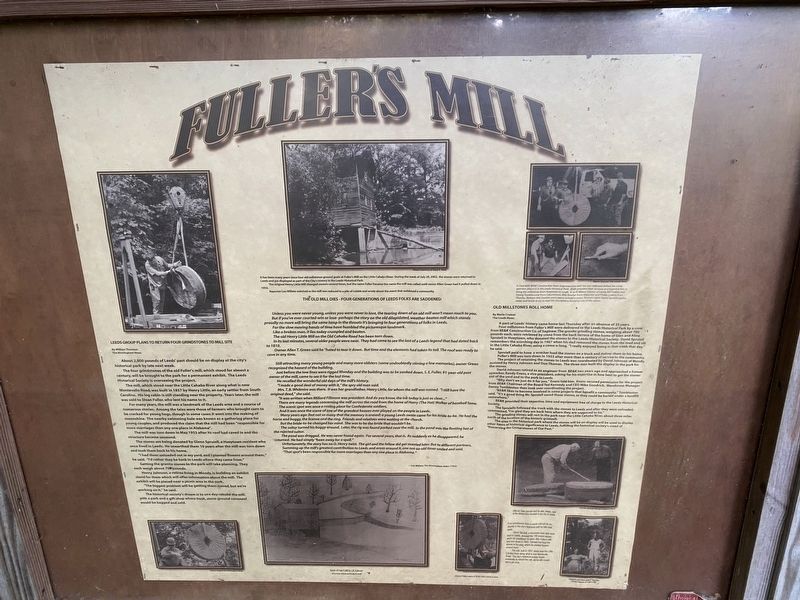
Fuller's Mill
Photographed by Cajun Scrambler, May 25, 2025
1. Fuller's Mill Marker
It has been many years since four millstones ground grain at Fuller's Mill on the Little Cahaba River. During the week of July 29, 2002, the stones were returned to Leeds and are displayed as part of the City's history in the Leeds Historical Park.
The original Henry Little Mill changed owners several times, but the name Fuller became the name the mill was called until owner Allen Green had it pulled down in 1953.
Reporter Leo Willete watched as the mill was reduced to a pile of rubble and wrote about the event that saddened the community.
LEEDS GROUP PLANS TO RETURN FOUR GRINDSTONES TO MILL SITE
By William Thornton
The Birmingham News
About 2,800 pounds of Leeds' past should be on display at the city's historical park by late next week.
The four grindstones of the old Fuller's mill, which stood for almost a century, will be brought to the park for a permanent exhibit. The Leeds Historical Society is overseeing the project.
The mill, which stood near the Little Cahaba River along what is now Montevallo Road, was built in 1857 by Henry Little, an early settler from South Carolina. His log cabin is still standing
this page online
For many years, the mill was a landmark of the Leeds area and a source of numerous stories. Among the tales were those of farmers who brought corn to be cracked for young hogs, though in some cases it went into the making of moonshine. The nearby swimming hole was known as a gathering place for young couples, and produced the claim that the mill had been "responsible for more marriages than any one place in Alabama".
The mill was torn down in May 1953 after its roof had caved in and the structure became unsound.
The stones are being donated by Glenn Spruiell, a Hueytown resident who once lived in Leeds. He unearthed them 10 years after the mill was torn down and took them back to his home.
"I had them unloaded out in my yard, and I planted flowers around them," he said. "I'd rather they be back in Leeds where they came from".
Getting the granite stones to the park will take planning. They each weigh about 700 pounds.
Henry Johnson, a retiree living in Moody, is building an exhibit stand for them which will offer information

Photographed by Cajun Scrambler, May 25, 2025
2. Fuller's Mill Marker
"The biggest problem will be getting them moved, but we're working on it," he said.
The historical society's dream is to one day rebuild the mill, with a park and a gift shop where fresh, stone-ground cornmeal would be bagged and sold.
THE OLD MILL DIES-FOUR GENERATIONS OF LEEDS FOLKS ARE SADDENED
Unless you were never young, unless you were never in love, the tearing down of an old mill won't mean much to you.
But if you've ever courted-win or lose-perhaps the story on the old dilapidated, weather-beaten mill which stands proudly no more will bring the same lump in the throats it's bringing to four generations of folks in Leeds.
For the slow moving hands of time have humbled the picturesque landmark.
Like a broken man, it lies today crumpled and beaten.
The old Henry Little Mill on the Old Cahaba Road has been torn down.
In its last minutes, several older people were near. They had come to see the last of a Leeds legend that had dated back to 1810.
Owner Allen T. Green said he "hated to tear it down. But time and the elements had taken its toll.

Photographed by Cajun Scrambler, May 25, 2025
3. Fuller's Mill Marker
Displays for Millstones built by
Henry Johnson
David Johnson
Donald Thomas
Henry Johnson
David Johnson
Donald Thomas
Still attracting many young people and many more oldsters (some undoubtedly stirring a few memories), owner Green recognized the hazard of the building.
Just before the tow lines were rigged Monday and the building was to be yanked down, S. E. Fuller, 91-year-old past owner of the mill, came to see it for the last time.
He recalled the wonderful old days of the mill's history.
"I made a good deal of money with it," the spry old man said.
Mrs. T.B. Whitmire was there. It was her grandfather, Henry Little, for whom the mill was named. "I still have the original deed," she said.
"It was written when Millard Fillmore was president. And do you know, the ink today is just as clear..."
There are many legends concerning the mill across the road from the home of Harry (The Hat) Walker of baseball fame.
The scenic spot was once a resting place for Confederate soldiers.
But the bride-to-be changed her mind. She was to be the bride that wouldn't be.
The suitor turned his buggy around. Later, the rig was found parked near the mill. In the pond was the floating hat of the rejected suitor.
The pond was dragged. He was never found again. For several years, that is. As suddenly as he disappeared, he returned. He had simply "been away for a spell."
Unfortunately, the story has no O. Henry twist. The girl and the fellow did get married later. But to different partners.
Summing up the mill's greatest contribution to Leeds and areas around it, one not-so-old timer smiled and said.
"That spot's been responsible for more marriages than any one place in Alabama."
OLD MILLSTONES ROLL HOME
By Marie Cromer
The Leeds News
A part of Leeds' history came home last Thursday after an absence of 35 years.
Four millstones from Fuller's Mill were delivered to the Leeds Historical Park by a crew from BE&K Construction Co. of Saginaw. The granite grinding stones, weighing about 700 pounds each, were retrieved by crane from the back terrace of the home of Glen and Aline Spruiell in Hueytown, who donated the stones to the Leeds Historical Society. David Spruiell remembers the scorching day in 1967 when his dad removed the stones from the mud in the Little Cahaba River, using a come-a-long. "I really enjoyed being in that creek that day," he said.
Spruiell paid to have a wrecker load the stones on a truck and deliver them to his home.
Fuller's Mill was torn down in 1953 after more than a century of service to the community.
The project of returning the stones to Leeds was coordinated by David Johnson of Moody assisted by Henry Johnson and Don Thomas. The three men built the display in the park for the stones.
David Johnson retired as an engineer from BE&K two years ago and approached a former coworker, Randy Evans, a vice president, asking for his expertise in how best to get the stones out of the yard and to the park in Leeds.
"Why don't we just do it for you," Evans told him. Evans secured permission for the project from BE&K Chairman of the Board Ted Kennedy and CEO Mike Goodrich. Warehouse Manager Danny Tumbleston then took over coordinating the project.
"BE&K likes to become involved in some projects that benefit a community," Tumbleston said. "It's a good thing Mr. Spruiell saved those stones, or they could be buried under a landfill somewhere."
BE&K provided their expertise, time and equipment free of charge to the Leeds Historical Society.
The Spruiells followed the truck with the stones to Leeds and after they were unloaded, commented, "I'm glad they are back here where they are supposed to be."
The grinding stones will rest in the park near the Little Cahaba River, about three miles north of the location of the historic gristmill.
The area in the historical park where the stones will be on display will be used to display other items of historical significance to Leeds, fulfilling the historical society's creed of "Preserving the Cornerstones of Our Past."
Erected 2002 by Leeds Historical Society.
Topics. This historical marker is listed in these topic lists: Agriculture • Settlements & Settlers.
Location. 33° 32.351′ N, 86° 33.76′ W. Marker is in Leeds, Alabama, in Jefferson County. It is on Montevallo Road Southwest (Alabama Route 119). Touch for map. Marker is at or near this postal address: 1204 Montevallo Rd SW, Leeds AL 35094, United States of America. Touch for directions.

Regionally, this marker is in the Birmingham Metropolitan Area. It is also in the American South and specifically in the Deep South. Globally, it is in North America, a Gulf of Mexico state, the Western Hemisphere, the Western World, and the Anglosphere. Historically, it finds itself in what was once the territory of the Mississippian Culture, one of the Confederate States of America, and the Antebellum South.
Other nearby markers. At least 8 other markers are within 4 miles of this marker, measured as the crow flies: Congressional Medal Of Honor Recipients (within shouting distance of this marker); Jonathan Bass House Museum (approx. ¼ mile away); Leeds Benchmarks In History (approx. 1.1 miles away); Rowan House (approx. 1.3 miles away); John Henry (approx. 1.4 miles away); The Depot (approx. 1.4 miles away); Shiloh Cemetery (approx. 1.4 miles away); Mt. Hebron School (approx. 3.6 miles away). Touch for a list and map of all markers in Leeds.
More about this marker. Located in the Leeds Historical Park.
Credits. This page was last revised on May 26, 2025. It was originally submitted on May 26, 2025, by Cajun Scrambler of Assumption, Louisiana. This page has been viewed 218 times since then and 56 times this year. Photos: 1, 2, 3. submitted on May 26, 2025, by Cajun Scrambler of Assumption, Louisiana.
