Suffolk, Virginia — The American South (Mid-Atlantic)
Siege of Suffolk
Bacon for the Confederacy
April 18, 2009
1. Siege of Suffolk CWT Marker
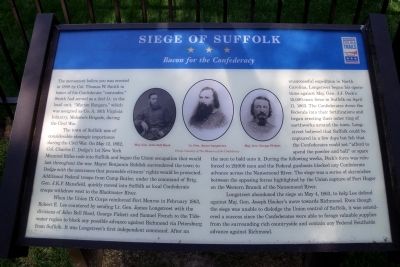
The monument before you was erected in 1889 by Col. Thomas W. Smith in honor of his Confederate “comrades.” Smith had served as a 2nd Lt. in the local unit, “Marion Rangers,” which was assigned as Co. A, 16th Virginia Infantry, Mahone’s Brigade, during the Civil War.
The town of Suffolk was of considerable strategic importance during the Civil War. On May 12, 1862, Col. Charles C. Dodge’s 1st New York Mounted Rifles rode into Suffolk and began the Union occupation that would last throughout the war. Mayor Benjamin Riddick surrendered the town to Dodge with the assurance that peaceable citizens’ rights would be protected. Additional Federal troops from Camp Butler, under the command of Brig. Gen. J.K.F. Mansfield, quickly moved into Suffolk as local Confederate troops withdrew west to the Blackwater River.
When the Union IX Corps reinforced Fort Monroe in February 1863, Robert E. Lee countered by sending Lt. Gen. James Longstreet with the divisions of John Bell Hood, George Pickett and Samuel French to the Tidewater region to block any possible advance against Richmond via Petersburg from Suffolk. It was Longstreet’s
this page online
Longstreet abandoned the siege on May 4, 1863, to help Lee defend against Maj. Gen. Joseph Hooker’s move towards Richmond. Even though the siege was unable to dislodge the Union control of Suffolk, it was considered a success since the Confederates were able to forage valuable supplies from the surrounding rich countryside and contain any
April 18, 2009
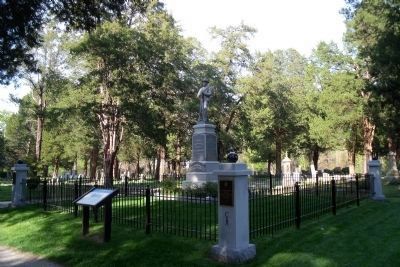
2. CWT Marker in front of the Confederate Monument.
Erected by Virginia Civil War Trails.
Topics and series. This historical marker is listed in this topic list: War, US Civil. In addition, it is included in the Virginia Civil War Trails series list. A significant historical month for this entry is February 1863.
Location. 36° 44.125′ N, 76° 34.732′ W. Marker is in Suffolk, Virginia. It can be reached from Mahan Street 0.2 miles north of Prentis Street, on the right when traveling north. The CWT marker is located in Cedar Hill Cemetery. Touch for map. Marker is at or near this postal address: 105 Mahan Street, Suffolk VA 23434, United States of America. Touch for directions.

Regionally, this marker is in Hampton Roads, specifically in Coastal Virginia, and in the Hampton Roads Metropolitan Area. It is also in the American South, specifically in the Upper South, in the Tidewater, and on the Eastern Seaboard. Globally, it is in the North Atlantic Region, North America, the Western Hemisphere, the Western World, and the Anglosphere. Historically, it finds itself in what was once the territory of the Mississippian Culture, one of the original
April 18, 2009
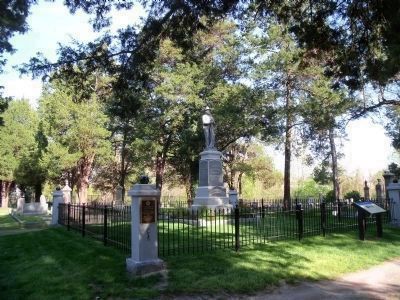
3. Monument to the Confederate Dead
Other nearby markers. At least 8 other markers are within walking distance of this marker: Confederate Monument (within shouting distance of this marker); Remembrance Garden Monuments (within shouting distance of this marker); Watering Fountain (within shouting distance of this marker); Civil War Militia of Suffolk and Nansemond County (about 500 feet away, measured in a direct line); Spanish War Veterans Memorial (about 600 feet away); Site of the John Constant House (about 700 feet away); World War I Monument (about 700 feet away); World War II Memorial (approx. 0.2 miles away). Touch for a list and map of all markers in Suffolk.
More about this marker. In the center are photographs of three Confederate Generals: “Maj. Gen. John Bell Hood”, “Lt. Gen. James Longstreet”, and “Maj. Gen. George Pickett”. Photos courtesy of The Museum of the Confederacy.
April 18, 2009
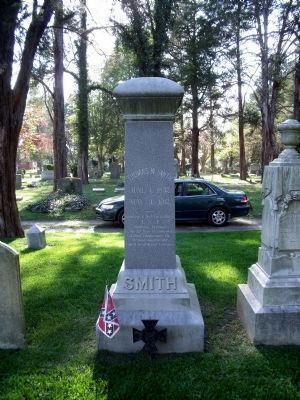
4. Nearby grave of Col. Thomas W. Smith
June 1, 1832
May 9, 1912
Company A 16th Va. Infantry
C.S.A.
Mahone’s Brigade
Lt. Col. 4th Regt. Va. Volunteers
Grand Commander Va
Brigade Commander
United Confederate Veterans
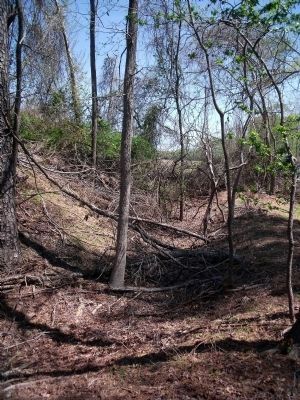
April 18, 2009
5. Union Battery Stevens
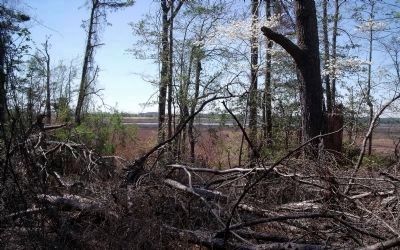
April 18, 2009
6. View from Battery Stevens opposite Fort Huger
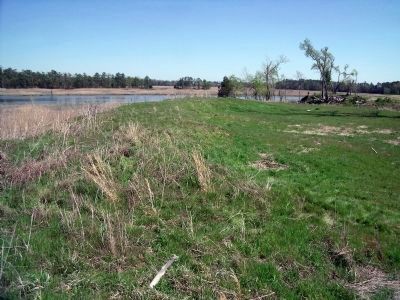
April 18, 2009
7. Confederate Hill's Point Battery (Fort Huger)
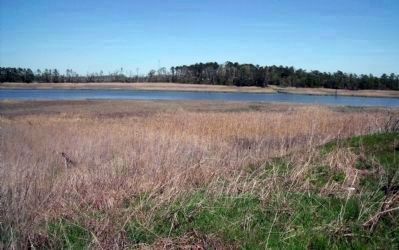
April 18, 2009
8. View from Fort Huger opposite Battery Stevens

9. View of Nansemond River from Fort Huger
Credits. This page was last revised on May 26, 2025. It was originally submitted on April 20, 2009, by Bernard Fisher of Richmond, Virginia. This page has been viewed 4,896 times since then and 111 times this year. Last updated on May 26, 2025, by Evan Dwyer of Richmond, Virginia. Photos: 1, 2. submitted on April 20, 2009. 3. submitted on April 22, 2009. 4. submitted on April 20, 2009. 5, 6, 7, 8, 9. submitted on April 21, 2009. • Devry Becker Jones was the editor who published this page.
