Barrie in Simcoe County, Ontario — Central Canada (North America)
The East End — 1800s
| — | Barrie Waterfront Heritage Trail | — |
Photographed by Cosmos Mariner, June 5, 2024
1. The East End — 1800s Marker
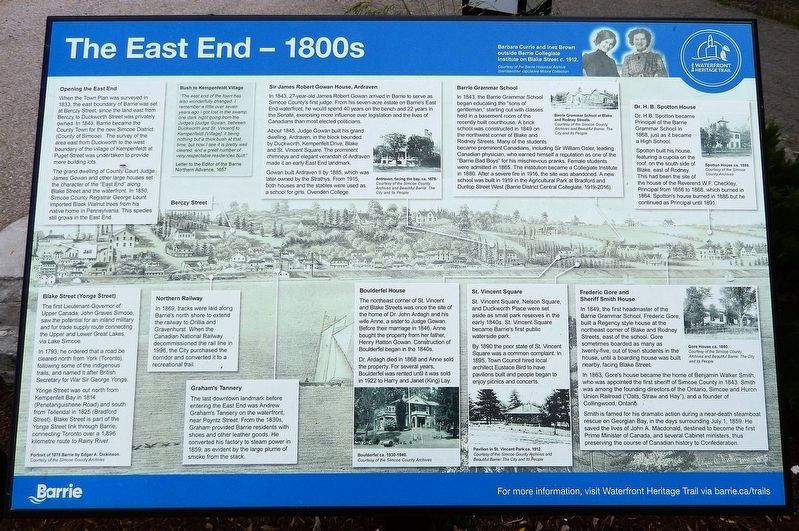
Opening the East End
When the Town Plan was surveyed in 1833, the east boundary of Barrie was set at Berczy Street, since the land east from Berczy to Duckworth Street was privately owned. In 1843, Barrie became the County Town for the new Simcoe District (County of Simcoe). The survey of the area east from Duckworth to the west boundary of the village of Kempenfeldt at Puget Street was undertaken to provide more building lots.
The grand dwelling of County Court Judge James Gowan and other large houses set the character of the "East End" along Blake Street and the waterfront. In 1850, Simcoe County Registrar George Lount imported Black Walnut trees from his native home in Pennsylvania. This species still grows in the East End.
Bush to Kempenfeldt Village
”The east end of the town has also wonderfully changed. I remember a little over seven years ago I got lost in the swamp one dark night going from the Judge's [Judge Gowan, between Duckworth and St. Vincent] to Kempenfeldt [Village], it being nothing but a thick bush at that time; but now I see it is pretty well cleared, and a great number of very respectable residences built.”
Letter
this page online
Sir James Robert Gowan House, Ardraven
In 1843, 27-year-old James Robert Gowan arrived in Barrie to serve as Simcoe County's first judge. From his seven-acre estate on Barrie’s East End waterfront, he would spend 40 years on the bench and 22 years in the Senate, exercising more influence over legislation and the lives of Canadians than most elected politicians.
About 1845, Judge Gowan built his grand dwelling, Ardraven, in the block bounded by Duckworth, Kempenfelt Drive, Blake and St. Vincent Square. The prominent chimneys and elegant verandah of Ardraven made it an early East End landmark.
Gowan built Ardraven II by 1885, which was later owned by the Strathys. From 1915, both houses and the stables were used as a school for girls, Ovenden College.
Barrie Grammar School
In 1843, the Barrie Grammar School began educating the "sons of gentleman," starting out with classes held in a basement room of the recently built courthouse. A brick school was constructed in 1849 on the northwest corner of Blake and Rodney Streets. Many of the students became prominent Canadians, including Sir William
Photographed by Cosmos Mariner, June 5, 2024
2. The East End — 1800s Marker
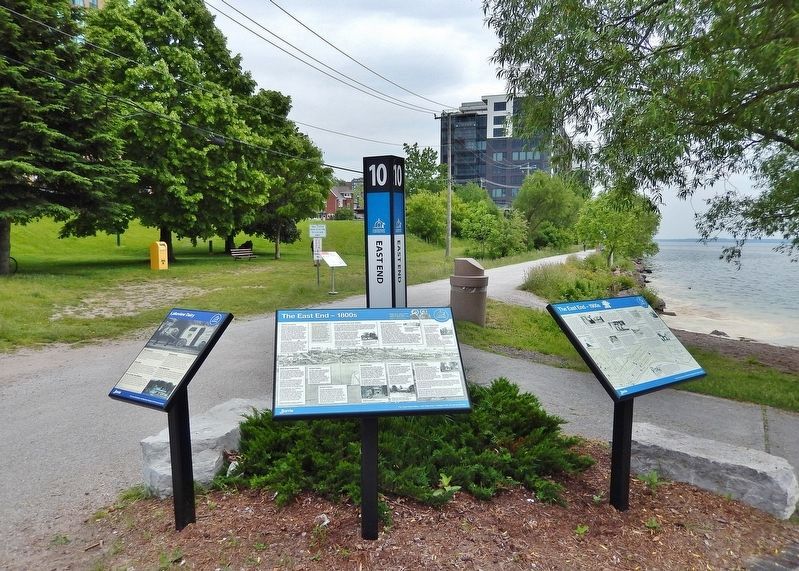
Looking northeast from the Heritage Park parking lot, across the Barrie North Shore Trail (former rail line). Sam Cancilla Park is in the background. It is the center one of three related interpretive panels at this location.
Dr. H. B. Spotton House
Dr. H.B. Spotton became Principal of the Barrie Grammar School in 1868, just as it became a High School.
Spotton built his house, featuring a cupola on the roof, on the south side of Blake, east of Rodney. This had been the site of the house of the Reverend W.F. Checkley, Principal from 1856 to 1868, which burned in 1864. Spotton's house burned in 1886 but he continued as Principal until 1891.
Blake Street (Yonge Street)
The first Lieutenant-Governor of Upper Canada, John Graves Simcoe, saw the potential for an inland military and fur trade supply route connecting the Upper and Lower Great Lakes, via Lake Simcoe.
In 1793, he ordered that a road be cleared north from York (Toronto), following some of the indigenous trails, and named it after British Secretary for War Sir George Yonge. Yonge Street was cut north from Kempenfelt Bay in 1814 (Penetanguishene Road) and south from Tollendal in 1825 (Bradford Street). Blake Street is part of the Yonge Street link through Barrie, connecting Toronto over a 1,896 kilometre route to Rainy River.
Northern Railway
In 1869, tracks were laid along Barrie's north shore to extend the railway to Orillia and Gravenhurst. When the Canadian National Railway decommissioned the rail line in 1996, the City purchased the corridor and converted it to a recreational trail.
Graham's Tannery
The last downtown landmark before entering the East End was Andrew Graham's Tannery on the waterfront, near Poyntz Street. From the 1830s, Graham provided Barrie residents with shoes and other leather goods. He converted his factory to steam power in 1859, as evident by the large plume of smoke from the stack.
Boulderfel House
The northeast corner of St. Vincent and Blake Streets was once the site of the home of Dr. John Ardagh and his wife Anne, a sister to Judge Gowan. Before their marriage in 1846, Anne bought the property from her father, Henry Hatton Gowan. Construction of Boulderfel began in the 1840s. Dr. Ardagh died in 1868 and Anne sold the property. For several years, Boulderfel was rented until it was sold in 1922 to Harry and Janet (King) Lay.
St. Vincent Square
St. Vincent Square, Nelson Square, and Duckworth Place were set aside as small park reserves in the early 1840s. St. Vincent Square became Barrie's first public waterside park. By 1890 the poor state of St. Vincent Square was a common complaint. In 1895, Town Council hired local architect Eustace Bird to have pavilions built and people began to enjoy picnics and concerts.
Frederic Gore and Sheriff Smith House
In 1849, the first headmaster of the Barrie Grammar School, Frederic Gore, built a Regency style house at the northeast corner of Blake and Rodney Streets, east of the school. Gore sometimes boarded as many as twenty-five, out of town students in the house, until a boarding house was built nearby, facing Blake Street.
In 1863, Gore's house became the home of Benjamin Walker Smith, who was appointed the first sheriff of Simcoe County in 1843. Smith was among the founding directors of the Ontario, Simcoe and Huron Union Railroad ("Oats, Straw and Hay"), and a founder of Collingwood, Ontario.
Smith is famed for his dramatic action during a near-death steamboat rescue on Georgian Bay, in the days surrounding July 1, 1859. He saved the lives of John A. Macdonald, destined to become the first Prime Minister of Canada, and several Cabinet ministers, thus preserving the course of Canadian history to Confederation.
[photo and image captions]
• [marker background image] Portrait of 1875 Barrie by Edgar A. Dickinson
• Barbara Currie and Inez Brown outside Barrie Collegiate Institute on Blake Street circa 1912
• Ardraven, facing the bay, circa 1875
• Barrie Grammar School at Blake and Rodney Streets
• Spotton House circa 1886
• Boulderfel circa 1930-1940
• Pavilion in St. Vincent Park circa 1912
• Gore House circa 1880
Erected by Barrie Waterfront Heritage Trail.
Topics. This historical marker is listed in these topic lists: Architecture • Education • Roads & Vehicles • Settlements & Settlers.
Location. 44° 23.328′ N, 79° 41.089′ W. Marker is in Barrie, Ontario, in Simcoe County. It is at the intersection of Simcoe Street and Mulcaster Street when traveling east on Simcoe Street. The marker is on the Barrie Waterfront Heritage Trail at Station #10 (East End), on the east side of Heritage Park. Touch for map. Marker is at or near this postal address: 9 Lakeshore Drive, Barrie ON L4M 3L9, Canada. Touch for directions.

Regionally, this marker is in Central Ontario Cottage Country and specifically in Georgian Bay Country. It is also in Central Canada. Globally, it is in North America, on the Great Lakes, in the Western Hemisphere, in the Western World, and in the Anglosphere. Historically, it finds itself in what was once a British colony, the Viceroyalty of New France, the Haudenosaunee (Iroquois) Confederacy, and Rupert’s Land.
Other nearby markers. At least 8 other markers are within walking distance of this marker: Lakeview Dairy (here, next to this marker); The East End — 1900s (here, next to this marker); Andrew Frederick Hunter (about 180 meters away, measured in a direct line); Market Hall (about 180 meters away); Wharfs & Boatworks (about 180 meters away); County Town (about 180 meters away); Lost Buildings (about 180 meters away); Railway Watercraft (about 180 meters away). Touch for a list and map of all markers in Barrie.
Related markers. Click here for a list of markers that are related to this marker. Barrie Waterfront Heritage Trail Station #10 — East End
Credits. This page was last revised on May 29, 2025. It was originally submitted on May 27, 2025, by Cosmos Mariner of Cape Canaveral, Florida. This page has been viewed 191 times since then and 37 times this year. Photos: 1, 2. submitted on May 28, 2025, by Cosmos Mariner of Cape Canaveral, Florida.
