Evanston in Cook County, Illinois — The American Midwest (Great Lakes)
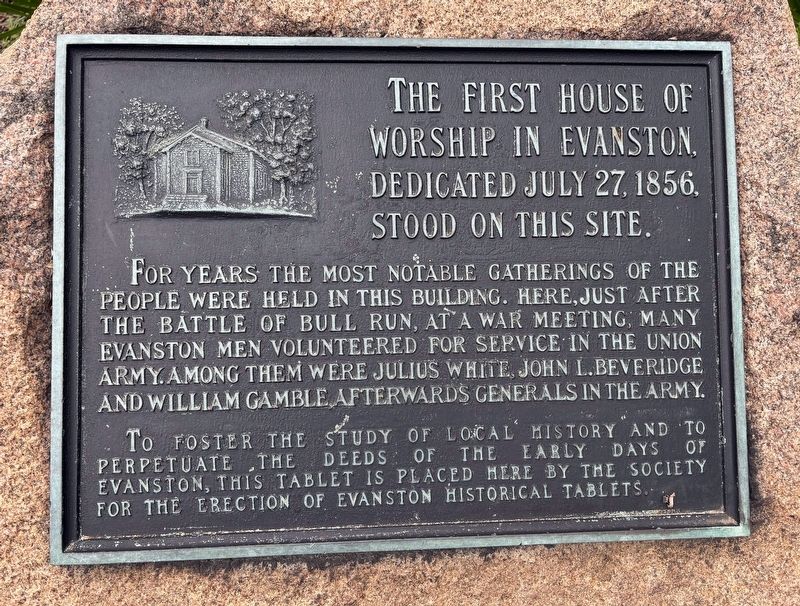
The First House of Worship in Evanston
Photographed by Sean P. Flynn, May 25, 2025
1. The First House of Worship in Evanston Marker
For years the most notable gatherings of the people were held in this building. Here, just after the Battle of Bull Run, at a war meeting, many Evanston men volunteered for service in the Union Army. Among them were Julius White, John L. Beveridge and William Gamble, afterwards generals in the Army.
To foster the study of local history and to perpetuate the deeds of the early days of Evanston, this tablet is placed here by the Society for the Erection of Evanston Historical Tablets.
Erected by Society for the Erection of Evanston Historical Tablets.
Topics. This historical marker is listed in these topic lists: Religion & Religious Structures • Settlements & Settlers • War, US Civil. A significant historical date for this entry is July 27, 1856.
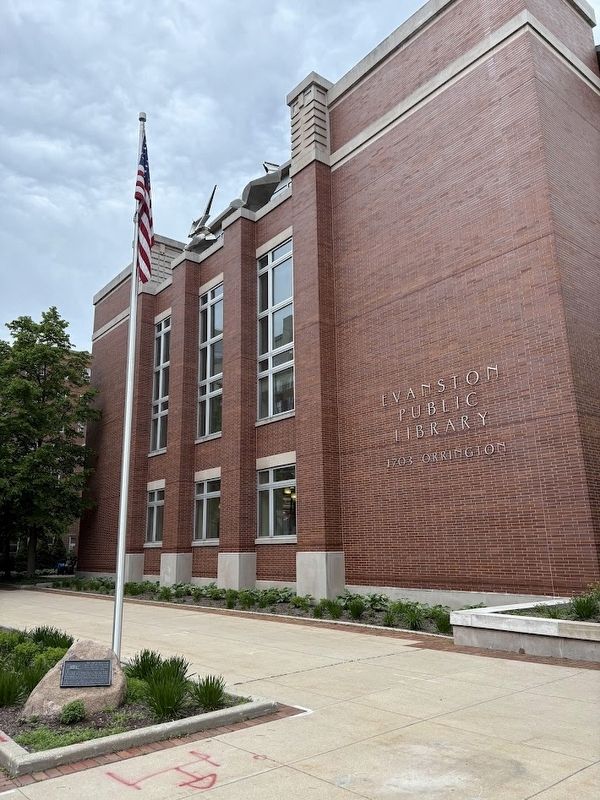
Location. 42° 2.903′ N, 87° 40.839′ W. Marker is in Evanston, Illinois, in Cook County. It is at the intersection of Church Street and Orrington Avenue on Church Street. The marker is on a small stone to the west of the Evanston Public Library. Touch for map. Marker is at or near this
this page online

Regionally, this marker is in Greater Chicago. It is also in the American Midwest. Globally, it is in North America, on the Great Lakes, in the Western Hemisphere, in the Western World, and in the Anglosphere. Historically, it finds itself in what was once the Viceroyalty of New France, the territory of the Mississippian Culture, and the Northwest Territory.
Other nearby markers. At least 8 other markers are within walking distance of this marker: Fountain Square Veterans Memorial Wall (about 500 feet away, measured in a direct line); Frances E. Willard (1839-1898) / Woman's Christian Temperance Union (about 600 feet away); The Chandler's Building (about 700 feet away); PolioPlus (approx. 0.2 miles away); First Methodist Church of Evanston (approx. 0.2 miles away); Northwestern University's First Building (approx. 0.2 miles away); Sigma Alpha Epsilon Fraternity (approx. ¼ mile away); David Thomas Hanson (approx. ¼ mile away). Touch for a list and map of all markers in Evanston.
Regarding The First House of Worship in Evanston. Northwestern
Photographed by Sean P. Flynn, May 25, 2025
2. The First House of Worship in Evanston Marker
The marker is in front of the Evanston Public Library
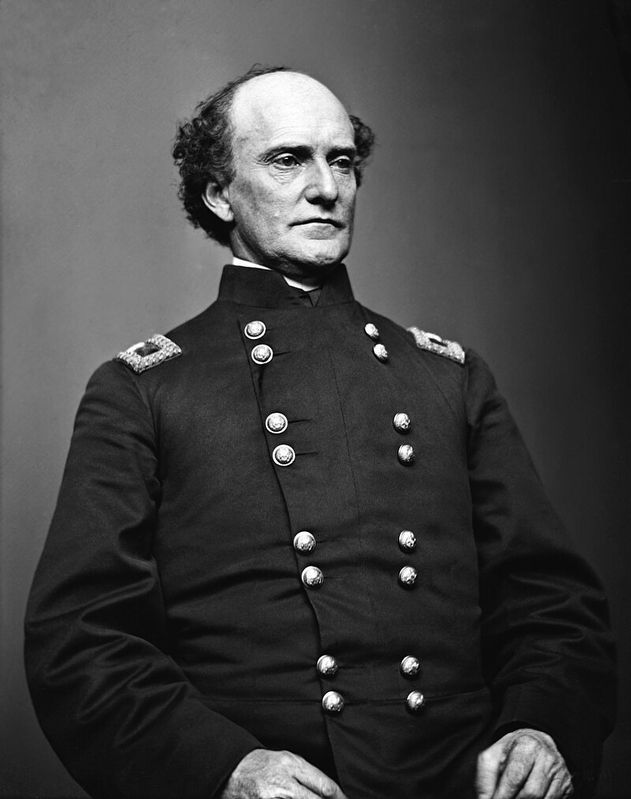
The men referenced on this plaque—Julius White, John L. Beveridge and William Gamble—were three among many in Evanston who answered the call for the Union in 1861. White, born in Upstate New York, was a longtime friend of Abraham Lincoln who hosted him at his Evanston home during the election campaign of 1860. Granted a job as a customs collector by Lincoln after the election,
Photographed by Sean P. Flynn, May 25, 2025
3. The First House of Worship in Evanston Marker
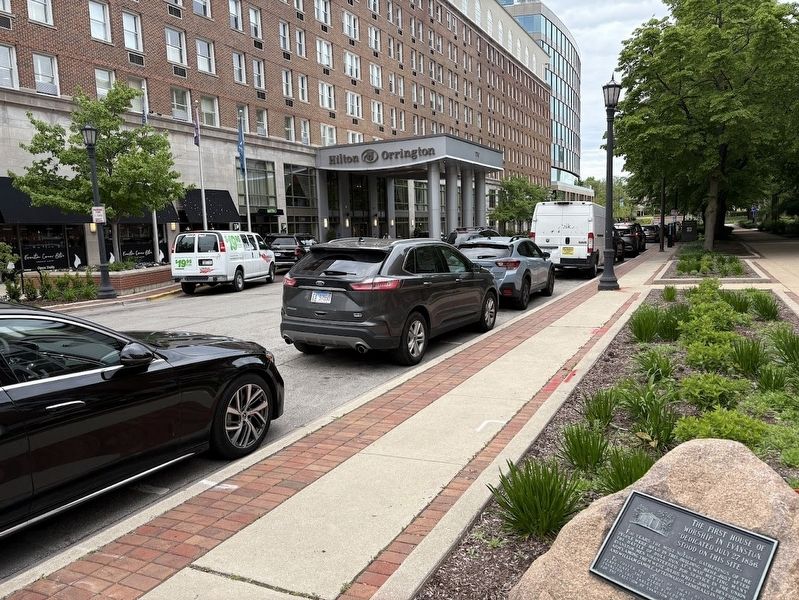
The Hilton Orrington is across the street.
Born in New York, John L. Beveridge would after the war serve in Congress and later as Illinois' 16th governor. Moving to Evanston in the 1850s, Beveridge practiced law in Chicago with John F. Farnsworth. When Beveridge volunteered for the Union Army in 1861, he was commissioned as an officer in the regiment that Farnsworth formed, the 8th Illinois Cavalry, whose ranks would include many men from Evanston. Beveridge commanded the 8th at Gettysburg, where the unit is credited with firing the first shot of the three-day battle. Later in 1863 he was granted permission to form his own regiment,
Courtesy of Library of Congress Prints and Photographs Division, circa 1863
4. Julius White (1816-1890)
Irish-born William Gamble, also a friend of Farnsworth's, had a background in the British Army and, after emigrating to the U.S., experience in the Seminole Wars before becoming a civil engineer working in Chicago and living in Evanston. In September 1861, he was appointed as lieutenant colonel in the 8th Illinois Cavalry. In August 1862, Gamble was shot in the chest near Malvern Hill, Va., during a cavalry charge of Confederate pickets. After several months of recovery, he returned to the field and was soon appointed commander of the 1st Brigade of the Army of the Potomac's cavalry division. But he was sidelined again by health problems and did not return to his troops until June 1863. At Gettysburg, his brigade (which included the 8th Illinois) held off the very first Confederate attack on July 1, 1863. He spent most of the rest of the war commanding his troops in and around Washington. After the war he was appointed to lead the Presidio, a fort in San Francisco, but he died of cholera in Nicauragua on his way there, on December 20, 1866, at age 48.
Also see . . .
1. Daily Northwestern: How Evanston became the 'City of Churches'.
Excerpt: "The founders’ hope was that organized religion in a suburban town would create a positive environment to surround the University, Leonard said. First United Methodist Church of Evanston, on Church Street, was founded in 1856 as Evanston’s first church. Later, Baptist, Congregationalist and Episcaplian churches popped up."(Submitted on May 27, 2025, by Sean P. Flynn of Oak Park, Illinois.)
2. First Methodist Church of Evanston: Our Building. The history of the First Methodist Church's current building includes a brief description of the two church buildings that preceded it, including the one memorialized by this historical marker two blocks west. (Submitted on May 28, 2025, by Sean P. Flynn of Oak Park, Illinois.)
Credits. This page was last revised on June 11, 2025. It was originally submitted on May 27, 2025, by Sean P. Flynn of Oak Park, Illinois. This page has been viewed 167 times since then and 29 times this year. Photos: 1, 2. submitted on May 27, 2025, by Sean P. Flynn of Oak Park, Illinois. 3, 4. submitted on May 28, 2025, by Sean P. Flynn of Oak Park, Illinois.
