Barrie in Simcoe County, Ontario — Central Canada (North America)
The Lost Village of Kempenfelt
| — | Barrie Waterfront Heritage Trail | — |

Photographed by Cosmos Mariner, June 5, 2024
1. The Lost Village of Kempenfelt Marker
Divided From the Beginning
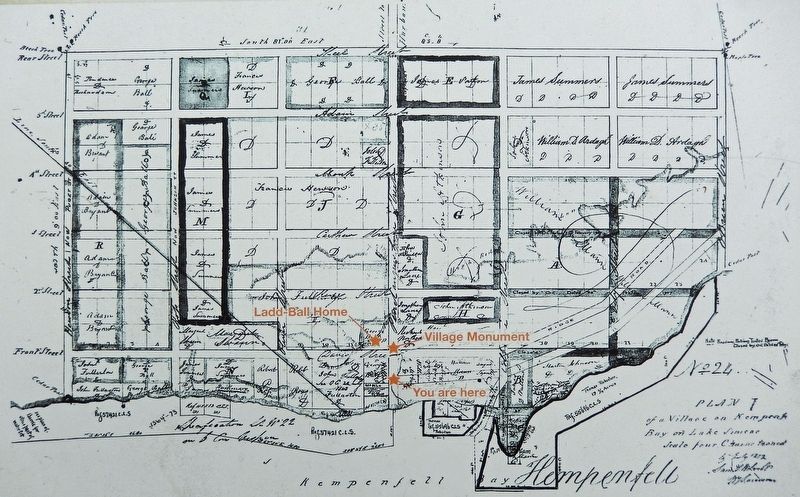
Penetanguishene Road was the division line between the townships of Vespra and Oro, splitting the village into two jurisdictions. The map below shows how the streets named Front, 2nd, 3rd, 4th, 5th, and Rear on the left side of the original survey were later changed in the 1830s to reflect area settlers. Steel and Puget Streets remain at the north and west boundary. Johnson Street and Penetanguishene Road ended at Kempenfelt Bay before there was a railroad.
Broken Promises, Broken Future
Kempenfelt settlers had been promised the village would become the County Town. When Barrie residents sent a petition to Toronto asking to become the administrative center for the new County in 1836, the Kempenfelt and Penetanguishene Road residents argued that no respectable person would ever choose to live in Barrie due to all the swampland with its noxious vapours. When Barrie was selected, Kempenfelt began its slow decline. High demand for building lots resulted in Kempenfelt being absorbed into Barrie's borders through the annexation of Vespra Township. A monument on the north side of the intersection of Penetanguishene
this page online
Early Pioneers
Many of the earliest (pre-1837) settler names can be found marked on their lots, such as Ardagh, Atkinson, Ball, Bryant, John Fullerton, Mann and Summers.
The Johnson family arrived in 1822 and built a hotel. Adam Bryant was an English house carpenter by trade. James Summers and his wife Elizabeth Snow were natives of Somersetshire, England. John Fullerton purchased his land in 1836. Barnett Vandeburgh, with James Johnson, built the first brick kiln at Kempenfeldt in 1836 or earlier.
George Ball
Born in 1801, George Ball emigrated in 1828 from Ireland taking passage on the brig “Workington Despatch” bound for Quebec. Disaster struck when their vessel was shipwrecked in the Gulf of St. Lawrence. The few survivors were rescued by fishermen in the Gulf and taken to Halifax in the British warship “Tyne”.
Finally in 1833, he came to Kempenfelt and bought the farm which he permanently settled upon the following year. When Mr. Ladd (tavern owner) drowned in Kempenfelt Bay, his widow sold her house to Mr. Ball and moved her family to the United States. He married
Simcoe County Archives & Beautiful Barrie: The City and Its People/Barrie 150 Book Project
2. Marker detail: 1812 survey for the village of "Kempenfelt"
Updated by hand as lots were sold by the Crown.
Mr. Ball would often raft saw logs across the bay to Lally’s Mill at Tollendal, for cutting into lumber, then bring the lumber back to Kempenfelt for use. George Ball died October 28, 1891, at 90 years of age.
Erected by Barrie Waterfront Heritage Trail.
Topics. This historical marker is listed in these topic lists: Industry & Commerce • Political Subdivisions • Roads & Vehicles • Settlements & Settlers. A significant historical year for this entry is 1836.
Location. 44° 23.57′ N, 79° 39.008′ W. Marker is in Barrie, Ontario, in Simcoe County. It can be reached from Penetanguishene Road 0.1 kilometers south of Shanty Bay Road (Provincial Road 20) when traveling south. The marker is on the Barrie Waterfront Heritage Trail / Barrie North Shore Trail at Station #11 (Kempenfelt Village), at the south end of Penetanguishene Road. Touch for map. Marker is in this post office area: Barrie ON L4M 1E6, Canada. Touch for directions.

Regionally, this marker is in Central Ontario Cottage Country and specifically in Georgian Bay Country. It is also in Central Canada. Globally,

Simcoe County Archives & Beautiful Barrie: The City and Its People/Barrie 150 Book Project
3. Marker detail: 1830’s Ladd-Ball house, circa 1885 in Kempenfelt
Other nearby markers. At least 8 other markers are within 3 kilometers of this marker, measured as the crow flies: Site of the Village of Kempenfelt (about 120 meters away, measured in a direct line); Early Settlement (approx. 2.3 kilometers away); The Ice Industry (approx. 2.3 kilometers away); Black Settlement in Oro Township / La Colonie Noire du Canton d'Oro (approx. 2.3 kilometers away); The East End — 1900s (approx. 2.8 kilometers away); The East End — 1800s (approx. 2.8 kilometers away); Lakeview Dairy (approx. 2.8 kilometers away); Andrew Frederick Hunter (approx. 2.8 kilometers away). Touch for a list and map of all markers in Barrie.
Related markers. Click here for a list of markers that are related to this marker. The Village of Kempenfelt
Also see . . . Lost villages of Simcoe County – Kempenfelt Village.
(by Bruce Forsyth)(Submitted on May 29, 2025, by Cosmos Mariner of Cape Canaveral, Florida.)Excerpt: Around the time that the Penetanguishene Road, surveyed by Samuel Wilmot, was cut through from Kempenfelt to Georgian Bay during the War of 1812, the village plots were laid out on 300 acres straddling the border between Vespra Township and Oro Township. As Kempenfelt grew in the years after its settlement in 1819, the village would include a boat landing, log barracks, stores, tavern, brewery and brickyard. In 1831, a petition was sent to Lieutenant-Governor Sir John Colborne to declare Kempenfelt the home of the Simcoe County administration centre, given that it was on the supply road to the Royal Navy’s Penetanguishene Naval Yard in Penetanguishene. This was rejected and two years later, the Government purchased land at the present site of Barrie which became the County Town in 1837.Photographed by Cosmos Mariner, June 5, 20244. The Lost Village of Kempenfelt MarkerThe marker is at the east end of the Barrie Waterfront Heritage Trail / Barrie North Shore Trail, at Station #11 (Kempenfelt Village).

Credits. This page was last revised on May 29, 2025. It was originally submitted on May 28, 2025, by Cosmos Mariner of Cape Canaveral, Florida. This page has been viewed 241 times since then and 88 times this year. Photos: 1, 2, 3, 4. submitted on May 29, 2025, by Cosmos Mariner of Cape Canaveral, Florida.
