Mackinaw City in Emmet County, Michigan — The American Midwest (Great Lakes)
Hattie Stimpson 1875-1948
Mackinaw City Historical Pathway
Photographed by Cosmos Mariner, July 29, 2017
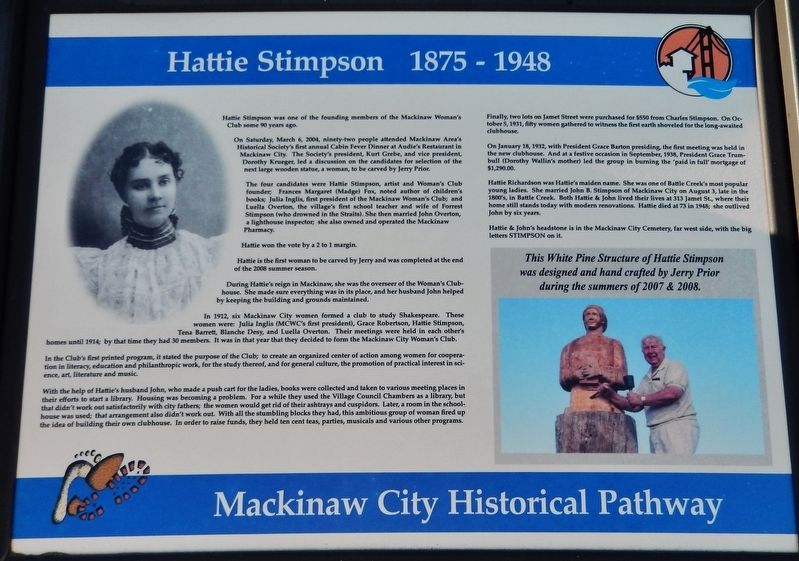
1. Hattie Stimpson 1875-1948 Marker
Hattie Stimpson was one of the founding members of the Mackinaw Woman's Club some 90 years ago.
On Saturday, March 6, 2004, ninety-two people attended Mackinaw Area's Historical Society's first annual Cabin Fever Dinner at Audie's Restaurant in Mackinaw City. The Society's president, Kurt Grebe, and vice president, Dorothy Krueger, led a discussion on the candidates for selection of the next large wooden statue, a woman, to be carved by Jerry Prior.
The four candidates were Hattie Stimpson, artist and Woman's Club founder; Frances Margaret (Madge) Fox, noted author of children's books; Julia Inglis, first president of the Mackinaw Woman's Club; and Luella Overton, the village's first school teacher and wife of Forrest Stimpson (who drowned in the Straits). She then married John Overton, a lighthouse inspector; she also owned and operated the Mackinaw Pharmacy.
Hattie won the vote by a 2 to 1 margin.
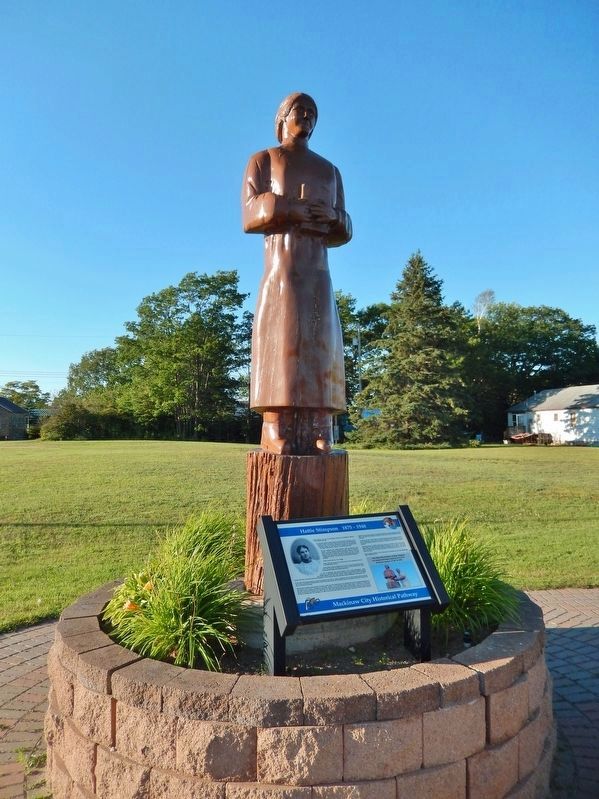
Hattie is the first woman to be carved by Jerry and was completed at the end of the 2008 summer season.
During Hattie's reign in Mackinaw, she was the overseer of the Woman's Clubhouse. She made sure everything was
this page online
In 1912, six Mackinaw City women formed a club to study Shakespeare. These women were: Julia Inglis (MCWC's first president), Grace Robertson, Hattie Stimpson, Tena Barrett, Blanche Desy, and Luella Overton. Their meetings were held in each other's homes until 1914; by that time they had 30 members. It was in that year that they decided to form the Mackinaw City Woman's Club.
In the Club's first printed program, it stated the purpose of the Club; to create an organized center of action among women for cooperation in literacy, education and philanthropic work, for the study thereof, and for general culture, the promotion of practical interest in science, art, literature and music.
With the help of Hattie's husband John, who made a push cart for the ladies, books were collected and taken to various meeting places in their efforts to start a library. Housing was becoming a problem. For a while they used the Village Council Chambers as a library, but that didn't work out satisfactorily with city fathers; the women would get rid of their ashtrays
Photographed by Cosmos Mariner, July 29, 2017
2. Hattie Stimpson 1875-1948 Marker & Tree-trunk Sculpture
Finally, two lots on Jamet Street were purchased for $550 from Charles Stimpson. On October 5, 1931, fifty women gathered to witness the first earth shoveled for the long-awaited clubhouse.
On January 18, 1932, with President Grace Barton presiding, the first meeting was held in the new clubhouse. And at a festive occasion in September, 1938, President Grace Trumbull (Dorothy Wallin's mother) led the group in burning the 'paid in full' mortgage of $1,290.00.
Hattie Richardson was Hattie's maiden name. She was one of Battle Creek's most popular young ladies. She married John B. Stimpson of Mackinaw City on August 3, late in the 1800's, in Battle Creek. Both Hattie & John lived their lives at 313 Jamet St., where their home still stands today with modem renovations. Hattie died at 73 in 1948; she outlived John by six years.
Photographed by Cosmos Mariner, July 29, 2017
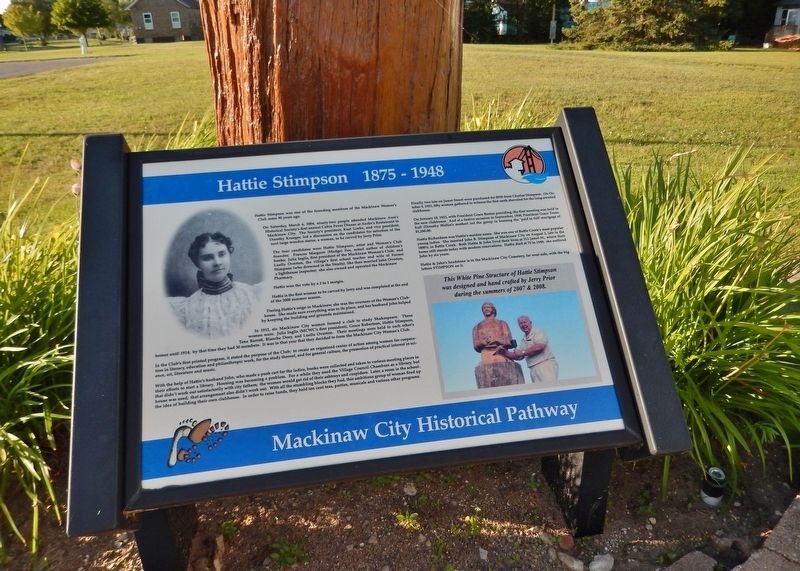
3. Hattie Stimpson 1875-1948 Marker (wide view)
Hattie & John's headstone is in the Mackinaw City Cemetery, far west side, with the big letters STIMPSON on it.
This White Pine Structure of Hattie Stimpson was designed and hand crafted by Jerry Prior during the summers of 2007 & 2008.
Erected by Mackinaw City Historical Pathway.
Topics. This historical marker is listed in these topic lists: Charity & Public Work • Fraternal or Sororal Organizations • Women. A significant historical date for this entry is January 18, 1932.
Location. 45° 46.904′ N, 84° 44.046′ W. Marker is in Mackinaw City, Michigan, in Emmet County. It is on West Central Avenue east of Louvigny Street, on the right when traveling west. Marker and tree-trunk sculpture are located beside the sidewalk on the north side of the street, just west of the Interstate-75 overpass. Touch for map. Marker is at or near this postal address: 110 West Central Avenue, Mackinaw City MI 49701, United States of America. Touch for directions.

Regionally, this marker is in Northern Michigan Lower Peninsula, on the Straits of Mackinac, and in one of the Lake Michigan Shore counties. It is also in the American Midwest. Globally,
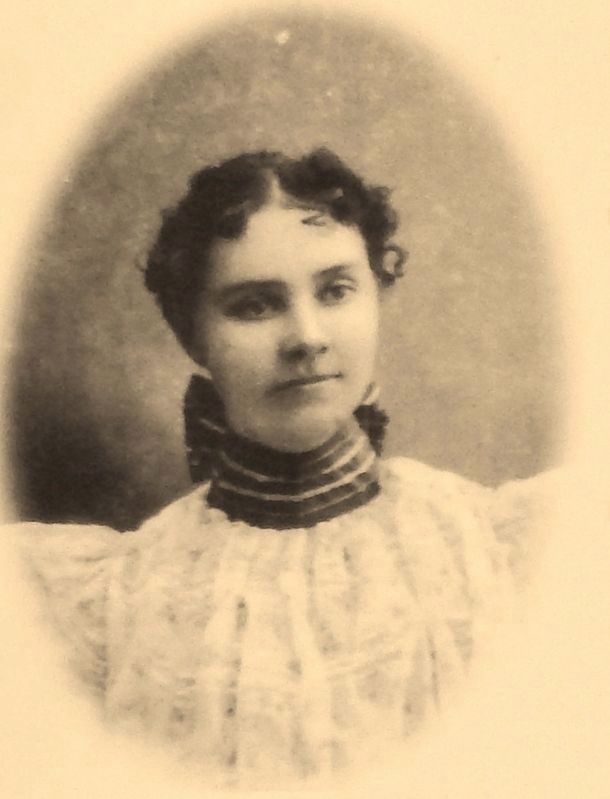
4. Marker detail: Hattie Stimpson
Other nearby markers. At least 8 other markers are within walking distance of this marker: Indians at the Straits (about 500 feet away, measured in a direct line); British Colonial Farm, 1774 - 1780 (about 500 feet away); Missionaries at Mackinac (about 700 feet away); French House Ruin, 1765 - 1781 (approx. 0.2 miles away); a different marker also named French House Ruin (approx. 0.2 miles away); Warrior Stone (approx. 0.2 miles away); Tourism at Mackinac (approx. 0.2 miles away); The Barnett Building (approx. ¼ mile away). Touch for a list and map of all markers in Mackinaw City.
Other markers no longer nearby. British Colonial Farm 1774 - 1780 (was about 500 feet away but has been replaced with another marker now near it); a different marker also named Tourism at Mackinac (was approx. 0.2 miles away but has been permanently removed).
Credits. This page was last revised on May 28, 2025. It was originally submitted on August 9, 2018, by Cosmos Mariner of Cape Canaveral, Florida. This page has been viewed 653 times since then and 51 times this year. Last updated on May 28, 2025, by Craig Doda of Napoleon, Ohio. Photos: 1, 2, 3, 4. submitted on August 9, 2018, by Cosmos Mariner of Cape Canaveral, Florida. • Devry Becker Jones was the editor who published this page.
