Mackinaw City in Emmet County, Michigan — The American Midwest (Great Lakes)
Maple Ridge Farm

Photographed by Craig Doda, May 25, 2025
1. Maple Ridge Farm Marker
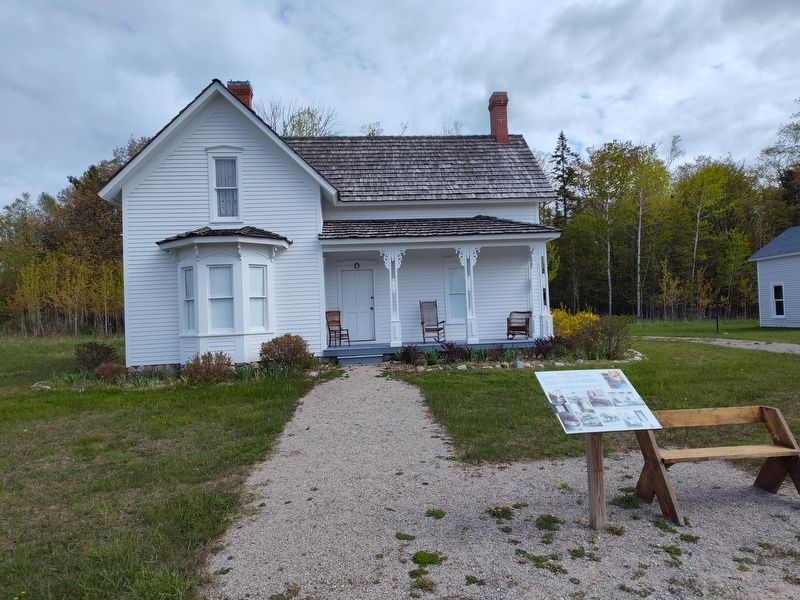
The Stimpson family (George, Elvira and six children) came to Mackinaw City in 1869 to construct a dock and sell cord wood to steamers passing through the Straits of Mackinac. Their eldest son, Charles, built the home this replica is patterned after.
Charles initially established himself by trading lumber. In 1882 when he was 32-years-old, he married Ella Eastman and a year later bought 156 acres on Stimpson Road, three miles southeast of Mackinaw City. He felled the trees, sold the lumber, cleared the land, and took up farming. The soil was stony and the growing season was short but with hard work and newly developed agricultural techniques "Maple Ridge Farm" became a model operation in Cheboygan County. He and Ella had two children.
He sold cedar logs to the railroads. He raised beef and dairy cattle as well as sheep and goats. From these he produced meat, milk and wool. The Angora goats, which produced valuable mohair, helped keep the land clear by grazing on the forest regrowth. Using horses and oxen, he tilled the land and hauled the harvests. He planted hay and oats to feed the animals and fruits and vegetables,
this page online
[Captions:]
By the 1940s, the Stimpson family no longer wanted the farm. It was sold to the Grebe family. The house burned to the ground in the 1960s and is reconstructed here from the memory of the Grebes.
The farm home had four bedrooms, a parlor, and a large kitchen, all for a family of four.
Ella with their two children Clarence and Ruth. Clarence went to college, earning a civil engineering degree, before enlisting in WWI where he lost an arm. Upon his return he moved out of the area. Ruth also went to college and returned to marry the local barber. Ruth and Herbert Barrett raised seven children in this house.
Many original Stimpson possessions were returned to this house.
Bare foot riding bareback, Ruth grew up loving the farm. Notice both kids are wearing hats with tassels to keep the black flies away.
Erected 2020 by Mackinaw Area Historical Society & Heritage Village.
Topics. This historical marker is listed in these topic lists: Agriculture • Architecture. A significant historical year for this entry is 1869.
Location. 45° 46.653′ N,
Photographed by Craig Doda, May 25, 2025
2. Maple Ridge Farm Marker

Regionally, this marker is in Northern Michigan Lower Peninsula, on the Straits of Mackinac, and in one of the Lake Michigan Shore counties. It is also in the American Midwest. Globally, it is in North America, in the Great North Woods, on the Great Lakes, in the Western Hemisphere, in the Western World, and in the Anglosphere. Historically, it finds itself in what was once the Viceroyalty of New France and also the Northwest Territory.
Other nearby markers. At least 8 other markers are within walking distance of this marker: Ice Harvesting (within shouting distance of this marker); The Cope Family Icehouse (within shouting distance of this marker); Grebe Tool Shanty (within shouting distance of this marker); Heritage Chapel (within shouting distance of this marker); The modern history of this land (within shouting distance of this marker); The early European history of this land (within shouting distance of this marker); Mackinaw's General Store (within shouting distance of this marker); Pest House (within shouting distance of this marker). Touch for a list and map of all markers in Mackinaw City.
Credits. This page was last revised on June 2, 2025. It was originally submitted on May 30, 2025, by Craig Doda of Napoleon, Ohio. This page has been viewed 115 times since then and 27 times this year. Photos: 1, 2. submitted on May 30, 2025, by Craig Doda of Napoleon, Ohio. • Devry Becker Jones was the editor who published this page.
