
Speyer, Rhineland-Palatinate, Germany — Central Europe
Kernkraftwerk Philippsburg Block 2 (KKP2)
⎯⎯⎯
Philippsburg Nuclear Power Plant Unit 2 (KKP2)
Photographed by James Hulse, May 21, 2025
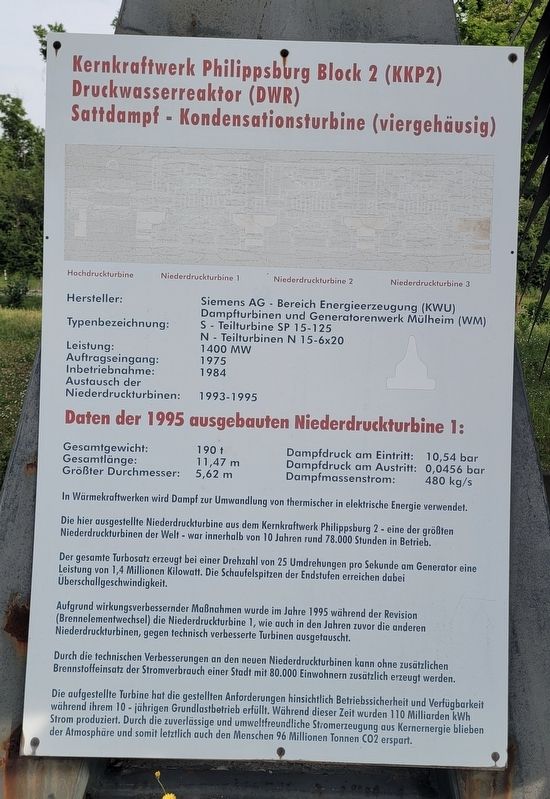
1. Kernkraftwerk Philippsburg Block 2 (KKP2) / Philippsburg Nuclear Power Plant Unit 2 (KKP2) Marker

Druckwasserreaktor (DWR)
Sattdampf - Kondensationsturbine (viergehäusig)
Hochdruckturbine • Niederdruckturbine 1 • Niederdruckturbine 2 • Niederdruckturbine 3
Hersteller: Siemens AG - Bereich Energieerzeugung (KWU) Dampfturbinen und Generatorenwerk Mülheim (WM)
Typenbezeichnung: S- Teilturbine SP 15-125 N- Teilturbinen N 15-6x20
Leistung: 1400 MW
Auftragseingang: 1975
Inbetriebnahme: 1984
Austausch der
Niederdruckturbinen: 1993-1995
Daten der 1995 ausgebauten Niederdruckturbine 1:
Gesamtgewicht: 190 t
Gesamtlänge: 11,47 m
Größter Durchmesser: 5,62 m
Dampfdruck am Eintritt: 10,54 bar
Dampfdruck am Austritt: 0,0456 bar
Dampfmassenstrom: 480 kg/s
In Wärmekraftwerken wird Dampf zur Umwandlung von thermischer in elektrische Energie verwendet. Die hier ausgestellte Niederdruckturbine aus dem Kernkraftwerk Philippsburg 2 - eine der größten Niederdruckturbinen der Welt - war innerhalb von 10 Jahren rund 78.000 Stunden in Betrieb. Der gesamte Turbosatz erzeugt bei einer Drehzahl von 25 Umdrehungen pro Sekunde am Generator eine Leistung von 1,4 Millionen Kilowatt. Die Schaufelspitzen
this page online
Pressurized Water Reactor (PWR)
Saturated Steam Condensation Turbine (four-casing design)
High-Pressure Turbine • Low-Pressure Turbine 1 • Low-Pressure Turbine 2 • Low-Pressure Turbine 3
Manufacturer: Siemens AG – Power Generation
Photographed by James Hulse, May 21, 2025
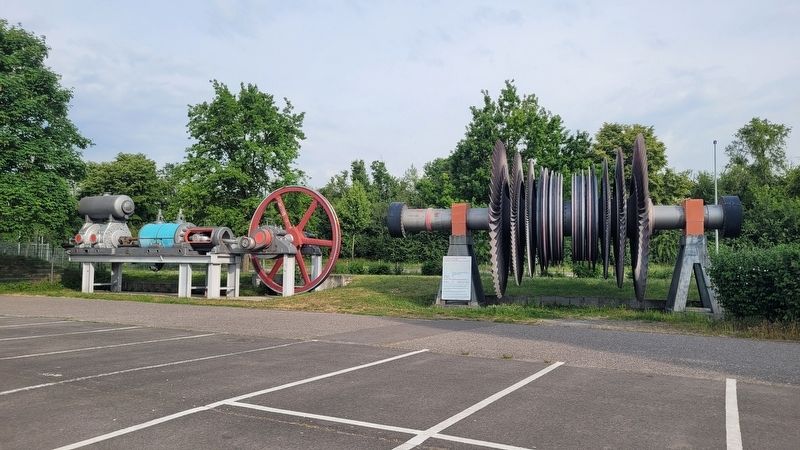
2. The view of the Philippsburg Nuclear Power Plant Unit 2 (KKP2) and Marker
Type Designation: S-Sectional Turbine SP 15-125 / N-Sectional Turbines N 15-6x20
Output: 1400 MW
Order Received: 1975
Commissioned: 1984
Replacement of Low-Pressure Turbines: 1993–1995
Specifications of the Low-Pressure Turbine 1 removed in 1995:
Total weight: 190 t
Overall length: 11.47 m
Largest diameter: 5.62 m
Steam pressure at inlet: 10.54 bar
Steam pressure at outlet: 0.0456 bar
Steam mass flow: 480 kg/s
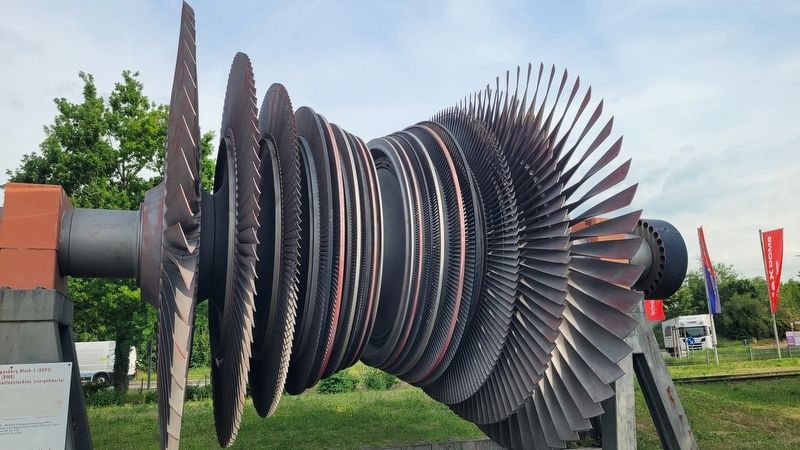
In thermal power plants, steam is used to convert thermal energy into electrical energy. The low-pressure turbine displayed here, from the Philippsburg Nuclear Power Plant Unit 2 — one of the largest low-pressure turbines in the world — was in operation for about 78,000 hours over a 10-year period. The entire turbine assembly generates an output of 1.4 million kilowatts at the generator with a rotational speed of 25 revolutions per second. The blade tips of the final stages reach supersonic speed. As part of efficiency improvement measures, Low-Pressure Turbine 1 was replaced in 1995 during a scheduled overhaul (fuel element replacement), as
Photographed by James Hulse, May 21, 2025
3. Closeup of the turbine
Erected by Technik Museen Sinsheim Speyer.
Topics. This historical marker is listed in these topic lists: Industry & Commerce • Science & Medicine. A significant historical year for this entry is 1400.
Location. 49° 18.781′ N, 8° 26.79′ E. Marker is in Speyer, Rheinland-Pfalz (Rhineland-Palatinate). It is at the intersection of Am Technik Museum and Geibstraße on Am Technik Museum. The marker is located in front of the Technik Museum Sinsheim Speyer at the parking lot. Touch for map. Marker is at or near this postal address: Am Technik Museum 1, Speyer RP 67346, Germany. Touch for directions.

Regionally, this marker is on the German Upper Rhine. Globally, it is in Europe, the European Union, Atlantic Europe, Central Europe, the Schengen Area, Western Europe, and the Western World. Historically, it finds itself in what was once the Roman Empire, the Holy Roman Empire, and the former West Germany.
Other nearby markers. At least 8 other markers are within walking distance of this marker: Fokker VFW-614 (within shouting distance of this marker); a different marker also named Fokker VFW-614 (within shouting distance of this marker); Straßenwalze / Road Roller (within shouting distance of this marker); Aufreißer / Ripper (within shouting distance of this marker); Nord 2501 „Noratlas“ (within shouting distance of this marker); a different marker also named Nord 2501 „Noratlas“ (within shouting distance of this marker); DC-3/C-47 „Dakota Skytrain“ (within shouting distance of this marker); F-84F Thunderstreak „Getti Tonanti“ (within shouting distance of this marker). Touch for a list and map of all markers in Speyer.
More about this marker. The static displays and markers are located on the grounds of the Technik Museum. There is an entrance fee to visit the museum and markers.
Also see . . . Philippsburg Nuclear Power Plant. Wikipedia
The Philippsburg Nuclear Power Plant is located in Philippsburg, Karlsruhe (district), Germany. The plant was operated by EnBW Kernkraft GmbH. As part of Germany's phase out of nuclear energy (Atomausstieg), unit 1 was shut down in 2011 and unit 2 in 2019. Demolition of conventional structures began in January 2020. The process of decommissioning is underway as of January 2020 beginning with defueling and dismantling of primary coolant lines. The plants operator EnBW expects the decommissioning process to take around 10-15 years.(Submitted on June 3, 2025, by James Hulse of Medina, Texas.)
Credits. This page was last revised on June 3, 2025. It was originally submitted on May 31, 2025, by James Hulse of Medina, Texas. This page has been viewed 180 times since then and 46 times this year. Photos: 1, 2, 3. submitted on June 3, 2025, by James Hulse of Medina, Texas.
