
Borden in Simcoe County, Ontario — Central Canada (North America)
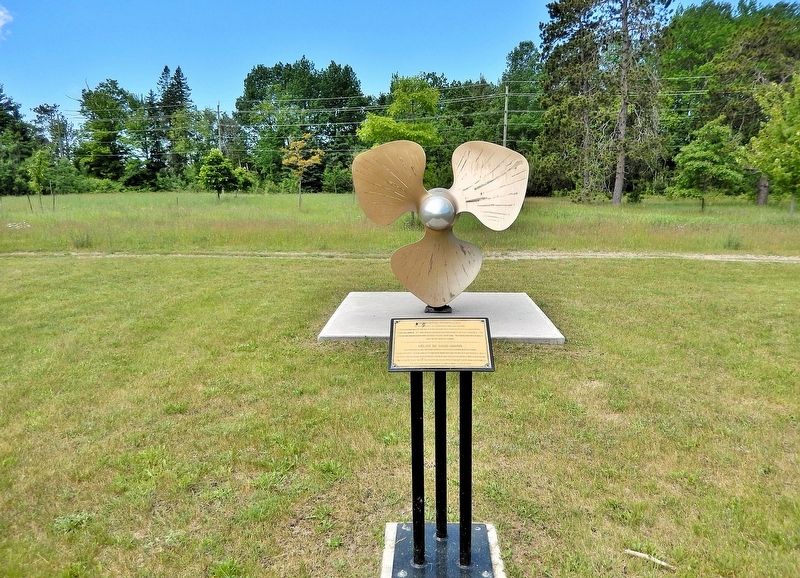
Submarine Propeller
⎯⎯⎯
Hélice de sous-marin

Photographed by Cosmos Mariner, June 6, 2024
1. Submarine Propeller / Hélice de sous-marin Marker

Topics. This historical marker is listed in these topic lists: Military • Waterways & Vessels. A significant historical year for this entry is 1964.
Location. 44° 17.753′ N,
this page online

Regionally, this marker is in Central Ontario Cottage Country and specifically in Georgian Bay Country. It is also in Central Canada. Globally, it is in North America, on the Great Lakes, in the Western Hemisphere, in the Western World, and in the Anglosphere. Historically, it finds itself in what was once a British colony, the Viceroyalty of New France, the Haudenosaunee (Iroquois) Confederacy, and Rupert’s Land.
Other nearby markers. At least 8 other markers are within walking distance of this marker: Bell CH-136 "Kiowa" Helicopter / Hélicoptère Bell CH-136 Kiowa (a few steps from this marker); Mine Plow / Charrue de Déminage (approx. one kilometer away); British Churchill Infantry Tank MK IV / Char d'infanterie britannique Churchill MK IV (approx. one kilometer
Photographed by Cosmos Mariner, June 6, 2024
2. Submarine Propeller / Hélice de sous-marin Marker
The marker is mounted directly in front of the propeller.
Also see . . . Oberon-class Submarine (Wikipedia).
Excerpt: The Oberon class was a ship class of 27 British-designed submarines operated by five nations. They were designed as a follow-on from the Porpoise class; physical dimensions were the same but stronger materials were used in hull construction and improved equipment was fitted. The Oberons operated during the Cold War, with duties including surveillance, tracking of other ships and submarines, delivery and retrieval of special forces personnel and serving as targets for anti-submarine training.(Submitted on May 31, 2025, by Cosmos Mariner of Cape Canaveral, Florida.)
The class used diesel-electric propulsion, with lead-acidbatteries to provide power when the engines cannot be used. Each vessel has two Admiralty-pattern V-16 diesel engines, each driving one 1280-kW 880-V generator. These can provide power directly to the two 3,000-brake-horsepower (2,200 kW) electric motors, one directly connected to each propeller.Photographed by Cosmos Mariner, June 6, 20243. Submarine Propeller / Hélice de sous-marin
The three Canadian submarines were built with improved air-conditioning systems, while as many common components as possible were replaced with Canadian equivalents. The Canadian Oberons used United States Navy torpedoes throughout their career: they were initially equipped with Mark 37 torpedoes, but were later upgraded for the Mark 48s.
The three boats were given First Nations names: Ojibwa, Onondaga and Okanagan. They entered service on 23 September 1965, 22 June 1967 and 22 June 1968 respectively for service as “clockwork mice”, submarines used to train surface vessels in anti-submarine warfare. Two further Oberons were acquired but never commissioned into the Canadian Navy.

Credits. This page was last revised on May 31, 2025. It was originally submitted on May 31, 2025, by Cosmos Mariner of Cape Canaveral, Florida. This page has been viewed 92 times since then and 11 times this year. Photos: 1, 2, 3. submitted on May 31, 2025, by Cosmos Mariner of Cape Canaveral, Florida.
