Bremen-East in Schwachhausen, Germany — Central Europe
Ohamakari
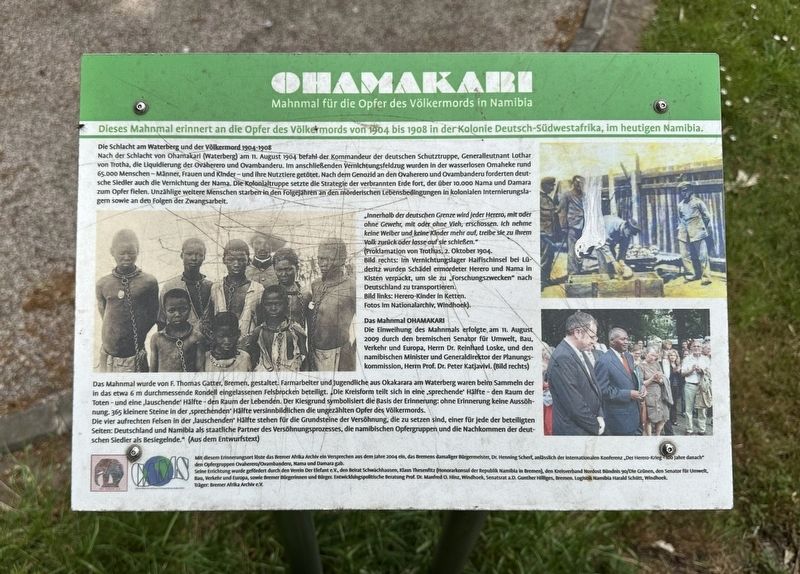
Photographed by Andrew Ruppenstein, May 19, 2025
1. Ohamakari Marker

Dieses Mahnmal erinnert an die Opfer des Völkemords von 1904 bis 1908 in der Kolonie Deutsch-Südwestafrika, im heutigen Namibia.
Die Schlacht am Waterberg und der Völkermord 1904-1908
Nach der Schlacht von Ohamakari (Waterberg) am 11. August 1904 befahl der Kommandeur der deutschen Schutztruppe, Generalleutnant Lothar von Trotha, die Liquidierung der Oviberero und Ovambanderu. Im anschließenden Vernichtungsfeldzug wurden in der wasserlosen Omaheke rund 65.000 Menschen-Männer, Frauen und Kinder- und ihre Nutztiere getötet. Nach dem Genozid an den Ovaherero und Ovambanderu forderten deutsche Siedler auch die Vernichtung der Nama. Die Kolonialtruppe setzte die Strategie der verbrannten Ende fort, der über 10.000 Nama und Damara zum Opfer fielen. Unzählige weitere Menschen starben in den Folgejahren an den dederischen Lebensbedingungen in kolonialen Internierungslagern sowie an den Folgen der Zwangsarbeit.
„Innerhalb der deutschen Grenze wird jeder Herero, mit oder ohne Gewehr, mit oder ohne Vieh, erschossen. Ich nehme keine Weiber und keine Kinder mehr auf, treibe sie zu ihrem Volk zurück oder lasse auf sie schießen.“
(Proklamation
this page online
Das Mahnmal OHAMAKARI
Die Einweihung des Mahnmals erfolgte, am 11. August 2009 durch den bremischen Senator für Umwelt, Bau, Verkehr und Europa, Herrn Dr. Reinhard Loske, und den namibischen Minister und Generaldirektor der Planungskommission, Herr Prof. Dr. Peter Katjavivi.
Das Mahnmal wurde von F. Thomas Gatter, Bremen, gestaltet. Farmarbeiter und Jugendliche aus Okakarara am Waterberg waren beim Sammeln der in das etwa 6 m durchmessende Rondell eingelassenen Felsbrocken beteiligt. „Die Kreisform teilt sich in eine ‚sprechende‘ Hälfte - den Raum der Toten-und eine ‚lauschende‘ Hälfte den Raum der Lebenden. Der Kiesgrund symbolisiert die Basis der Erinnerung: ohne Erinnerung keine Aussöhnung. 365 kleinere Steine in der ‚sprechenden‘ Hälfte versinnbildlichen die ungezählten Opfer des Völkermords.
Die vier aufrechten Felsen in der ‚lauschender‘ Hälfte stehen für die Grundsteine der Versöhnung, die zu setzen sind, einer für jede der beteiligten Seiten: Deutschland und Namibia als staatliche Partner des Versöhnungsprozesses, die namibischen Opfergruppen und die Nachkommen der deutschen Siedler
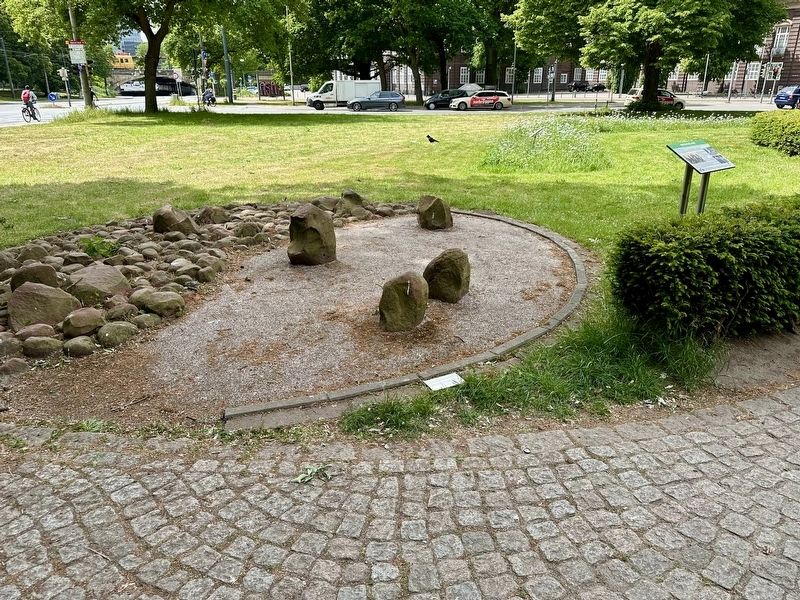
Photographed by Andrew Ruppenstein, May 19, 2025
2. Ohamakari memorial and marker
Memorial to the Victims of the Genocide in Namibia
This memorial commemorates the victims of the genocide that occurred from 1904 to 1908 in the colony of German South West Africa, in present-day Namibia.
The Battle of Waterberg and the Genocide 1904-1908
After the Battle of Ohamakari (Waterberg) on August 11, 1904, the commander of the German Schutztruppe, Lieutenant General Lothar von Trotha, ordered the liquidation of the Oviberero and Ovambanderu. In the ensuing campaign of extermination, approximately 65,000 people—men, women, and children—and their livestock were killed in the waterless Omaheke. Following the genocide of the Ovaherero and Ovambanderu, German settlers also demanded the extermination of the Nama. The colonial troops continued the scorched earth strategy, which claimed the lives of over 10,000 Nama and Damara. Countless more people died in the following years due to the degrading living conditions in colonial internment camps and as a result of forced labor.
"Within the German border, every Herero, with or without a gun, with or without cattle, will be shot. I will no longer take in women or children; I will drive them back to their people or have them shot."
(Proclamation
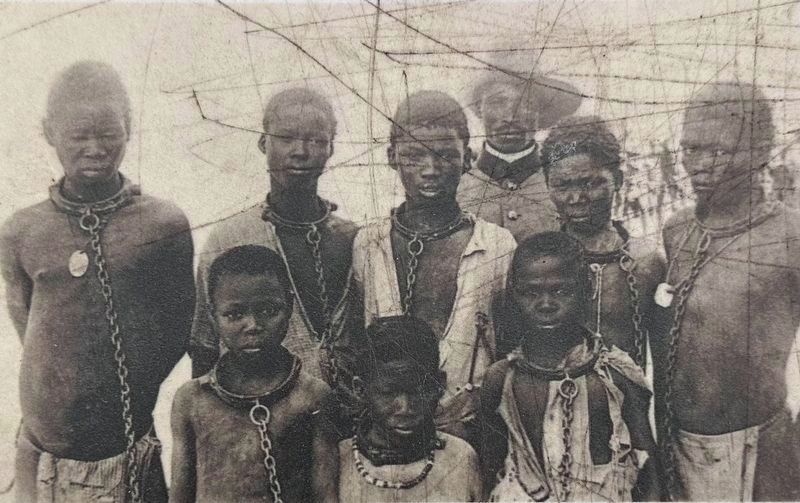
courtesy Nationalarchiv Windhoek, circa 1904
3. Marker photo: Herero children in chains
The OHAMAKARI Memorial
The memorial was inaugurated on August 11, 2009, by Dr. Reinhard Loske, Bremen's Senator for the Environment, Building, Transport and Europe, and Prof. Dr. Peter Katjavivi, the Namibian Minister and Director General of the Planning Commission. The memorial was designed by F. Thomas Gatter of Bremen. Farmworkers and young people from Okakarara near the Waterberg participated in collecting the boulders embedded in the approximately 6-meter-diameter circular structure. "The circular shape is divided into a 'speaking' half—the space of the dead—and a 'listening' half—the space of the living. The gravel base symbolizes the foundation of remembrance: without remembrance, there can be no reconciliation. 365 smaller stones in the 'speaking' half symbolize the countless victims of the genocide. The four upright rocks in the 'listening' half represent the foundation stones of reconciliation that are to be laid, one for each of the parties involved: Germany and Namibia as state partners in the reconciliation process, the Namibian victim groups, and the descendants of the German
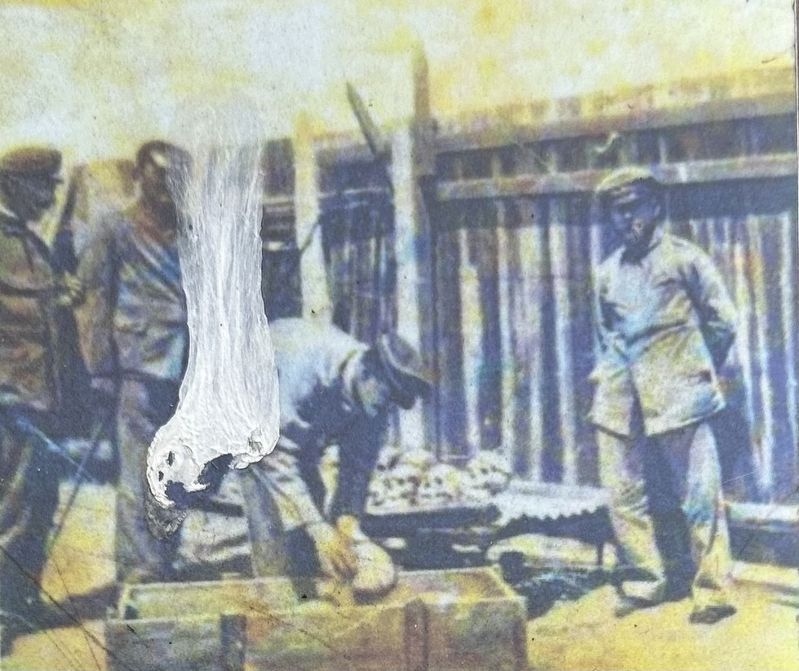
courtesy Nationalarchiv Windhoek, circa 1906
4. Marker photo: Skulls being shipped
This photo shows skulls being packed for shipment to Germany for “research purposes” from the death camp at Haifischinsel near Lüderitz.
Topics. This memorial is listed in this topic list: Wars, Non-US. A significant historical date for this entry is August 11, 1904.
Location. 53° 5.035′ N, 8° 49.051′ E. Memorial is in Bremen, in Schwachhausen. It is in Bremen-East. It can be reached from Blumenthalstraße. The memorial is in the “panhandle” of the Bremen Bürgerpark. Touch for map. Memorial is in this post office area: Bremen 28209, Germany. Touch for directions.

Regionally, it is in Europe, the European Union, Atlantic Europe, Central Europe, the Schengen Area, Western Europe, and the Western World. Historically, it finds itself in what was once the Holy Roman Empire and also the former West Germany.
Other nearby markers. At least 8 other markers are within walking distance of this marker: Antikolonialdenkmal „Der Elefant“ / Anticolonial Memorial “The Elephant” (here, next to this marker); Hermann-Böse-Gymnasium (about 90 meters away, measured in a direct line); Khatchkar - Armenian Genocide Memorial (about 240 meters away); Hauptbahnhof / Main Railway Station (approx. 0.3 kilometers away); Bremen-Minsk Jewish Deportation Memorial
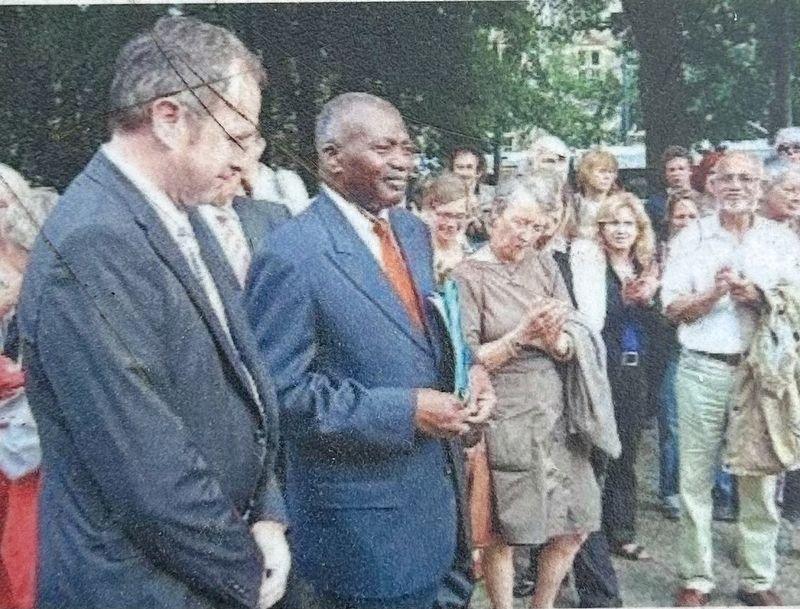
August 11, 2009
5. Marker photo: Dedication of the Ohamakari memorial
Also see . . . Herero Wars (Wikipedia). Overview:
The Herero Wars were a series of colonial wars between the German Empire and the Herero people of German South West Africa (present-day Namibia). They took place between 1904 and 1908.(Submitted on June 1, 2025.)
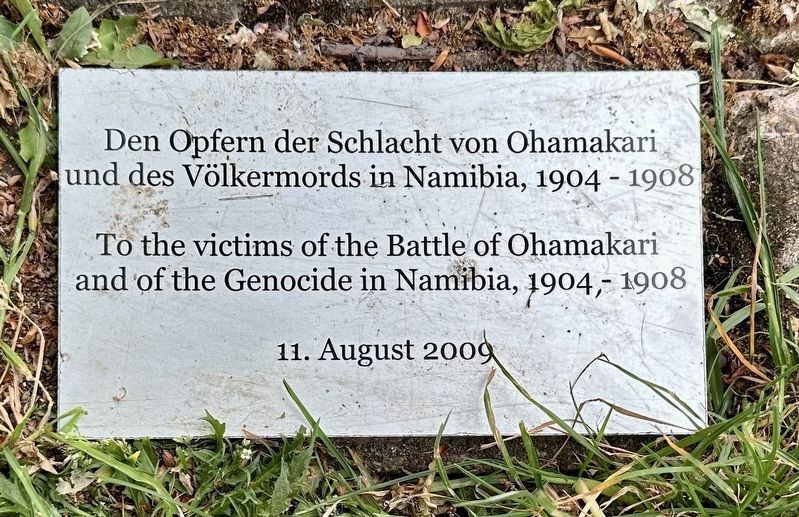
Photographed by Andrew Ruppenstein, May 19, 2025
6. Ohamakari memorial dedication plaque
Credits. This page was last revised on June 1, 2025. It was originally submitted on June 1, 2025, by Andrew Ruppenstein of Lamorinda, California. This page has been viewed 140 times since then and 34 times this year. Photos: 1, 2, 3, 4, 5, 6. submitted on June 1, 2025, by Andrew Ruppenstein of Lamorinda, California.
