
Ariton in Dale County, Alabama — The American South (East South Central)
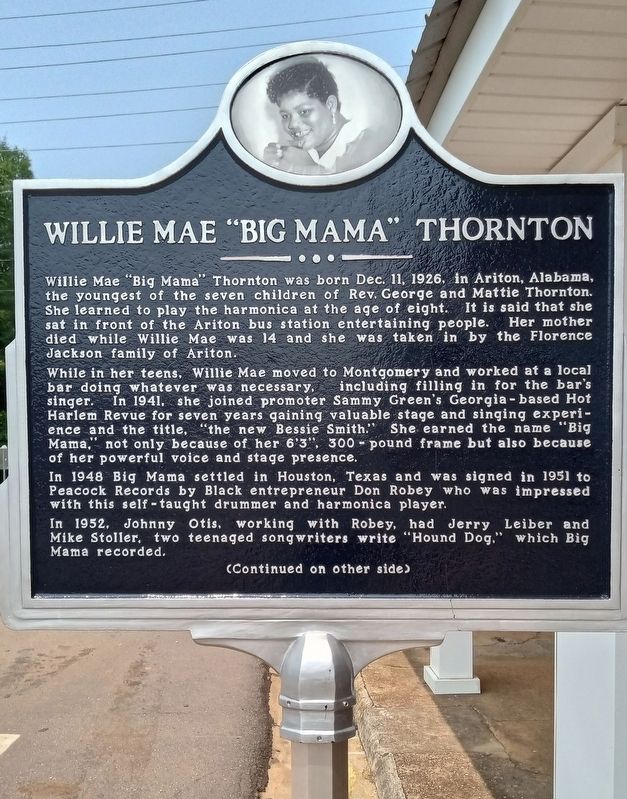
Willie Mae "Big Mama" Thornton
Photographed by James L.Whitman, June 1, 2025
1. Willie Mae "Big Mama" Thornton Marker
While in her teens. Willie Mae moved to Montgomery and worked at a local bar doing whatever was necessary, including filling in for the bar's singer. In 1941, she joined promoter Sammy Green's Georgia-based Hot Harlem Revue for seven years gaining valuable stage and singing experience and the title, "the new Bessie Smith." She earned the name "Big Mama, not only because of her 6'3", 300-pound frame but also because of her powerful voice and stage presence.
In 1948 Big Mama settled in Houston, Texas and was signed in 1951 to Peacock Records by Black entrepreneur Don Robey who was impressed with this self-taught drummer and harmonica player.
In 1952, Johnny Otis, working with Robey, had Jerry Leiber and Mike Stoller, two
this page online
(Continued on other side)
Reverse Side
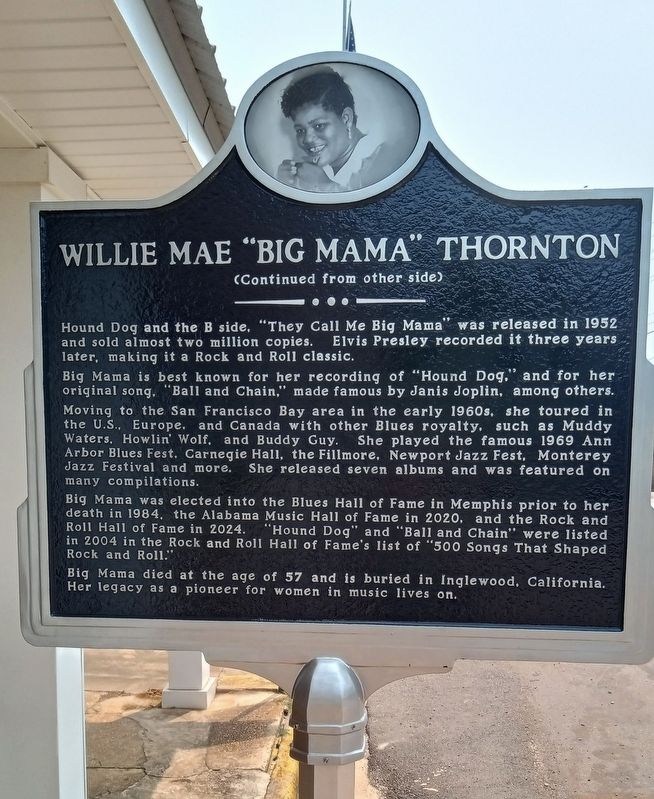
Hound Dog and the B side, "They Call Me Big Mama" was released in 1952 and sold almost two million copies. Elvis Presley recorded it three years later, making it a Rock and Roll classic.
Big Mama is best known for her recording of "Hound Dog" and for her original song, "Ball and Chain," made famous by Janis Joplin, among others.
Moving to San Francisco Bay area in the early 1960s, she toured in the U.S., Europe, and Canada with other Blues royalty, such as Muddy Waters, Howlin' Wolf,and Buddy Guy. She played the famous 1969 Ann Arbor Blues Fest, Carnegie Hall, the Fillmore, Newport Jazz Fest, Monterey Jazz Festival and more. She released seven albums and was featured on many compilations.
Big Mama was elected into the Blues Hall of Fame in Memphis prior to her death in 1984, the Alabama Music Hall of Fame in 2020, and the Rock and Roll Hall of Fame in 2024, "Hound Dog" and "Ball and Chain" were listed in 2004 in the Rock and Roll Hall of Fame's list of "500 Songs That Shaped Rock and Roll." Big Mama died at the
Photographed by James L.Whitman, June 1, 2025
2. Willie Mae "Big Mama" Thornton Marker
Topics. This historical marker is listed in these topic lists: African Americans • Arts, Letters, Music • Entertainment • Women. A significant historical date for this entry is December 11, 1926.
Location. 31° 36.012′ N, 85° 43.132′ W. Marker is in Ariton, Alabama, in Dale County. It is at the intersection of East Main Street (Alabama Route 123) and Creel Richardson Street, on the right when traveling west on East Main Street. Touch for map. Marker is at or near this postal address: 5094 AL-123, Ariton AL 36311, United States of America. Touch for directions.

Regionally, this marker is in the American South, specifically in the Deep South, and in the Wiregrass. Globally, it is in North America, a Gulf of Mexico state, the Western Hemisphere, the Western World, and the Anglosphere. Historically, it finds itself in what was once the territory of the Mississippian Culture, one of the Confederate States of America, and the Antebellum South.
Other nearby markers. At least 8 other markers are within 9 miles of this marker,

Photographed by James L.Whitman, June 1, 2025
3. Willie Mae "Big Mama" Thornton Marker
Credits. This page was last revised on June 2, 2025. It was originally submitted on June 1, 2025, by James L.Whitman of Eufaula, Alabama. This page has been viewed 466 times since then and 102 times this year. Photos: 1, 2, 3. submitted on June 1, 2025, by James L.Whitman of Eufaula, Alabama. • James Hulse was the editor who published this page.
