Lucan in Middlesex County, Ontario — Central Canada (North America)
The Wilberforce Settlement
⎯⎯⎯
L’Établissement Wilberforce
Photographed by Tim Boyd, May 30, 2025
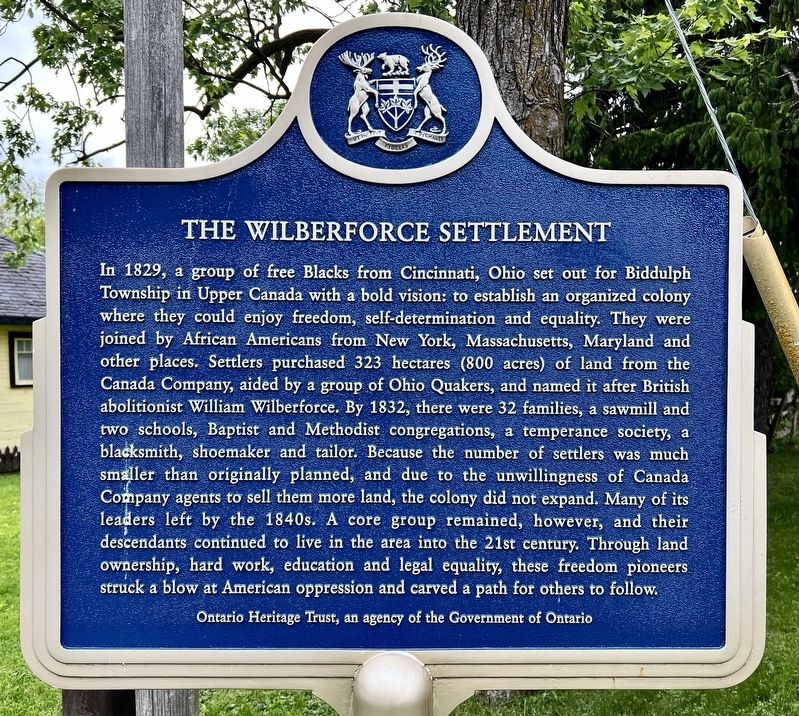
1. The Wilberforce Settlement Marker

In 1829, a group of free Blacks from Cincinnati, Ohio set out for Biddulph Township in Upper Canada with a bold vision: to establish an organized colony where they could enjoy freedom, self-determination and equality. They were joined by African Americans from New York, Massachusetts, Maryland and other places. Settlers purchased 323 hectares (800 acres) of land from the Canada Company, aided by a group of Ohio Quakers, and named it after British abolitionist William Wilberforce. By 1832, there were 32 families, a sawmill and two schools, Baptist and Methodist congregations, a temperance society, a blacksmith, shoemaker and tailor. Because the number of settlers was much smaller than originally planned, and due to the unwillingness of Canada Company agents to sell them more land, the colony did not expand. Many of its leaders left by the 1840s. A core group remained, however, and their descendants continued to live in the area into the 21st century. Through land ownership, hard work, education and legal equality, these freedom pioneers struck a blow at American oppression and carved
this page online
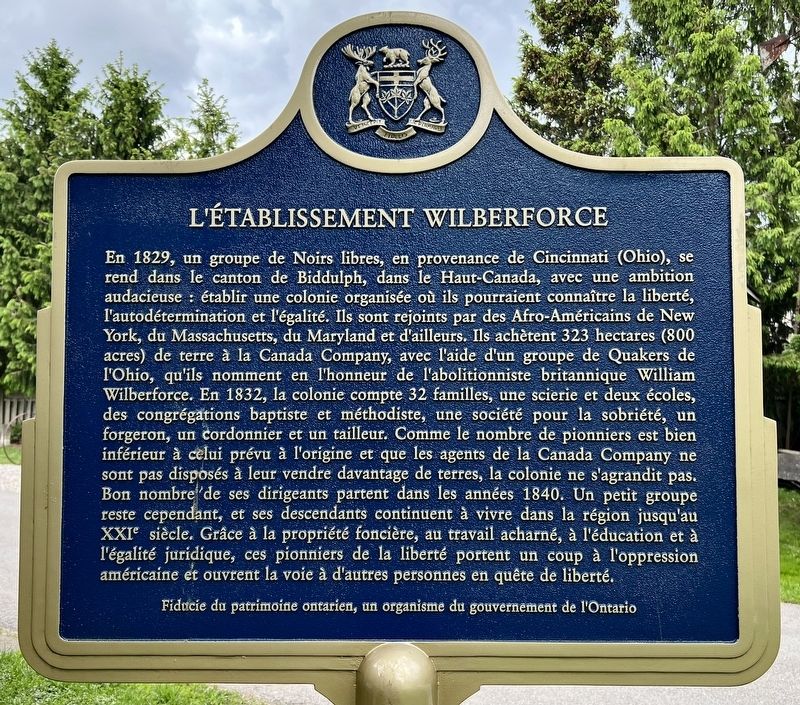
En 1829, un groupe de Noirs libres, en provenance de Cincinnati (Ohio), se rend dans le canton de Biddulph, dans le Haut-Canada, avec une ambition audacieuse: établir une colonie organisée ou ils pourraient connaître la liberté, l'autodétermination et l'égalité. Ils sont rejoints par des Afro-Américains de New York, du Massachusetts, du Maryland et d'ailleurs. Ils achètent 323 hectares (800 acres) de terre à la Canada Company, avec l'aide d'un groupe de Quakers de l'Ohio, qu'ils nomment en l'honneur de l'abolitionniste britannique William Wilberforce. En 1832, la colonie compte 32 familles, une scierie et deux écoles, des congrégations baptiste et méthodiste, une société pour la sobriété, un forgeron, un cordonnier et un tailleur. Comme le nombre de pionniers est bien inférieur à celui prévu à l'origine et que les agents de la Canada Company ne sont pas disposés à leur vendre davantage de terres, la colonie ne s'agrandit pas. Bon nombre de ses dirigeants partent dans les années 1840. Un petit groupe reste cependant, et ses descendants continuent à vivre dans la région jusqu'au
Photographed by Tim Boyd, May 30, 2025
2. The Wilberforce Settlement / L’Établissement Wilberforce Marker (français)
Erected by Ontario Heritage Trust.
Topics and series. This historical marker is listed in these topic lists: Abolition & Underground RR • African Americans • Settlements & Settlers. In addition, it is included in the Canada, Ontario Heritage Trust series list. A significant historical year for this entry is 1829.
Location. 43° 11.275′ N, 81° 24.277′ W. Marker is in Lucan, Ontario, in Middlesex County. It is on Frank Street 0.1 kilometers south of Main Street, on the right when traveling north. The marker is on the grounds of the Donnelly Museum approx. 50 metres from the entrance on Frank Street. Also accessible from the parking lot of the museum on Main Street between Frank and William Street. Touch for map. Marker is at or near this postal address: 186 Frank Street, Lucan ON N0M 2J0, Canada. Touch for directions.

Regionally, this marker is in the Southwest Ontario Area and in Southwestern
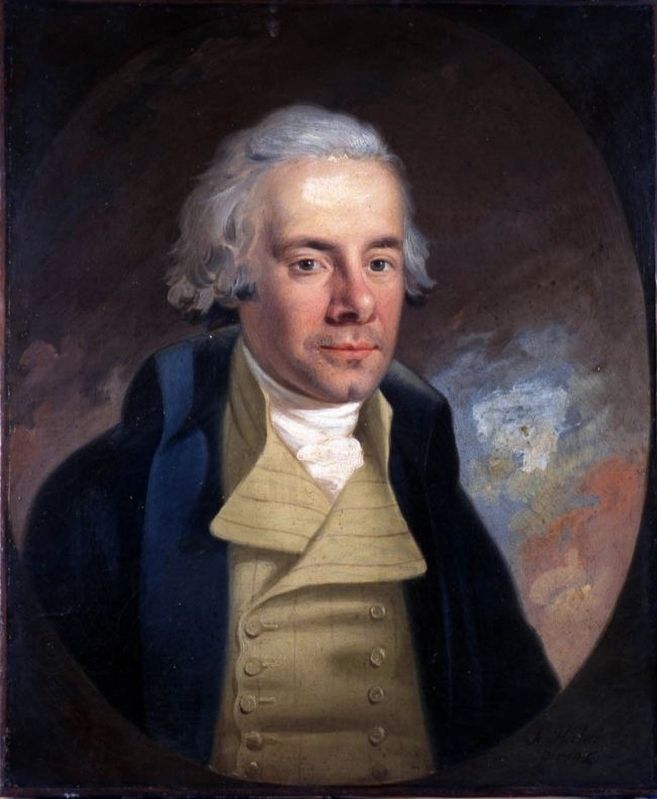
3. William Wiberforce (1759-1833)The Wilberforce Settlement was named after this abolitionist
Source: Wikipedia (Bridgeman Art Gallery, public domain)
Other nearby markers. At least 8 other markers are within 3 kilometers of this marker, measured as the crow flies: The “Donnelly” Log Cabin (here, next to this marker); The Ivan Hearn Barn (here, next to this marker); C. Frederick McLean 1875-1942 (here, next to this marker); The Founding of Lucan (a few steps from this marker); Wilberforce Colony (about 90 meters away, measured in a direct line); Sauble Hill - Wilberforce Cemetery (approx. 2.1 kilometers away); St. James Anglican Church & Cemetery (approx. 2.8 kilometers away); Lieut-Col. James Hodgins (approx. 2.8 kilometers away). Touch for a list and map of all markers in Lucan.
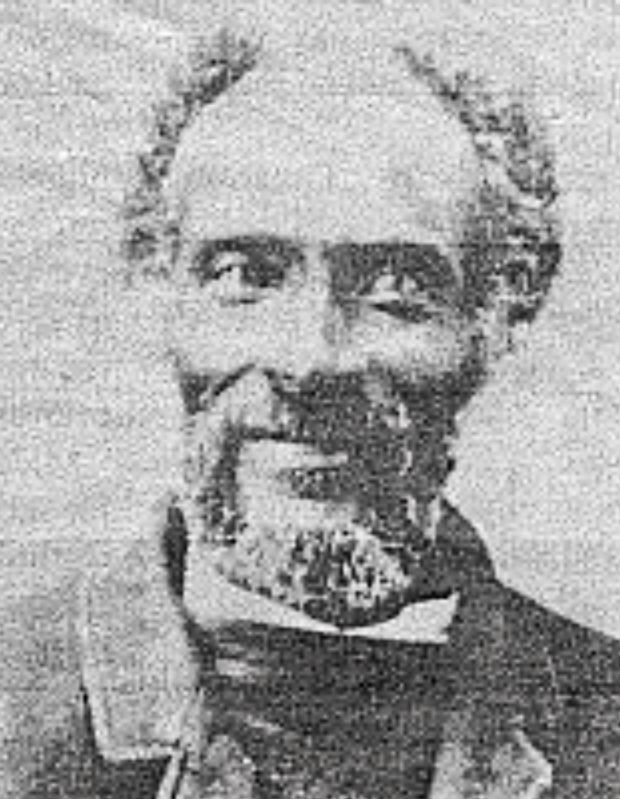
4. Peter Butler, an early Wilberforce settler, his descendants are still in the area
Source: Wikipedia (public domain)

Photographed by Tim Boyd, May 30, 2025
5. The Wilberforce Settlement / L’Établissement Wilberforce Marker (left of photo)
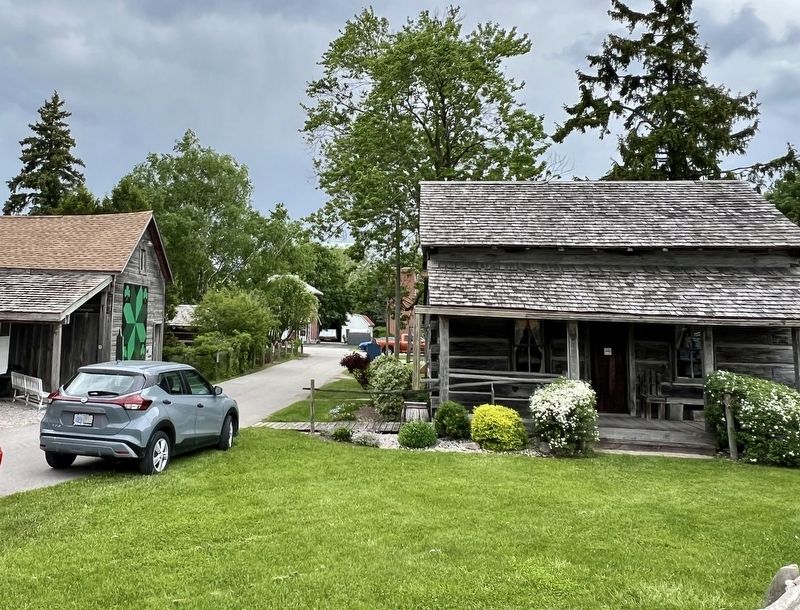
Photographed by Tim Boyd, May 30, 2025
6. The Donnelly Museum, Lucan
The Wilberforce Settlement marker is visible at the centre of the photo
Credits. This page was last revised on June 2, 2025. It was originally submitted on June 2, 2025, by Tim Boyd of Hamilton, Ontario. This page has been viewed 156 times since then and 64 times this year. Photos: 1, 2, 3, 4, 5, 6. submitted on June 2, 2025, by Tim Boyd of Hamilton, Ontario. • Andrew Ruppenstein was the editor who published this page.
