Workington in Cumberland, England, United Kingdom — Northwestern Europe (the British Isles)
Remembering World War II
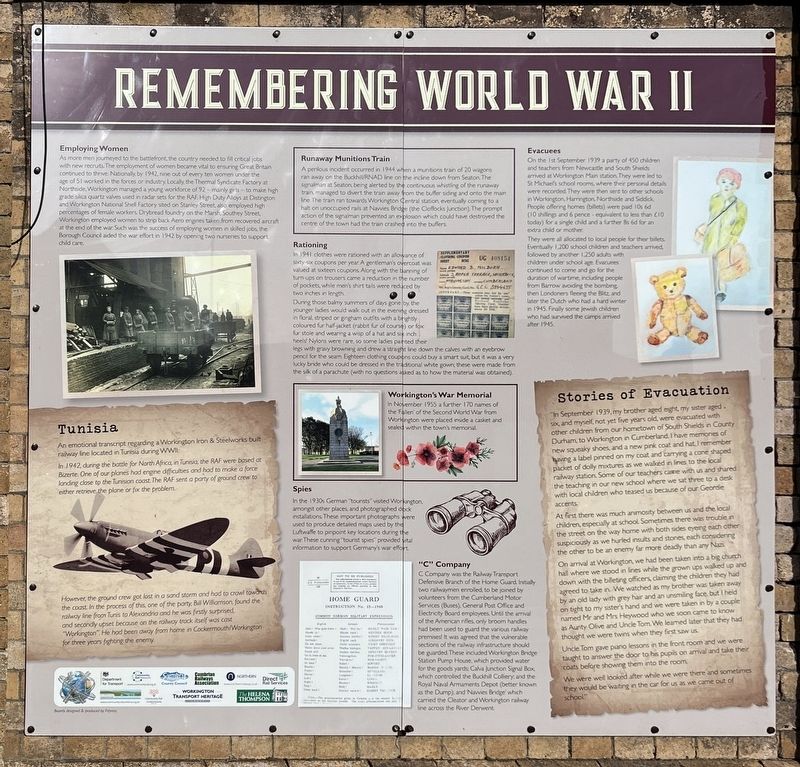
Photographed by Ray Gurganus, April 11, 2025
1. Remembering World War II Marker
Employing Women
As more men journeyed to the battlefront, the country needed to fill critical jobs with new recruits. The employment of women became vital to ensuring Great Britain continued to thrive. Nationally, by 1942, nine out of every ten women under the age of 51 worked in the forces or industry. Locally, the Thermal Syndicate Factory at Northside, Workington managed a young workforce of 92 - mainly girls - to make high grade silica quartz valves used in radar sets for the RAF. High Duty Alloys at Distington and Workington National Shell Factory, sited on Stanley Street, also employed high percentages of female workers. Drybread foundry on the Marsh, South Street, Workington employed women to strip back Aero engines taken from recovered aircraft at the end of the war. Such was the success of employing women in skilled jobs, the Borough Council aided the war effort in 1942 by opening two nurseries to support child care.
Tunisia
An emotional transcript regarding a Workington Iron & Steelworks built railway line located in Tunisia during WWII:
In 1942, during the bottle for North Africa in Tunisia the RAF were based at Bizerte. One of our planes had engine difficulties and had to make a force landing close to the Tunisian coast. The RAF sent a party of ground crew to either retrieve the plane or fix the problem.
However, the ground crew got lost in a sand storm and had to crawl towards the coast. In the process of this one of the party Bill Williamson found the railway line from Tunis to Alexandria and he was firstly surprised and secondly upset because on the railway track itself was cast "Workington". He had been away from home in Cockermouth/Workington for three years fighting the enemy.
Runaway Munitions Train
A
this page online
Rationing
1941 clothes were rationed with an allowance of sisty-six coupons per year. A gentleman's overcoat was valued at sixteen coupons. Along with the banning of turn-ups on trousers came a reduction in the number of pockets, while men's shirt tails were reduced by two inches in length.
During those balmy summers of days gone by, younger ladies would walk out in the evening dressed in floral striped or gingham outfits with a brightly coloured fur half-jacket (rabbit fur of course) or fox fur stole and wearing a wisp of a hat and six inch
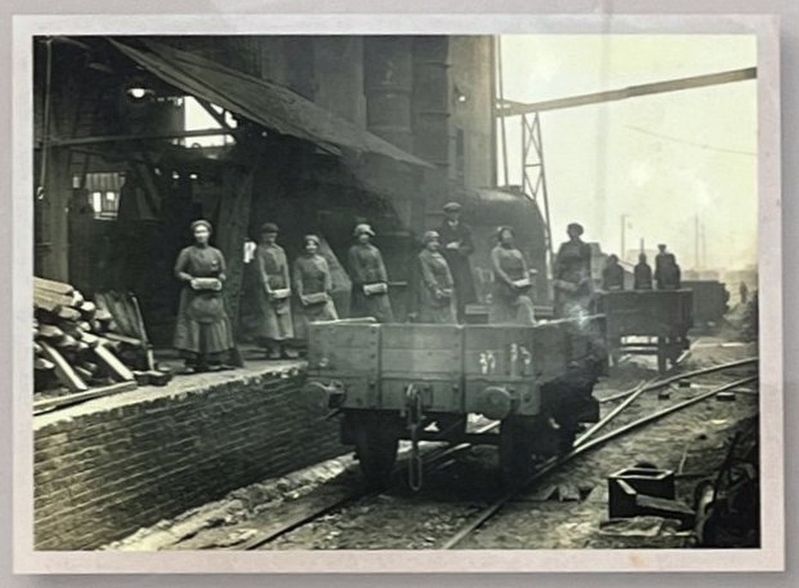
Photographed by Ray Gurganus, April 11, 2025
2. Employing Women
Workington's War Memorial
In November 1955 a further 170 names of the Fallen of the Second World War from Workington were placed inside a casket and sealed within the town's memorial.
Spies
In the 1930s German "tourists" visited Workington amongst other places, and photographed dock installations. These important photographs were used to produce detailed maps used by the Luftwaffe to pinpoint key locations during the war. These cunning tourist spies provided information to support Germany's war effort.
"C" Company
C Company was the Railway Transport Defensive Branch of the Home Guard. Initially two railwaymen enrolled, to be joined by volunteers from the Cumberland Motor Services (Buses), General Post Office and Electricity Board employees. Until the arrival of the American rifles, only broom handles had been used to guard the various railway premises. It was agreed that the vulnerable sections of the railway infrastructure be guarded. These included Workington Bridge Station Pump House, which provided water for the goods yards; Calva Junction Signal Box, which controlled the Buckhill Colliery; and the Royal Naval Armaments Depot (better known as the Dump); and 'Navvies Bridge' which carried the Cleator and Workington railway line across the River Derwent.
Evacuees
On the 1st September 1939 a party of 450 children and teachers from Newcastle and South Shields arrived at Workington Main station. They were led to St Michael's school rooms, where their personal detail were recorded. They were then sent to other schools in Workington, Harrington, Nortside and Siddick People offering homes (billets) were paid 10s 6d (10 shillings and 6 pence - equivalent to less than £10 today) for a single child and a further 8s 6d for an extra child or mother.
They were all located to local people for their billets. Eventually 1,200 school children and teachers arrived followed by another 1,250 children under school age. Evacuees continued to come and go for the duration of wartime, including people from Barrow avoiding the bombing, then Londoners fleeing the Blitz, and later the Dutch who had a hard winter in 1945. Finally some Jewish children who had survived the camps arrived after 1945.
Stories of Evacuation
"In September 1939, my brother aged eight, my sister aged six, and myself not yet five years old, were evacuated with other children from our hometown of South Shields in County Durham, to Workington in Cumberland. I have memories of new squeaky shoes and a new pink coat and hat. I remember having a label pinned on my coat and carrying a cone shaped packet of dolly mixtures as we walked in lines to the local railway station. Some of our teachers came with us and shared the teaching in our new school where we sat three to a desk with local children who teased us because of our Geordie accents.
At first there was much animosity between us and the local children, especially at school. Sometimes there was trouble in the street on the way home with both sides eyeing each other suspiciously as we hurled insults and stones, each considering the other to be an enemy far more deadly than any Nazi.
On arrival at Workington, we had been taken into a big church hall where we stood in lines while the grown ups walked up and down with the billeting officers, claiming the children they had agreed to take in. We watched as my brother was taken away by an old lady with grey hair and an unsmiling face but I held on tight to my sister's hand and we were taken in by a couple named Mr and Mrs Heywood who we soon came to know as Aunty Olive and Uncle Tom. We learned later that they had thought we were twins when they first saw us.
Uncle Tom gave piano lessons in the front room and we were taught to answer the door to his pupils on arrival and take their coats before showing them into the room.
We were well looked after while we were there and sometimes they would be waiting in the car for us as we came out of school."
Topics. This historical marker is listed in these topic lists: Railroads & Streetcars • War, World II • Women. A significant historical date for this entry is September 1, 1939.
Location. 54° 38.716′ N, 3° 33.521′ W. Marker is in Workington, England, in Cumberland. It can be reached from Falcon Street. On the Workington train station platform. Touch for map. Marker is at or near this postal address: 3 Falcon St, Workington, England CA14 2XD, United Kingdom. Touch for directions.

Regionally, this marker is in North West England. Globally, it is on the Atlantic Ocean, in the North Atlantic Region, in Europe, in Atlantic Europe, on one of the British Isles, in the Western World, and in the Anglosphere. Historically, it finds itself in what was once the Roman Empire.
Other nearby markers. At least 8 other markers are within walking distance of this marker: Remembering World War I (here, next to this marker); A History of Workington Station (here, next to this marker); The Helena Thompson Museum (here, next to this marker); The Rails Which Circled the World (within shouting distance of this marker); a different marker also named The Rails Which Circled the World (within shouting distance of this marker); James Alexander Smith (within shouting distance of this marker); Workington Station (within shouting distance of this marker); Shipping Throughout the Years (within shouting distance of this marker). Touch for a list and map of all markers in Workington.
Credits. This page was last revised on June 11, 2025. It was originally submitted on June 2, 2025, by Ray Gurganus of Washington, District of Columbia. This page has been viewed 137 times since then and 22 times this year. Photos: 1, 2. submitted on June 2, 2025, by Ray Gurganus of Washington, District of Columbia. • Andrew Ruppenstein was the editor who published this page.
Editor’s want-list for this marker. photo of the marker within its surroundings • Can you help?
