
Borden in Simcoe County, Ontario — Central Canada (North America)
Sherman Crab Mine Flail
⎯⎯⎯
Fléau de Déminage du Sherman Crab

Photographed by Cosmos Mariner, June 6, 2024
1. Sherman Crab Mine Flail / Fléau de Déminage du Sherman Crab Marker

this page online
Topics. This historical marker is listed in these topic lists: Military • Roads & Vehicles • War, World II.
Location. 44° 17.31′ N, 79° 53.474′ W. Marker is in Borden, Ontario, in Simcoe County. It is at the intersection of Dieppe Road and Gibraltar Road, on the left when traveling south on Dieppe Road. The marker and tank are located near the northeast corner of Worthington Memorial Park at Canadian Forces

Photographed by Cosmos Mariner, June 6, 2024
2. Sherman Crab Mine Flail / Fléau de Déminage du Sherman Crab Marker
The marker is mounted directly in front of the mine flail.

Regionally, this marker is in Central Ontario Cottage Country and specifically in Georgian Bay Country. It is also in Central Canada. Globally, it is in North America, on the Great Lakes, in the Western Hemisphere, in the Western World, and in the Anglosphere. Historically, it finds itself in what was once a British colony, the Viceroyalty of New France, the Haudenosaunee (Iroquois) Confederacy, and Rupert’s Land.
Other nearby markers. At least 8 other markers are within walking distance of this marker: British Armoured Recovery Vehicle (ARV) MKII / Véhicule blindé de dépannage britannique (VBD) MKII (within shouting distance of this marker); Canadian Tank School 50th Anniversary (within shouting distance of this marker); Canadian Armoured Corps 50th Anniversary (within shouting distance of this marker); British Centurion MK5 Main Battle Tank / Char de combat principal britannique Centurion MK5 (about 90 meters away, measured in a direct line); British Churchill Infantry Tank MK IV / Char d'infanterie britannique Churchill MK IV

Photographed by Cosmos Mariner, June 6, 2024
3. Sherman Crab Mine Flail / Fléau de Déminage du Sherman Crab
Also see . . . Mine Flail (Wikipedia).
Excerpt: A mine flail is a vehicle-mounted device that makes a safe path through a minefield by deliberately detonating land mines in front of the vehicle that carries it. They were first used by the British during World War II. The mine flail consists of a number of heavy chains ending in fist-sized steel balls (flails) that are attached to a horizontal, rapidly rotating rotor mounted on two arms in front of the vehicle. The rotor's rotation makes the flails spin wildly and violently pound the ground. The force of a flail strike above a buried mine mimics the weight of a person or vehicle and causes the mine to detonate, but in a safe manner that does little damage to the flails or the vehicle. An innovation was the addition of cutters to the rotor that cut barbed wire and stopped the flail from becoming(Submitted on June 3, 2025, by Cosmos Mariner of Cape Canaveral, Florida.)tangled. This feature made the Crab very effective at tearing up barbed wire obstacles. A blast shield between the flail and the tank gave added protection from detonating mines. The Crab weighed 32 tons - around two tons more than a normal Sherman.Photographed by Cosmos Mariner, June 6, 20244. Sherman Crab Mine Flail / Fléau de Déminage du Sherman Crab
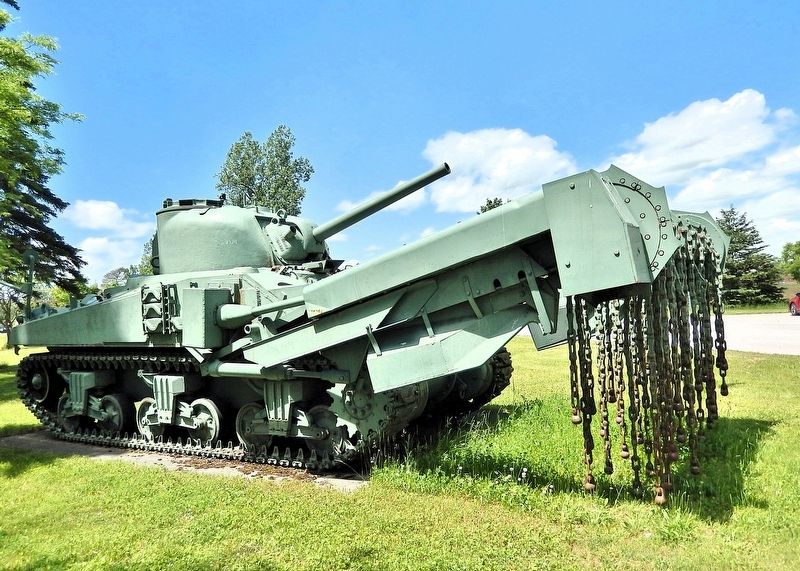

Photographed by Cosmos Mariner, June 6, 2024
5. Sherman Crab Mine Flail / Fléau de Déminage du Sherman Crab
Credits. This page was last revised on June 3, 2025. It was originally submitted on June 2, 2025, by Cosmos Mariner of Cape Canaveral, Florida. This page has been viewed 286 times since then and 112 times this year. Photos: 1, 2, 3, 4, 5. submitted on June 3, 2025, by Cosmos Mariner of Cape Canaveral, Florida.
