Minesing in Simcoe County, Ontario — Central Canada (North America)
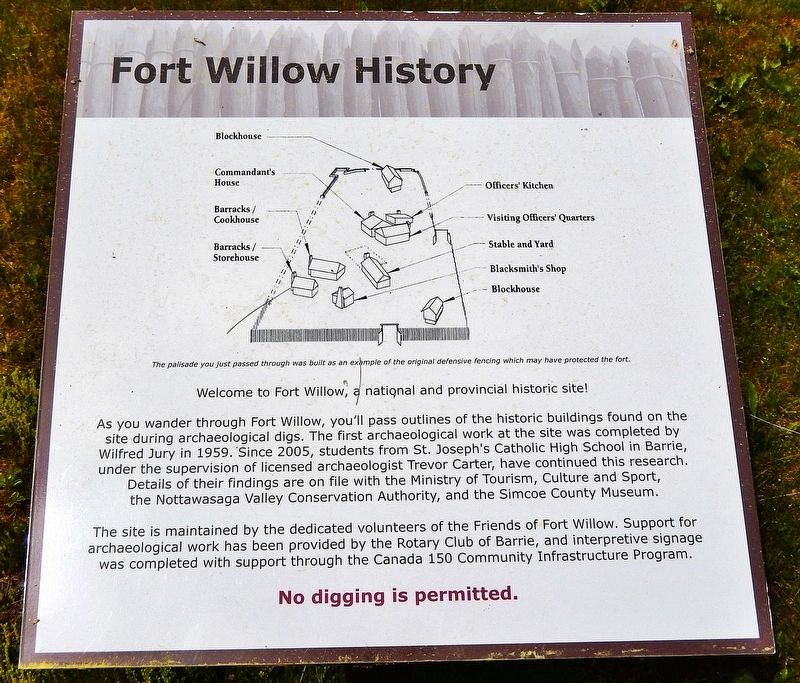
Fort Willow History
Welcome to Fort Willow, a national and provincial historic site!
Photographed by Cosmos Mariner, June 6, 2024
1. Fort Willow History Marker
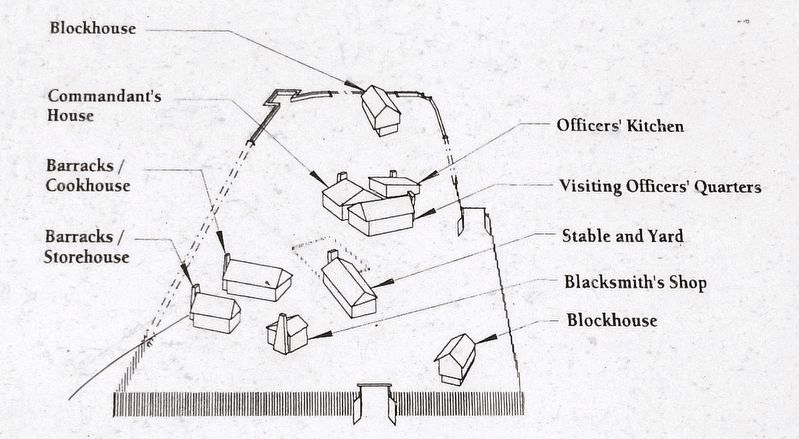
As you wander through Fort Willow, you'll pass outlines of the historic buildings found on the site during archaeological digs. The first archaeological work at the site was completed by Wilfred Jury in 1959. Since 2005, students from St. Joseph's Catholic High School in Barrie, under the supervision of licensed archaeologist Trevor Carter, have continued this research. Details of their findings are on file with the Ministry of Tourism, Culture and Sport, the Nottawasaga Valley Conservation Authority, and the Simcoe County Museum.
The site is maintained by the dedicated volunteers of the Friends of Fort Willow. Support for archaeological work has been provided by the Rotary Club of Barrie, and interpretive signage was completed with support through the Canada 150 Community Infrastructure Program.
No digging is permitted
Topics. This historical marker is listed in these topic lists: Anthropology & Archaeology • Charity & Public Work • Education • Forts and Castles. A significant historical year for this entry is 1959.
Location. 44° 23.716′ N, 79° 49.298′ W. Marker is in Minesing, Ontario, in Simcoe County. It
this page online

Regionally, this marker is in Central Ontario Cottage Country and specifically in Georgian Bay Country. It is also in Central Canada. Globally, it is in North America, on the Great Lakes, in the Western Hemisphere, in the Western World, and in the Anglosphere. Historically, it finds itself in what was once a British colony, the Viceroyalty of New France, the Haudenosaunee (Iroquois) Confederacy, and Rupert’s Land.
Other nearby markers. At least 8 other markers are within walking distance of this marker: Blockhouse (here, next to this marker); Dedicated to the Men of the Royal Newfoundland Regiment of Fencible Infantry (a few steps from this marker); Blacksmith (a few steps from this marker); Willow Creek Depot (a few steps from this marker); Nine Mile Portage and Willow Depot / Portage Nine Mile et Dépôt Willow
2. Marker detail: Fort Willow Layout
The palisade you just passed through was built as an example of the original defensive fencing which may have protected the fort.
Related markers. Click here for a list of markers that are related to this marker. Historic Fort Willow
Also see . . . History of Fort Willow (Nottawasaga Valley Conservation Authority).
Excerpt: Strategically located as a supply depot during the War of 1812, the Fort Willow area was also actively used for centuries by First Nations, the fur trade and French explorers as part of a major transportation route known as the Nine Mile Portage.(Submitted on June 3, 2025, by Cosmos Mariner of Cape Canaveral, Florida.)Restorations and archaeological investigations have been located and outlined the former buildings used by the soldiers. Information kiosks provide a thorough history of the area’s past use and how its location helped ensure the geographical boundaries of Canada today.
Owing to their importance in the development of our nation, Fort Willow and the Nine Mile Portage are recognized as both provincial and national
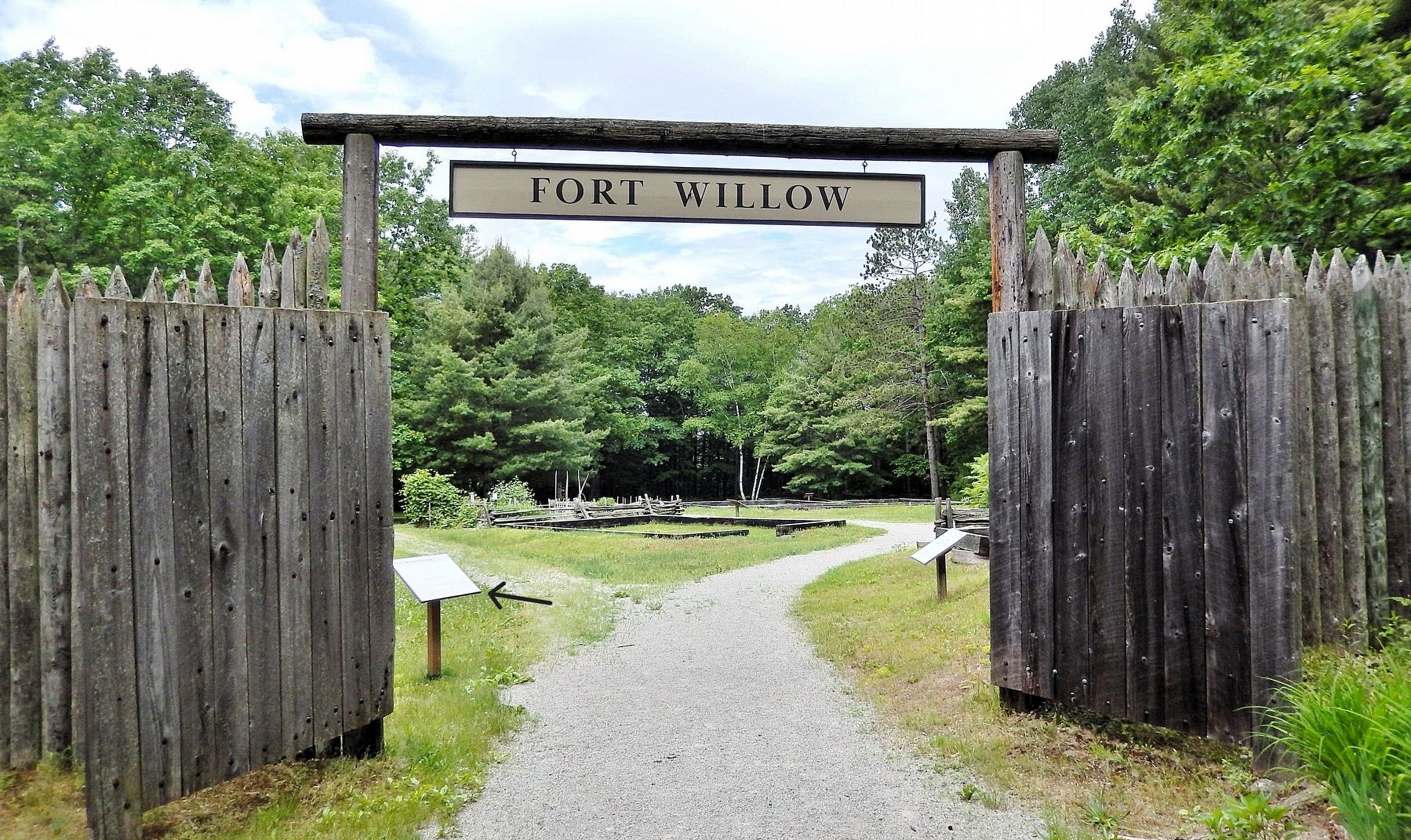
historic sites.Photographed by Cosmos Mariner, June 6, 20243. Fort Willow History MarkerThe marker is just inside the palisade gate, on the left.
Credits. This page was last revised on June 7, 2025. It was originally submitted on June 2, 2025, by Cosmos Mariner of Cape Canaveral, Florida. This page has been viewed 118 times since then and 17 times this year. Photos: 1, 2, 3. submitted on June 3, 2025, by Cosmos Mariner of Cape Canaveral, Florida.
