Stoughton in Dane County, Wisconsin — The American Midwest (Great Lakes)
The Stoughton Downtown Historic District
May 17, 2025
1. The Stoughton Downtown Historic District Marker
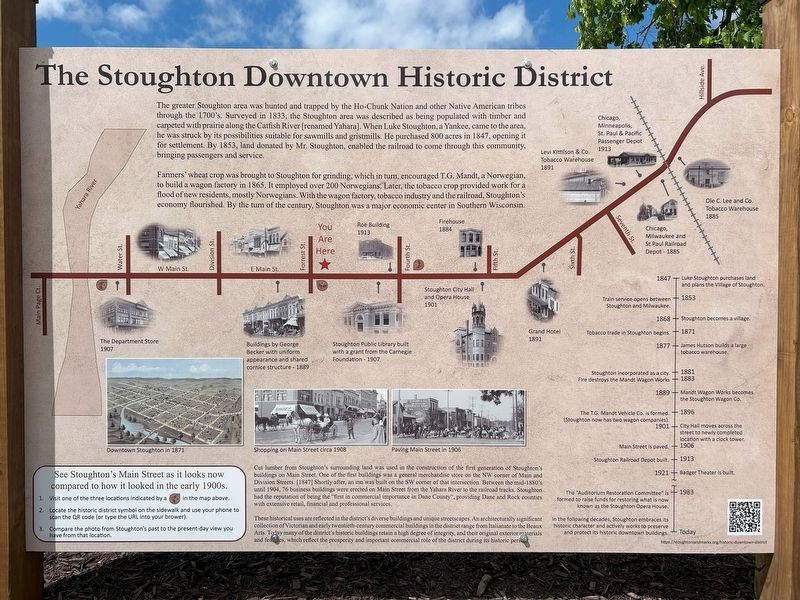
The greater Stoughton area was hunted and trapped by the Ho-Chunk Nation and other Native American tribes through the 1700's. Surveyed in 1833, the Stoughton area was described as being populated with timber and carpeted with prairie along the Catfish River [renamed Yahara]. When Luke Stoughton, a Yankee, came to the area, he was struck by its possibilities suitable for sawmills and gristmills. He purchased 800 acres in 1847, opening it for settlement. By 1853, land donated by Mr. Stoughton, enabled the railroad to come through this community, bringing passengers and service.
Farmers' wheat crop was brought to Stoughton for grinding, which in turn, encouraged T.G. Mandt, a Norwegian, to build a wagon factory in 1865. It employed over 200 Norwegians. Later, the tobacco crop provided work for a flood of new residents, mostly Norwegians. With the wagon factory, tobacco industry and the railroad, Stoughton's economy flourished. By the turn of the century, Stoughton was a major economic center in Southern Wisconsin.
Downtown Stoughton in 1871
Shopping on Main Street circa 1908
Paving Main Street in 1906
Cut lumber
this page online
These historical uses are reflected in the district's diverse buildings and unique streetscapes. An architecturally significant collection of Victorian and early twentieth-century commercial buildings in the district range from Italianate to the Beaux Arts. Today many of the district's historic buildings retain a high degree of integrity, and their original exterior materials and features, which reflect the prosperity and important commercial role of the district during its historic period.
See Stoughton's Main

May 17, 2025
2. The Stoughton Downtown Historic District Marker
1. Visit one of the three locations indicated by a [symbol] in the map above.
2. Locate the historic district symbol on the sidewalk and use your phone to scan the QR code (or type the URL into your brower).
3. Compare the photo from Stoughton's past to the present-day view you have from that location.
The Department Store 1907
Buildings by George Becker with uniform appearance and shared cornice structure - 1889
Stoughton Public Library built with a grant from the Carnegie Foundation - 1907
Roe Building 1913
Firehouse 1884
Stoughton City Hall and Opera House 1901
Grand Hotel 1891
Levi Kittilson & Co. Tobacco Warehouse 1891
Chicago, Minneapolis, St. Paul & Pacific Passenger Depot 1913
Chicago, Milwaukee and St Paul Railroad Depot - 1885
Ole C. Lee and Co. Tobacco Warehouse 1885
1847 — Luke Stoughton purchases land and plans the Village of Stoughton.
1853 — Train service opens between Stoughton and Milwaukee.
1868 — Stoughton becomes a village.
1871 — Tobacco trade in Stoughton begins.
1877 — James Hutson builds a large tobacco warehouse.
1881 — Stoughton incorporated as a city.
1883 — Fire destroys the Mandt Wagon Works
1889 — Mandt Wagon Works becomes the Stoughton Wagon Co.
1896 — The T.G. Mandt Vehicle Co. is formed. (Stoughton now has two wagon companies).
1901 — City Hall moves across the street to newly completed location with a clock tower.
1906 — Main Street is paved.
1913 — Stoughton Railroad Depot built.
1921 — Badger Theater is built.
1983 — The "Auditorium Restoration Committee" is formed to raise funds for restoring what is now known as the Stoughton Opera House.
Today — In the following decades, Stoughton embraces its historic character and actively works to preserve and protect its historic downtown buildings.
Erected 2024.
Topics. This historical marker is listed in these topic lists: Indigenous Peoples and Communities • Industry & Commerce • Settlements & Settlers. A significant historical year for this entry is 1847.
Location. 42° 55.012′ N, 89° 13.128′ W. Marker is in Stoughton, Wisconsin, in Dane County. It is on East Main Street (U.S. 51) east of Forrest Street, on the right when traveling west. Touch for map. Marker is in this post office area: Stoughton WI 53589, United States of America. Touch for directions.

Regionally, this marker is in Southeast Wisconsin and in Greater Madison. It is also in the American Midwest and in the Corn Belt. Globally, it is in North America, the Western Hemisphere, the Western World, and the Anglosphere. Historically, it finds itself in what was once the territory of the Mississippian Culture and also the Northwest Territory.
Other nearby markers. At least 8 other markers are within 5 miles of this marker, measured as the crow flies: Main Street Historic District (about 500 feet away, measured in a direct line); Stoughton (approx. ¼ mile away); East Park Historic District (approx. 0.4 miles away); Robert Marion La Follette, Sr. (approx. 3.4 miles away); Bovre Congregation (approx. 3.7 miles away); Seasons of Fish Camp (approx. 5.1 miles away); Carp for sale (approx. 5.1 miles away); Too many carp (approx. 5.1 miles away). Touch for a list and map of all markers in Stoughton.
Another marker is no longer nearby. Yahara River (was approx. 4.6 miles away but has been confirmed missing).
Also see . . . Historic Stoughton - Stoughton Historic Downtown District. (Submitted on June 3, 2025.)
Credits. This page was last revised on July 26, 2025. It was originally submitted on June 3, 2025. This page has been viewed 223 times since then and 33 times this year. Photos: 1, 2. submitted on June 3, 2025.
