Minesing in Simcoe County, Ontario — Central Canada (North America)
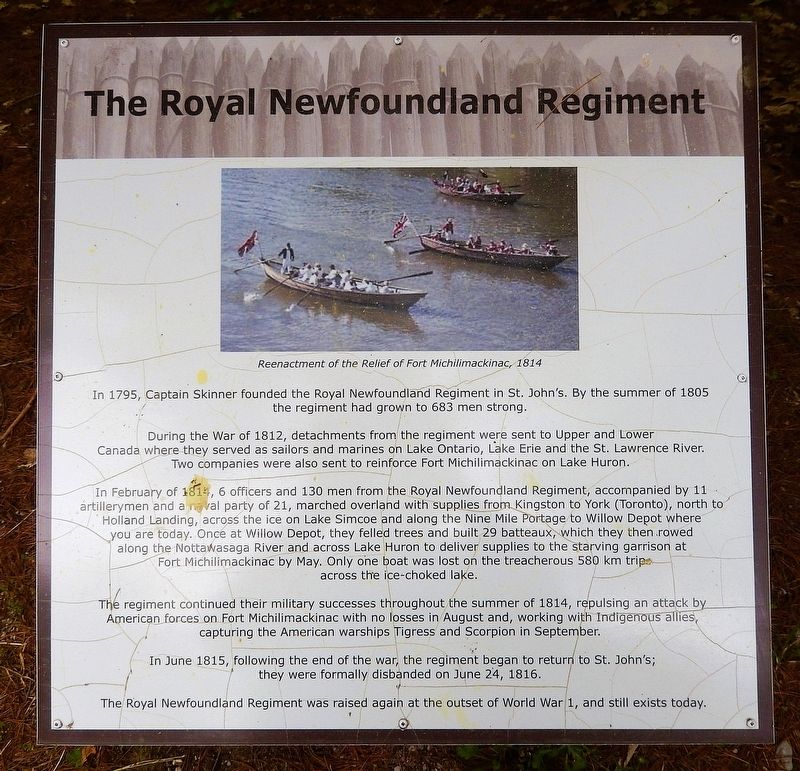
The Royal Newfoundland Regiment
Photographed by Cosmos Mariner, June 6, 2024
1. The Royal Newfoundland Regiment Marker
In 1795, Captain Skinner founded the Royal Newfoundland Regiment in St. John's. By the summer of 1805 the regiment had grown to 683 men strong.
During the War of 1812, detachments from the regiment were sent to Upper and Lower Canada where they served as sailors and marines on Lake Ontario, Lake Erie and the St. Lawrence River. Two companies were also sent to reinforce Fort Michilimackinac on Lake Huron.
In February of 1814, 6 officers and 130 men from the Royal Newfoundland Regiment, accompanied by 11 artillerymen and a naval party of 21, marched overland with supplies from Kingston to York (Toronto), north to Holland Landing, across the ice on Lake Simcoe and along the Nine Mile Portage to Willow Depot where you are today. Once at Willow Depot, they felled trees and built 29 batteaux, which they then rowed along the Nottawasaga River and across Lake Huron to deliver supplies to the starving garrison at Fort Michilimackinac by May. Only one boat was lost on the treacherous 580 km trip across the ice-choked lake.
The regiment continued their military successes throughout the summer of 1814, repulsing an attack by American
this page online
In June 1815, following the end of the war, the regiment began to return to St. John's; they were formally disbanded on June 24, 1816.
The Royal Newfoundland Regiment was raised again at the outset of World War I, and still exists today.
[photo caption] Reenactment of the Relief of Fort Michilimackinac, 1814
Topics. This historical marker is listed in these topic lists: Forts and Castles • War of 1812 • War, World I • Waterways & Vessels. A significant historical month for this entry is February 1814.
Location. 44° 23.7′ N, 79° 49.285′ W. Marker is in Minesing, Ontario, in Simcoe County. It can be reached from Grenfel Road 3.6 kilometers north of Sunnidale Road (County Road 40), on the left when traveling north. The marker is located on the Historic Fort Willow grounds at Fort Willow Conservation Area. Touch for map. Marker is at or near this postal address: 2714 Grenfel Road, Minesing ON L0L 1Y3, Canada. Touch for directions.

Regionally, this marker is in Central Ontario
Photographed by Cosmos Mariner, June 6, 2024
2. The Royal Newfoundland Regiment Marker
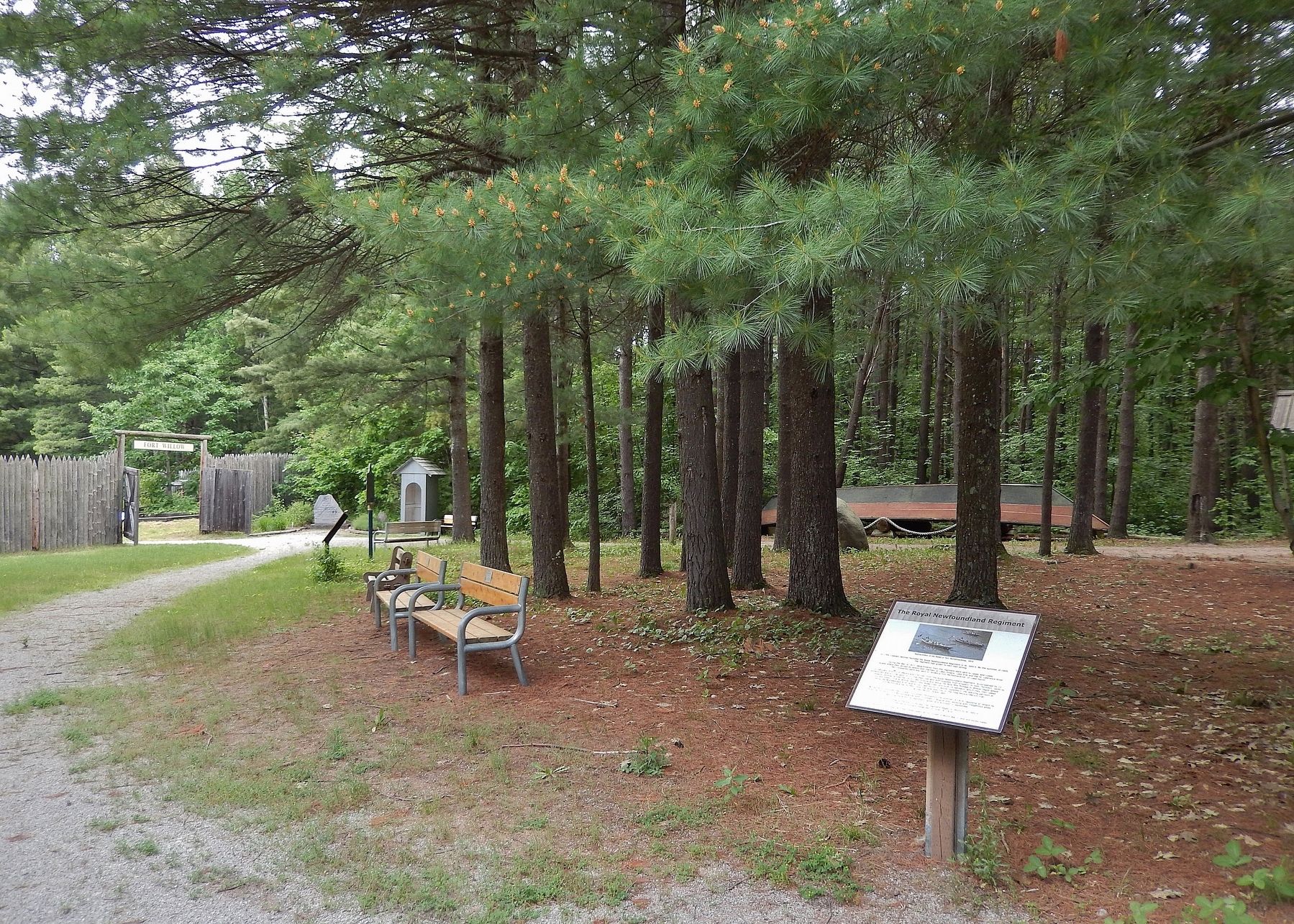
The Fort Willow palisade gate is in the left background.
Other nearby markers. At least 8 other markers are within walking distance of this marker: Formed by Ice (a few steps from this marker); The Post War Years (a few steps from this marker); The War of 1812 (a few steps from this marker); a different marker also named The War of 1812 (a few steps from this marker); A Meeting Place (a few steps from this marker); Nine Mile Portage and Willow Depot / Portage Nine Mile et Dépôt Willow (a few steps from this marker); Welcome to Fort Willow (a few steps from this marker); Willow Creek Depot (a few steps from this marker). Touch for a list and map of all markers in Minesing.
Related markers. Click here for a list of markers that are related to this marker. Historic Fort Willow
Also see . . . Royal Newfoundland Regiment (Wikipedia).
Excerpt: The regiment, called at the time the Royal Newfoundland Regiment of Fencible Infantry, was significantly involved in the War of 1812. Battles in which elements of the regiment took part included: Skirmish at Canard River 16 July 1812, Battle of Detroit 16 August 1812, Battle of Matilda 16 September 1812, Battle of the River Raisin or Frenchtown, Michigan 22 January 1813, the British raid on Ogdensburg, New York 22 February 1813, the Battle of York (Toronto) 27 April 1813 and operations in northwest Ohio, including the siege of Fort Meigs in the spring of 1813 and the Battle of Fort George (Niagara-on-the-Lake), 25–27 May 1813. The regiment was also involved in the British Raid on Sacket's Harbour, New York on 29 May 1813, and provided soldiers who served as marines in the Battle of Lake Erie on 10 September 1813. The regiment's service continued at the Battle of the Thames or Moraviantown on 5 October 1813, and in northern Michigan at the Battle of Michilimackinac or Mackinac Island, 4 August 1814 and as part of the capture of American naval vessels Tigress 3 September 1814 and Scorpion on Upper Lake Huron on 6 September 1814.(Submitted on June 4, 2025, by Cosmos Mariner of Cape Canaveral, Florida.)
Credits. This page was last revised on June 7, 2025. It was originally submitted on June 3, 2025, by Cosmos Mariner of Cape Canaveral, Florida. This page has been viewed 142 times since then and 17 times this year. Photos: 1, 2. submitted on June 4, 2025, by Cosmos Mariner of Cape Canaveral, Florida.
