
Rosedale-Moore Park in Toronto, Ontario — Central Canada (North America)
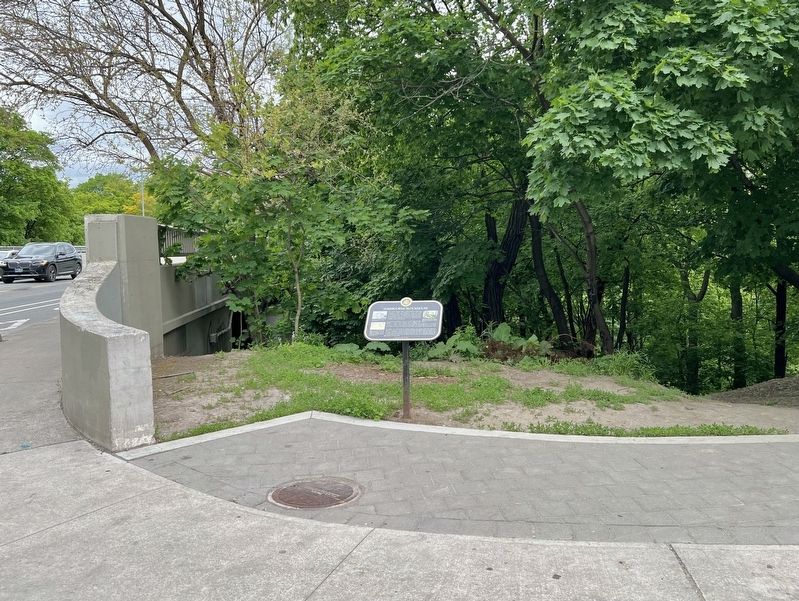
Sherbourne Blockhouse

Photographed by Tim Boyd, June 1, 2025
1. Sherbourne Blockhouse Marker
The Sherbourne blockhouse was one of three built after the Rebellion of 1837, when insurgents led by William Lyon Mackenzie marched south on Yonge Street demanding the establishment of responsible government in Upper Canada. While Toronto's defenses had traditionally focused on protecting the city from naval attack, the blockhouses were built to guard against rebel raids from the north.
The military use of the blockhouses declined rapidly as new weaponry made them difficult to defend and as threats to Toronto decreased. By the 1850s, discharged soldiers were living in the Sherbourne blockhouse, windows having been cut in the log walls to make the building more hospitable. Artists appreciated the romantic
this page online
Erected 2016 by Heritage Toronto.
Topics and series. This historical marker is listed in these topic lists: Forts and Castles • Wars, Non-US. In addition, it is included in the Canada, Toronto Heritage series list. A significant historical year for this entry is 1839.
Location. 43° 40.349′ N, 79° 22.605′ W. Marker is in Toronto, Ontario. It is in Rosedale-Moore Park. It is at the intersection of Bloor Street East and Sherbourne Street, on the right when traveling west on Bloor Street East. Touch for map. Marker is at or near this postal address: 421 Bloor St E, Toronto ON M4W 3T1, Canada. Touch for directions.

Regionally, this marker is in Greater Toronto and on the Golden Horseshoe. It is also in Central Canada. Globally, it is in North America, on the Great Lakes, in the Western Hemisphere, in the Western World, and in the Anglosphere. Historically, it finds itself in what was once a British colony, the Viceroyalty of New France,
Photographed by Tim Boyd, June 1, 2025
2. Sherbourne Blockhouse Marker
Other nearby markers. At least 8 other markers are within walking distance of this marker: Underground Railroad Restaurant (within shouting distance of this marker); James Cooper House (1881) (about 180 meters away, measured in a direct line); Church of St. Simon-the-Apostle (approx. 0.2 kilometers away); St. Paul’s Anglican Church (approx. 0.4 kilometers away); The Rekai Family (approx. half a kilometer away); Vincent Massey (approx. 0.6 kilometers away); Raymond Massey (approx. 0.6 kilometers away); Joseph Bloor (approx. 0.6 kilometers away). Touch for a list and map of all markers in Toronto.
Also see . . . Rebellion in Upper Canada. The Canadian Encyclopedia website entry:
Between 5 and 8 December 1837, approximately 1,000 men gathered at Montgomery's Tavern in Toronto. Largely from the countryside north of Toronto, they represented a cross section of the farming community from which Mackenzie had always drawn most of his support. A large number of the settlers were of American origin.(Submitted on June 4, 2025, by Tim Boyd of Hamilton, Ontario.)
On 5 December, a motley assortment of 500 to 700 rebels bearingonly hunting rifles, staves and pitchforks, marched south on Yonge Street. Their objective was to engage a smaller force of armed government loyalists and militia. On their way, the rebels ran into a picket of about 20 loyalists who opened fire. The front rank of the rebel force returned fire and then dropped to the ground, to assume a safer firing position. However, the remaining rebels thought their comrades at the front had been killed. In their fear and confusion, they turned and ran.Photographed by Tim Boyd, June 1, 20253. Sherbourne Blockhouse marker photos and captions detail (left)
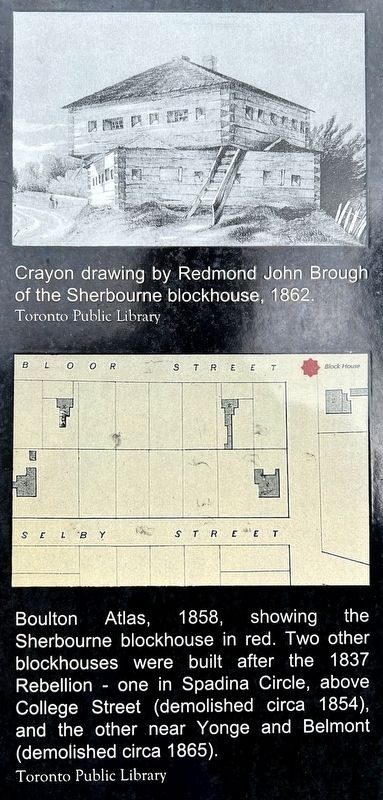
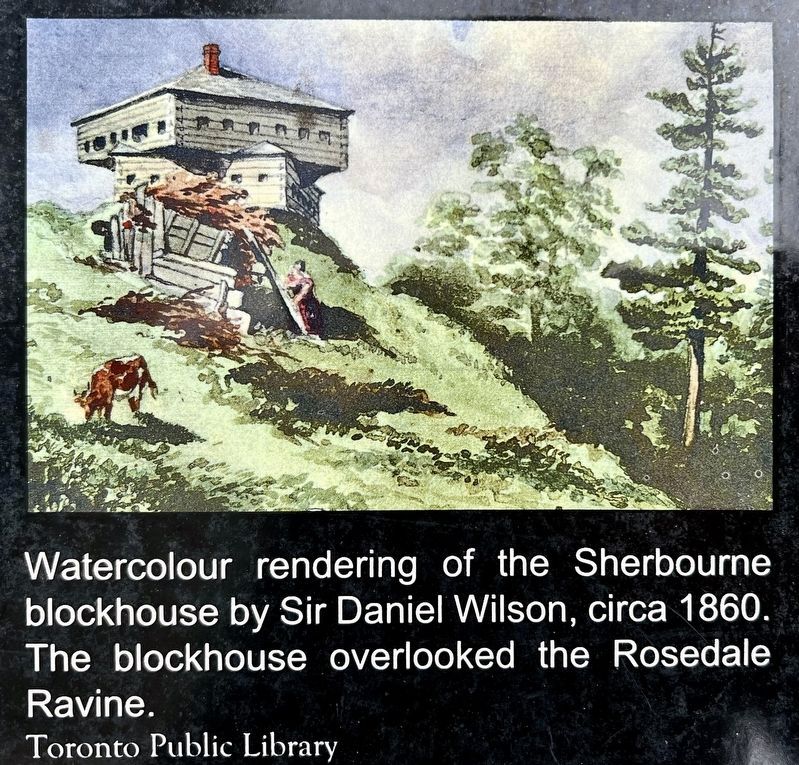
Photographed by Sir Daniel Wilson, circa 1860s
4. Sherbourne Blockhouse marker photos and captions and caption detail
Credits. This page was last revised on July 12, 2026. It was originally submitted on June 4, 2025, by Tim Boyd of Hamilton, Ontario. This page has been viewed 182 times since then and 30 times this year. Photos: 1, 2, 3, 4. submitted on June 4, 2025, by Tim Boyd of Hamilton, Ontario. • Andrew Ruppenstein was the editor who published this page.
