
Niagara-on-the-Lake in Niagara Region, Ontario — Central Canada (North America)
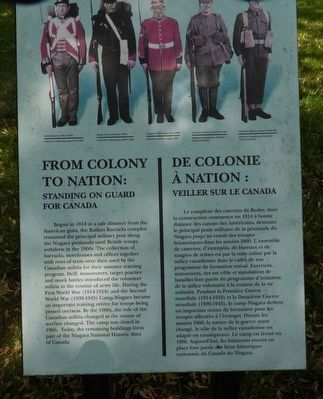
From Colony To Nation: Standing On Guard For Canada
De Colonie À Nation: Veiller Sur Le Canada
Photographed by Kevin Westell, June 2, 2025
1. From Colony To Nation Marker - 1 of 3

[PANEL 1 of 3]
Begun in 1814 at a safe distance from the American guns, the Butlers Barracks complex remained the principal military post along the Niagara peninsula until British troops withdrew in the 1860s. The collection of barracks, storehouses and offices together with rows of tents were then used by the Canadian militia for their summer training program. Drill, manoeuvres, target practice and mock battles introduced the volunteer militia to the routine of army life. During the First World War (1914-1918) and the Second World War (1939-1945) Camp Niagara became an important training centre for troops being posted overseas. By the 1960s, the role of the Canadian militia changed as the nature of warfare changed. The camp was closed in 1966. Today, the remaining buildings form part of the Niagara National Historic Sites of Canada.
Le complexe des casernes de Butler, dont la construction commence en 1814 à bonne distance des canons des Américains, demeure le principal poste militaire de la péninsule du Niagara jusqu'au retrait des troupes britanniques dans les années 1860. L'ensemble de
this page online
[PANEL 2 of 3]
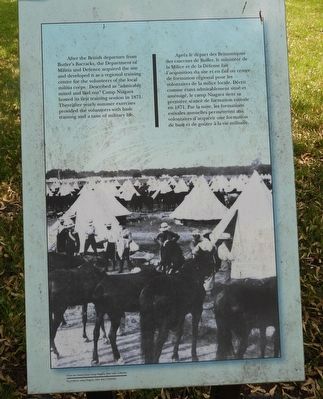
After the British departure from Butler's Barracks, the Department of Militia and Defence acquired the site and developed it as a regional training centre for the volunteers of the local militia corps. Described as "admirably suited and laid out" Camp Niagara hosted its first training session in 1871. Thereafter yearly summer
Photographed by Kevin Westell, June 2, 2025
2. From Colony To Nation Marker - 2 of 3
Après le départ des Britanniques des casernes de Butler, le ministère de la Milice et de la Défense fait l'acquisition du site et en fait un centre de formation régional pour les volontaires de la milice locale. Décrit comme étant admirablement situé et aménagé, le camp Niagara tient sa première séance de formation estivale en 1871. Par la suite, les formations estivales annuelles permettront aux volontaires d'acquérir une formation de base et de goûter la vie militaire.
[PANEL 3 of 3]
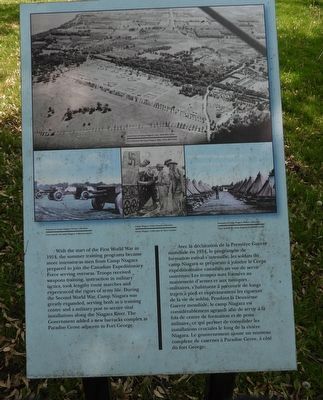
With the start of the First World War in 1914, the summer training programs became more intensive-as men from Camp Niagara prepared to join the Canadian Expeditionary Force serving overseas. Troops received weapons training, instruction in military tactics, took lengthy route marches and experienced the rigors of army life. During the Second World War, Camp Niagara was greatly expanded, serving both as a training centre and a military post to secure vital installations along the Niagara River. The Government
Photographed by Kevin Westell, June 2, 2025
3. From Colony To Nation Marker - 3 of 3
Avec la déclaration de la Première Guerre mondiale en 1914, le programme de formation estival s'intensifie, les soldats du camp Niagara se préparant à joindre le Corps expéditionnaire canadien en vue de servir outremer. Les troupes sont formées au maniement d'armes et aux tactiques militaires, s'habituent à parcourir de longs trajets à pied et expérimentent les rigueurs de la vie de soldat. Pendant la Deuxième Guerre mondiale, le camp Niagara est considérablement agrandi afin de servir à la fois de centre de formation et de poste militaires, ce qui permet de consolider les installations cruciales le long de la rivière Niagara. Le gouvernement ajoute un nouveau complexe de casernes à Paradise Grove, à côté du fort George.
Erected by Parks Canada.
Topics. This historical marker is listed in these topic lists: Patriots & Patriotism • War of 1812 • War, World I • War, World II. A significant historical year for this entry is 1814.
Location. 43° 14.864′ N, 79° 4.394′ W. Marker is in Niagara-on-the-Lake,
Photographed by Kevin Westell, June 2, 2025
4. From Colony To Nation - Marker in context
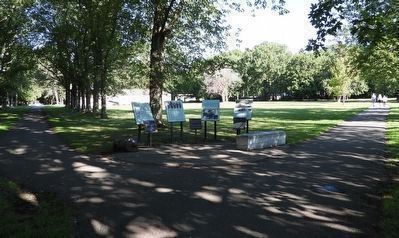
The Mary Street trail (left) leads north-west; the Brock Road trail (right) leads north.
On the ground (centre left) is an 1812 howitzer.

Regionally, this marker is on Ontario’s Golden Horseshoe and in Niagara Canada. It is also in Central Canada. Globally, it is in North America, on the Great Lakes, in the Western Hemisphere, in the Western World, and in the Anglosphere. Historically, it finds itself in what was once a British colony, the Viceroyalty of New France, the Haudenosaunee (Iroquois) Confederacy, and Rupert’s Land.
Other nearby markers. At least 8 other markers are within walking distance of this marker: The Scouting Movement In Canada / Le Scoutisme au Canada (a few steps from this marker); Butler's Barracks (about 90 meters away, measured in a direct line); Eighth World Boy Scout Jamboree (about
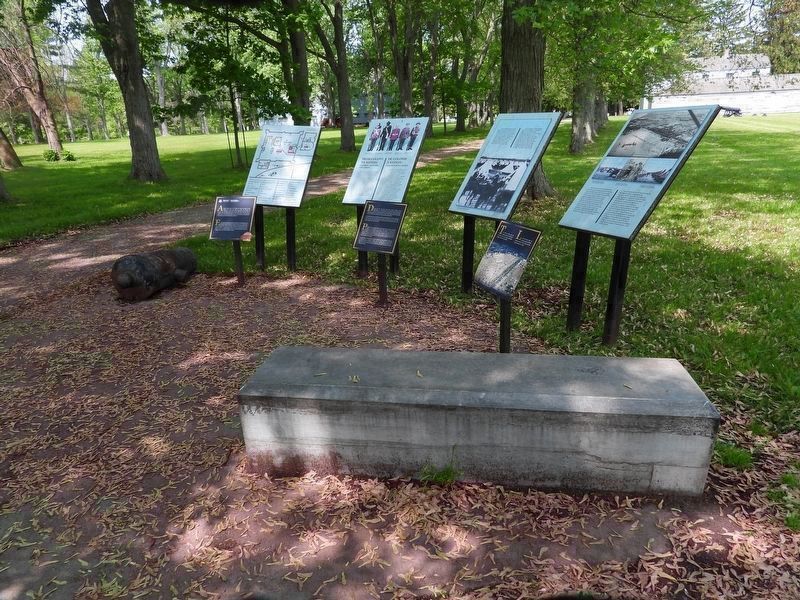
Photographed by Kevin Westell, June 2, 2025
5. From Colony To Nation display, looking west along the path to Mary Street
To the west (top right), behind the distant black cannon, is the Butler's Barracks one-storey gun shed, and behind it, the two-storey commissariat store.

Photographed by Kevin Westell, June 2, 2025
6. The three smaller bottom panels
Credits. This page was last revised on December 22, 2025. It was originally submitted on June 4, 2025, by Kevin Westell of St. Catharines, Ontario. This page has been viewed 65 times since then and 17 times this year. Photos: 1, 2, 3, 4. submitted on June 4, 2025, by Kevin Westell of St. Catharines, Ontario. 5, 6. submitted on June 5, 2025, by Kevin Westell of St. Catharines, Ontario. • J. J. Prats was the editor who published this page.
