Astra in Quinte West in Hastings County, Ontario — Central Canada (North America)
CT-133 Silver Star
Canadair, Lockheed

Photographed by William Fischer, Jr., May 12, 2025
1. CT-133 Silver Star Marker

The Canadair T-33 Silver Star (designated CT-133 by the RCAF) was built in Montreal, Quebec. The T-33 Silver Star was developed out of necessity for a jet trainer to prepare pilots to fly the Lockheed P-80 Shooting Star. Without a trainer, pilots were crashing, so Lockheed took a basic P-80 and expanded it into a two-seater trainer. With the new configuration, the fuselage fuel tank had to be made smaller, so wingtip fuel tanks were added, thus creating the distinctive look of the T-Bird. While the modifications actually resulted in the trainer performing better than the Shooting Star fighter aircraft, the T-33 remained a trainer.
Canada's first 30 T-Birds were borrowed from the USAF in 1951, but that changed once Lockheed granted Canadair a license that same year to build Silver Stars in Canada. The RCAF promptly ordered hundreds of them, with the final total being for 656 aircraft.
Used for pilot, armament training and photo reconnaissance, they served across Canada as well as with Canada's NATO forces in Germany. The T-33s served for more than 50 years between 1953 and March 31, 2005.
The Museum
this page online
Specifications
Tail #: 21435 Mark: III
Wingspan: 13 m, Length: 11.49 m,
Height: 3.6 m
Max Weight: 7 620 kg
Max Speed: 917 km/h
Crew: 2 crew in ejection seats
Role: trainer, electronic warfare trainer,
target towing
In service: 1953-2005
No d'immatriculation: 21435 Mark III
Envergure: 13 m, Longueur: 11,49 m,
Hauteur: 3,6 m
Masse maximale: 7 620 kg
Vitesse maximale 917 km/h
Équipage: 2 membres d'équipage
en sièges éjectables
Rôle: entrainement, simulateur de guesse
électronique, remorquage de cibles
En service: 1953-2005
Erected by National Air Force Museum of Canada.
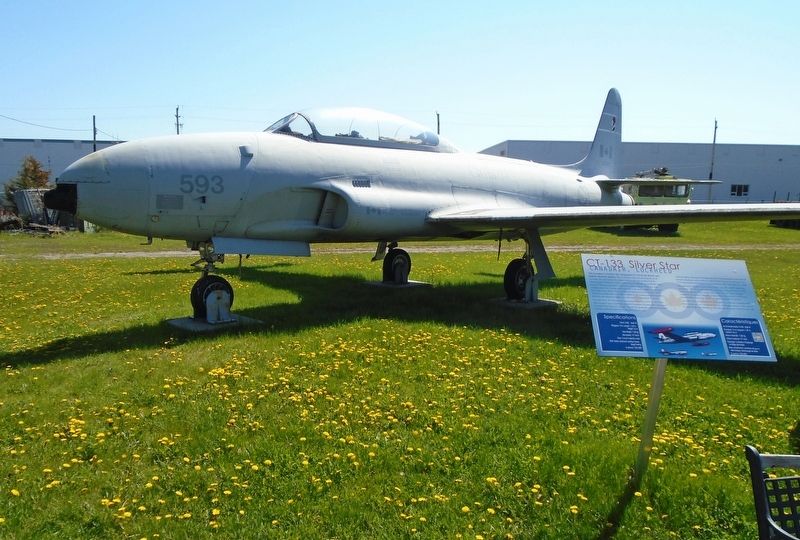
Photographed by William Fischer, Jr., May 12, 2025
2. CT-133 Silver Star and Marker
Topics. This historical marker is listed in these topic lists: Air & Space • Patriots & Patriotism • War, Cold. A significant historical year for this entry is 2002.
Location. 44° 6.888′ N, 77° 32.972′ W. Marker is in Quinte West, Ontario, in Hastings County. It is in Astra. It can be reached from Portage Drive. Marker and aircraft are in the National Air Force Museum of Canada's Memorial Air Park. Touch for map. Marker is at or near this postal address: 220 RCAF Road, Quinte West ON K0K 3V0, Canada. Touch for directions.

Regionally, this marker is in Eastern Ontario and specifically in Southeastern Ontario. It is also in Central Canada. Globally, it is in North America, on the Great Lakes, in the Western Hemisphere, in the Western World, and in the Anglosphere. Historically, it finds itself in what was once a British colony, the Viceroyalty of New France, the Haudenosaunee (Iroquois) Confederacy, and Rupert’s Land.
Other nearby markers. At least 8 other markers are within walking distance of this marker: CT-134 Musketeer (here, next to this marker); CH-135 Twin Huey (a few steps from this marker);
More about this marker. Admission required, and the outdoor Air Park is closed during inclement weather.
Also see . . .
1. Lockheed Silver Star. (Submitted on June 5, 2025, by William Fischer, Jr. of Reynoldsburg, Ohio.)
2. National Air Force Museum of Canada. (Submitted on June 5, 2025, by William Fischer, Jr. of Reynoldsburg, Ohio.)
Credits. This page was last revised on June 5, 2025. It was originally submitted on June 5, 2025, by William Fischer, Jr. of Reynoldsburg, Ohio. This page has been viewed 193 times since then and 54 times this year. Photos: 1, 2. submitted on June 5, 2025, by William Fischer, Jr. of Reynoldsburg, Ohio.
