Minesing in Simcoe County, Ontario — Central Canada (North America)
The Post War Years
Fortifying the Lakes & Heading West
Photographed by Cosmos Mariner, June 6, 2024
1. The Post War Years Marker
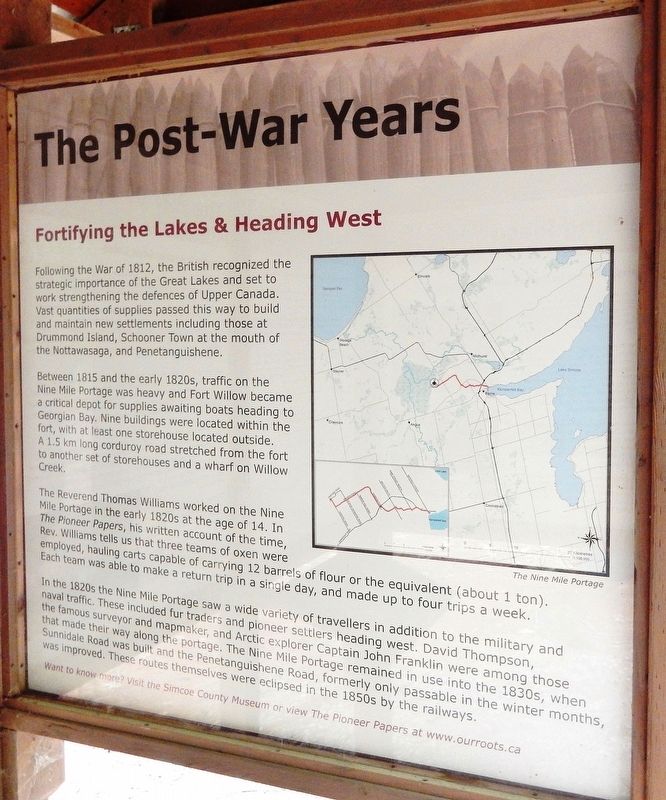
Following the War of 1812, the British recognized the strategic importance of the Great Lakes and set to work strengthening the defences of Upper Canada. Vast quantities of supplies passed this way to build and maintain new settlements including those at Drummond Island, Schooner Town at the mouth of the Nottawasaga, and Penetanguishene.
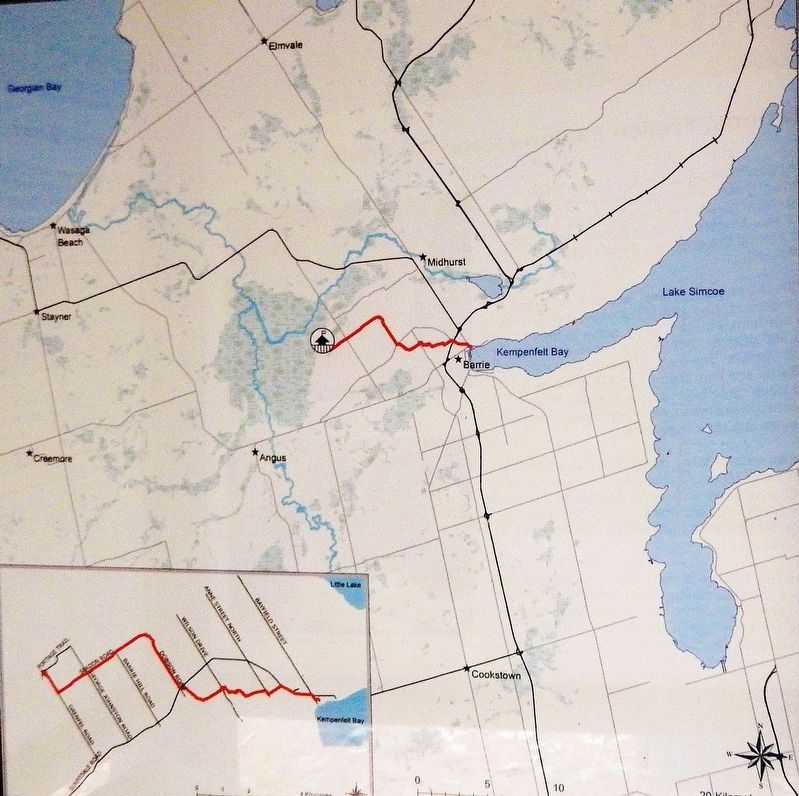
Between 1815 and the early 1820s, traffic on the Nine Mile Portage was heavy and Fort Willow became a critical depot for supplies awaiting boats heading to Georgian Bay. Nine buildings were located within the fort, with at least one storehouse located outside. A 1.5 km long corduroy road stretched from the fort to another set of storehouses and a wharf on Willow Creek.
The Reverend Thomas Williams worked on the Nine Mile Portage in the early 1820s at the age of 14. In The Pioneer Papers, his written account of the time, Rev. Williams tells us that three teams of oxen were employed, hauling carts capable of carrying 12 barrels of flour or the equivalent (about 1 ton). Each team was able to make a return trip in a single day, and made up to four trips a week.
In the 1820s the Nine Mile Portage
this page online
Topics. This historical marker is listed in these topic lists: Forts and Castles • Industry & Commerce • Roads & Vehicles • Settlements & Settlers. A significant historical year for this entry is 1815.
Location. 44° 23.701′ N, 79° 49.275′ W. Marker is in Minesing, Ontario, in Simcoe County. It can be reached from Grenfel Road 3.6 kilometers north of Sunnidale Road (County Road 40), on the left when traveling north. The marker is located on the Historic Fort Willow grounds at Fort Willow Conservation Area. Touch for map. Marker is at or near this postal address: 2714 Grenfel Road, Minesing ON L0L 1Y3,
2. Marker detail: The Nine Mile Portage

Regionally, this marker is in Central Ontario Cottage Country and specifically in Georgian Bay Country. It is also in Central Canada. Globally, it is in North America, on the Great Lakes, in the Western Hemisphere, in the Western World, and in the Anglosphere. Historically, it finds itself in what was once a British colony, the Viceroyalty of New France, the Haudenosaunee (Iroquois) Confederacy, and Rupert’s Land.
Other nearby markers. At least 8 other markers are within walking distance of this marker: The War of 1812 (here, next to this marker); a different marker also named The War of 1812 (here, next to this marker); Formed by Ice (here, next to this marker); A Meeting Place (here, next to this marker); Welcome to Fort Willow (here, next to this marker); The Royal Newfoundland Regiment (a few steps from this marker); Nine Mile Portage and Willow Depot / Portage Nine Mile et Dépôt Willow (a few steps from this marker); Willow Creek Depot (a few steps from this marker). Touch for a list and map of all markers in Minesing.
Related markers. Click here for a list of markers that are
Photographed by Cosmos Mariner, June 6, 2024
3. The Post War Years Marker
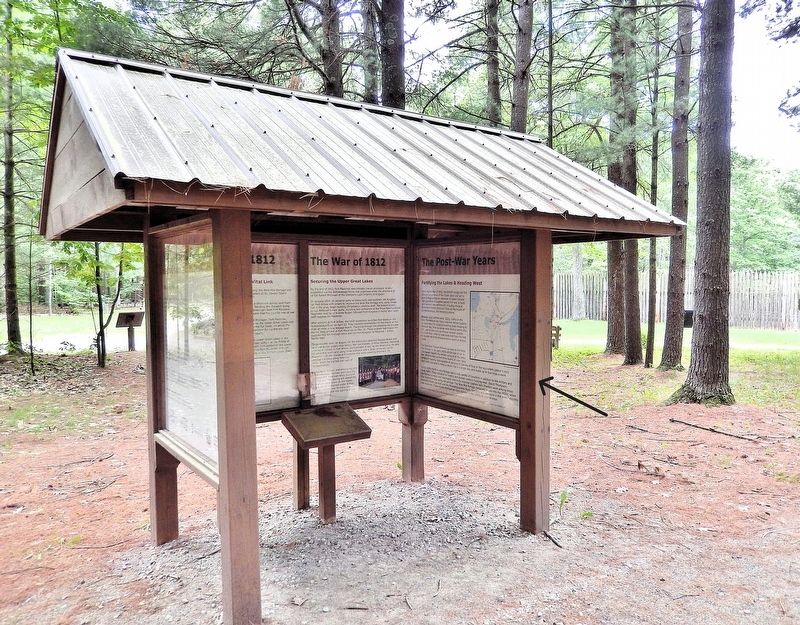
The marker is mounted on the interpretive kiosk near the Historic Fort William entrance. It is the rightmost panel in this photo.
Also see . . . Nine Mile Portage (Wikipedia).
Excerpt: The Nine Mile Portage connected Kempenfelt Bay of Lake Simcoe, Ontario, to Willow Creek, a tributary of the Nottawasaga River that flows to Wasaga Beach on Georgian Bay. In the early centuries of the colonial period, the Nine Mile Portage was a minor fur trade route. It was used by Étienne Brûlé and Alexander Henry, among others. Following the War of 1812, the portage was used by the Royal Navy and British Army until as late as the 1850s to transport supplies to the Penetanguishene Naval Yard.(Submitted on June 6, 2025, by Cosmos Mariner of Cape Canaveral, Florida.)
Credits. This page was last revised on June 7, 2025. It was originally submitted on June 5, 2025, by Cosmos Mariner of Cape Canaveral, Florida. This page has been viewed 101 times since then and 10 times this year. Photos: 1, 2, 3. submitted on June 6, 2025, by Cosmos Mariner of Cape Canaveral, Florida.
