Amsterdam in Montgomery County, New York — The American Northeast (Mid-Atlantic)
Dams and Waterfalls
The Chuctanunda Creek Trail
Photographed by Steve Stoessel, June 3, 2025
1. Dams and Waterfalls Marker
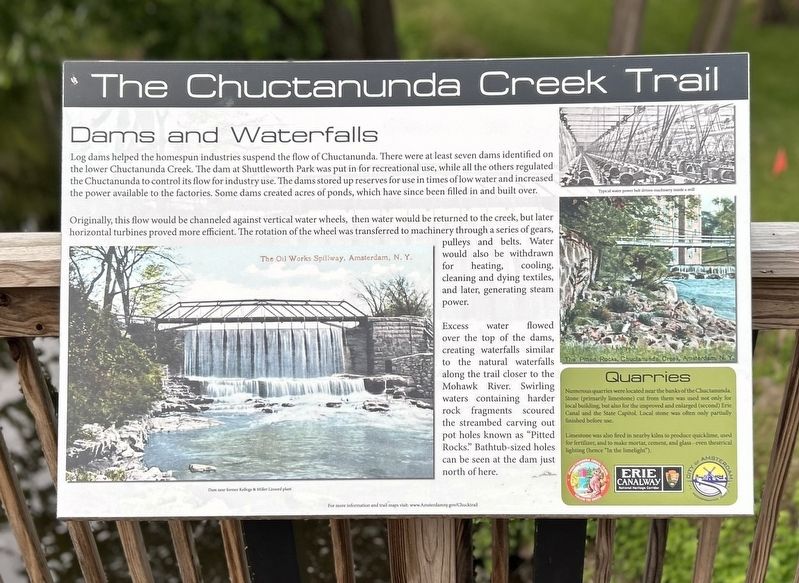
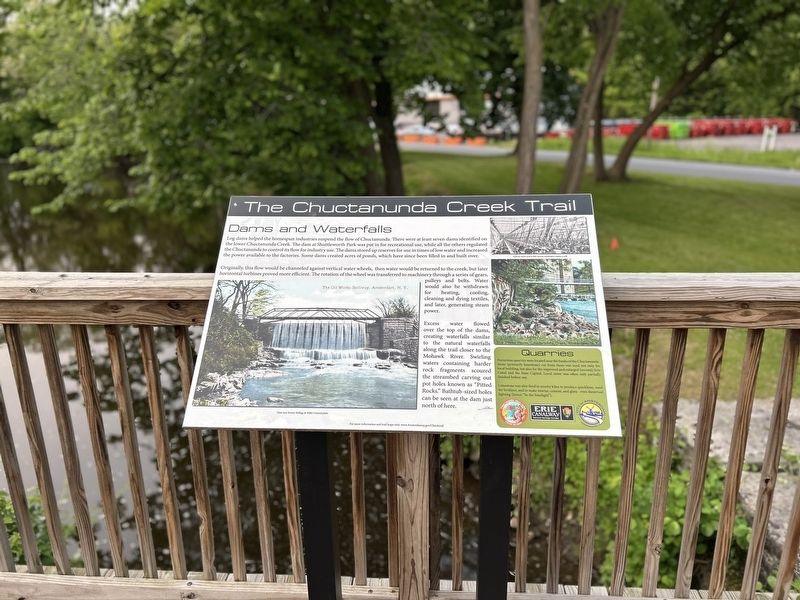
Log dams helped the homespun industries suspend the flow of Chuctanunda. There were at least seven dams identified on the lower Chuctanunda Creek. The dam at Shuttleworth Park was put in for recreational use, while all the others regulated the Chuctanunda to control its flow for industry use. The dams stored up reserves for use in times of low water and increased the power available to the factories. Some dams created acres of ponds, which have since been filled in and built over.
Originally, this flow would be channeled against vertical water wheels, then water would be returned to the creek, but later horizontal turbines proved more efficient. The rotation of the wheel was transferred to machinery through a series of gears, pulleys and belts. Water would also be withdrawn for heating, cooling, cleaning and dying textiles, and later, generating steam power.
Excess water flowed over the top of the dams, creating waterfalls similar to the natural waterfalls along the trail closer to the Mohawk River. Swirling waters containing harder rock fragments scoured the streambed carving out pot holes known as "Pitted Rocks." Bathtub-sized
this page online
[ Lower Inset ]
Quarries
Numerous quarries were located near the banks of the Chuctanunda. Stone (primarily limestone) cut from them was used not only for local building, but also for the improved and enlarged (second) Erie Canal and the State Capitol. Local stone was often only partially finished before use.
Limestone was also fired in nearby kilns to produce quicklime, used for fertilizer, and to make mortar, cement, and glass - even theatrical lighting (hence "In the limelight").
[ Photo Captions: ]
- Dam near former Kellogs & Miller Linseed plant
- The Pitted Rocks, Chuctanunda Creek, Amsterdam, N.Y.
- Typical water power belt driven machinery inside a mill.
Erected by City of Amsterdam, Erie Canalway.
Topics. This historical marker is listed in these topic lists: Industry & Commerce • Waterways & Vessels.
Location. 42° 56.504′ N, 74° 10.606′ W. Marker is in Amsterdam, New York, in Montgomery County. It can be reached from Forest Avenue 0.1 miles south of Second Avenue, on the right when traveling south.
Photographed by Steve Stoessel, June 3, 2025
2. Dams and Waterfalls Marker

Regionally, this marker is in Upstate New York and in the Mohawk Valley. It is also in the American Northeast and in the Mid-Atlantic. Globally, it is in North America, the Western Hemisphere, the Western World, and the Anglosphere. Historically, it finds itself in what was once the Haudenosaunee (Iroquois) Confederacy, New Netherland, and one of the original Thirteen Colonies.
Other nearby markers. At least 8 other markers are within walking distance of this marker: The AC&N Rail Road (approx. 0.4 miles away); Green Hill Cemetery (approx. 0.4 miles away); St. Stanislaus (approx. half a mile away); Sanford Mansion (approx. 0.6 miles away); Early Industry (approx. 0.7 miles away); Kirk Douglas (approx. ¾ mile away); "Mother Lake" (approx. ¾ mile away); Kirk Douglas Park (approx. ¾ mile away). Touch for a list and map of all markers in Amsterdam.
Photographed by Steve Stoessel, June 3, 2025
3. Dams and Waterfalls Marker

Photographed by Steve Stoessel, June 3, 2025
4. Dams and Waterfalls Marker
Credits. This page was last revised on June 9, 2025. It was originally submitted on June 5, 2025, by Steve Stoessel of Niskayuna, New York. This page has been viewed 145 times since then and 17 times this year. Photos: 1, 2, 3, 4. submitted on June 5, 2025, by Steve Stoessel of Niskayuna, New York.
