
Huron Sussex in Toronto, Ontario — Central Canada (North America)
“Stop Spadina Save Our City”

Photographed by Tim Boyd, June 1, 2025
1. “Stop Spadina Save Our City” Marker
For many people, the Spadina Expressway was necessary for Toronto to adapt to modern needs. For others, it promised only the destruction of homes and parks, more traffic congestion, and pollutants from automobile exhaust.
Citizen-led efforts against the expressway grew into the "Stop Spadina Save Our City Coordinating Committee" in 1969. This committee argued that the negative impact of the expressway and its soaring costs were not justified by a faster drive to and from downtown Toronto - itself a short-term gain because increasing traffic from suburban and urban growth would soon overwhelm and clog the expressway. The committee argued instead for better public transit.
The Stop Spadina committee could not convince Metropolitan Toronto Council to cancel the expressway, and then lost a legal challenge in 1970 to cut off funding for its completion. A final appeal to the Government of Ontario, however, was a stunning success. Amidst great controversy, Premier William Davis cancelled the Spadina Expressway on June 3, 1971.
Erected 2010 by Heritage Toronto.
Topics and series. This historical marker is listed
this page online
Location. 43° 39.998′ N, 79° 24.212′ W. Marker is in Toronto, Ontario. It is in Huron Sussex. It is at the intersection of Bloor Street West and Spadina Avenue, on the right when traveling east on Bloor Street West. Touch for map. Marker is at or near this postal address: 393 Bloor Street W, Toronto ON M5S 2J4, Canada. Touch for directions.

Regionally, this marker is in Greater Toronto and on the Golden Horseshoe. It is also in Central Canada. Globally, it is in North America, the Western Hemisphere, the Western World, and the Anglosphere. Historically, it finds itself in what was once a British colony, the Viceroyalty of New France, the Haudenosaunee (Iroquois) Confederacy, and Rupert’s Land.
Other nearby markers. At least 8 other markers are within walking distance of this marker: After the Spadina Expressway (here, next to this marker); Spadina Expressway (here, next to this marker); Young Men’s - Young Women’s Hebrew Association
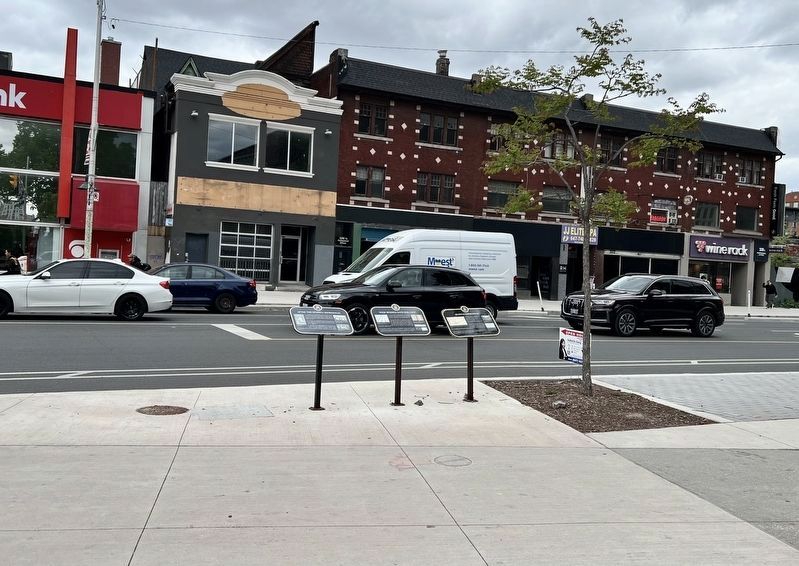
Photographed by Tim Boyd, June 1, 2025
2. “Stop Spadina Save Our City” Marker (the centre marker of the three)
Also see . . . Stop Spadina Save Our City Co-ordinating Committee (Connexions.org).
World famous University of Toronto philosopher and futurist Marshall McLuhan was a member of the Stop Spadina Save Our City Coordinating Committee. He argued that old notions of progress had to change if Toronto was to continue to be a livable city: “Toronto will commit suicide if it plunges the Spadina Expressway into its heart. In an age of software Metro planners treat people like hardware; they haven’t the faintest interest in the values of neighbourhood or community. Their failure to learn from the mistakes of American cities will be ours too.”(Submitted on June 6, 2025, by Tim Boyd of Hamilton, Ontario.)

Photographed by Tim Boyd, June 1, 2025
3. “Stop Spadina Save Our City” marker photo and captions and detail (left)

Photographed by Tim Boyd, June 1, 2025
4. “Stop Spadina Save Our City” marker photos and captions detail (right)
Credits. This page was last revised on June 7, 2025. It was originally submitted on June 6, 2025, by Tim Boyd of Hamilton, Ontario. This page has been viewed 522 times since then and 186 times this year. Photos: 1, 2, 3, 4. submitted on June 6, 2025, by Tim Boyd of Hamilton, Ontario. • Andrew Ruppenstein was the editor who published this page.
