Shanty Bay in Simcoe County, Ontario — Central Canada (North America)
The Ice Industry
Photographed by Cosmos Mariner, June 6, 2024
1. The Ice Industry Marker
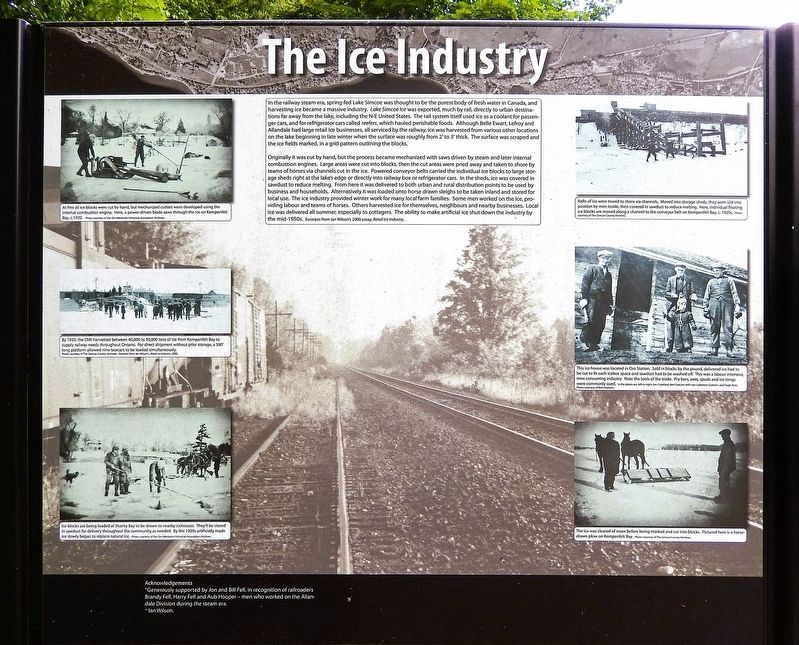
In the railway steam era, spring-fed Lake Simcoe was thought to be the purest body of fresh water in Canada, and harvesting ice became a massive industry. Lake Simcoe Ice was exported, much by rail, directly to urban destinations far away from the lake, including the N-E United States. The rail system itself used ice as a coolant for passenger cars, and for refrigerator cars called reefers, which hauled perishable foods. Although Belle Ewart, Lefroy and Allandale had large retail ice businesses, all serviced by the railway, ice was harvested from various other locations on the lake beginning in late winter when the surface was roughly from 2' to 3' thick. The surface was scraped and the ice fields marked, in a grid pattern outlining the blocks.
Originally it was cut by hand, but the process became mechanized with saws driven by steam and later internal combustion engines. Large areas were cut into blocks, then the cut areas were pried away and taken to shore by teams of horses via channels cut in the ice. Powered conveyor belts carried the individual ice blocks to large storage sheds right at the lake's edge or directly
this page online
[other photo captions]
• By 1920, the CNR harvested between 40,000 to 50,000 tons of ice from Kempenfelt Bay to supply railway needs throughout Ontario. For direct shipment without prior storage, a 360' long platform allowed nine boxcars to be loaded simultaneously.
• The ice was cleared of snow before being marked and cut into blocks. Pictured here is a horse-drawn plow on Kempenfelt Bay.
Acknowledgements
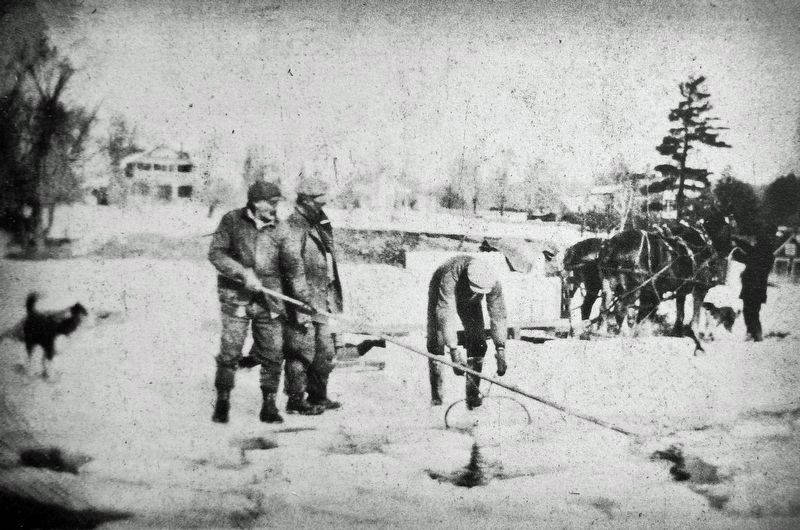
• Generously supported by Jon andBill Fell, in recognition of railroaders Brandy Fell, Harry Fell and Aub Hooper — men who worked on the Allandale Division during the steam era.Oro-Medonte Historical Association Archives2. Marker detail: Power-driven blade saws through the ice on Kempenfelt Bay, circa 1920At first all ice blocks were cut by hand, but mechanized cutters were developed using the internal combustion engine.
• Ian Wilson

Topics. This historical marker is listed in these topic lists: Industry & Commerce • Railroads & Streetcars • Waterways & Vessels.
Location. 44° 23.936′ N, 79° 37.376′ W. Marker is in Shanty Bay, Ontario, in Simcoe County. It is on Line 1 South 0.9 kilometers east of Ridge Road West (County Road 20), on the right when traveling east. The marker is located on the Oro-Medonte Rail Trail, near the Shanty Bay Parking Area. Touch for map. Marker is at or near this postal address: 1377 Line 1 South, Shanty Bay ON L0L 2L0, Canada. Touch for directions.

Regionally, this marker is in Central Ontario Cottage Country and specifically in Georgian Bay Country. It is also in Central Canada. Globally, it is in North America, on the Great Lakes, in the Western Hemisphere, in the Western World, and in the Anglosphere. Historically, it finds itself in what was once a British colony, the Viceroyalty of New France, the
Oro-Medonte Historical Association Archives
3. Marker detail: Ice blocks are being loaded at Shanty Bay to be drawn to nearby icehouses
They'll be stored in sawdust for delivery throughout the community as needed. By the 1930s artificially made ice slowly began to replace natural ice.
Other nearby markers. At least 8 other markers are within 6 kilometers of this marker, measured as the crow flies: Early Settlement (here, next to this marker); Black Settlement in Oro Township / La Colonie Noire du Canton d'Oro (here, next to this marker); Site of the Village of Kempenfelt (approx. 2.2 kilometers away); The Lost Village of Kempenfelt (approx. 2.3 kilometers away); St. Thomas' Church 1838 (approx. 3.5 kilometers away); Hon. Ernest Charles Drury (approx. 4.9 kilometers away); Warming Up the Land (approx. 5 kilometers away); Andrew Frederick Hunter (approx. 5 kilometers away). Touch for a list and map of all markers in Shanty Bay.
Also see . . . The retail ice industry near Barrie, Ontario, from the 1800s to the 1950s.
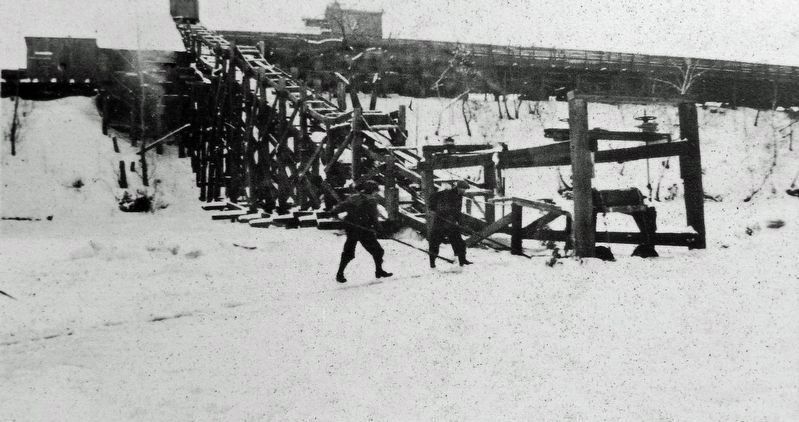
(by Ian Wilson) Excerpt: This industry was a fixture in the day-to-day lives of people, not to mention railway and truck operations, during the latter part of the 19th century and the first half of the 20th century. Lake Simcoe Ice & Fuel boasted 18 separate rooms in its ice house, each 100 feet deep by 30 feet wide by(Submitted on June 8, 2025, by Cosmos Mariner of Cape Canaveral, Florida.)30 feet high. Belle Ewart had twelve to fourteen ice house compartments, each 150 feet deep by 30 feet wide by 30 feet high. Armies of men and horses invaded the lakeshore in late winter, when the ice reached a minimum depth of 12 inches.Simcoe County Archives4. Marker detail: Individual floating ice blocks are moved along a channel to conveyer belt, c. 1920sRafts of ice were towed to shore via channels. Moved into storage sheds, they were slid into position by men inside, then covered in sawdust to reduce melting.
Toronto and many other large Canadian and American cities depended upon hundreds of carloads of the pure, natural ice. While some ice went directly to city markets by rail, the bulk of the harvest was packed into the massive storage houses. When the ice houses were full, the community erupted in a spontaneous celebration. Over the next year, boxcars of ice, loaded as many as eight at a time, were shipped out.
Courtesy Bert Graham
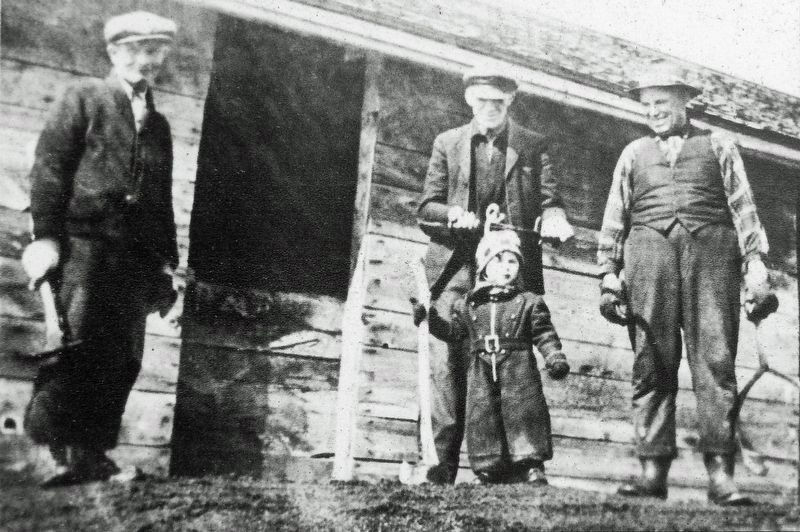
5. Marker detail: This ice house was located in Oro Station
Sold in blocks by the pound, delivered ice had to be cut to fit each icebox space and sawdust had to be washed off. This was a labour intensive, time consuming industry. Note the tools of the trade. Pry bars, axes, spuds and ice tongs were commonly used. In the photo are, left to right: Jim Crawford, Bert Graham with son Lawrence Graham, and Hugh Ross.

Photographed by Cosmos Mariner, June 6, 2024
6. The Ice Industry Marker
Looking west along the Oro-Medonte Rail Trail. The Shanty Bay Parking Area is in the right background.
Credits. This page was last revised on June 8, 2025. It was originally submitted on June 7, 2025, by Cosmos Mariner of Cape Canaveral, Florida. This page has been viewed 161 times since then and 37 times this year. Photos: 1, 2. submitted on June 7, 2025, by Cosmos Mariner of Cape Canaveral, Florida. 3, 4, 5. submitted on June 8, 2025, by Cosmos Mariner of Cape Canaveral, Florida. 6. submitted on June 7, 2025, by Cosmos Mariner of Cape Canaveral, Florida.
