Barrie in Simcoe County, Ontario — Central Canada (North America)
Juno Beach
1944
| — | Barrie Waterfront Heritage Trail | — |
Photographed by Cosmos Mariner, June 5, 2024
1. Juno Beach Marker
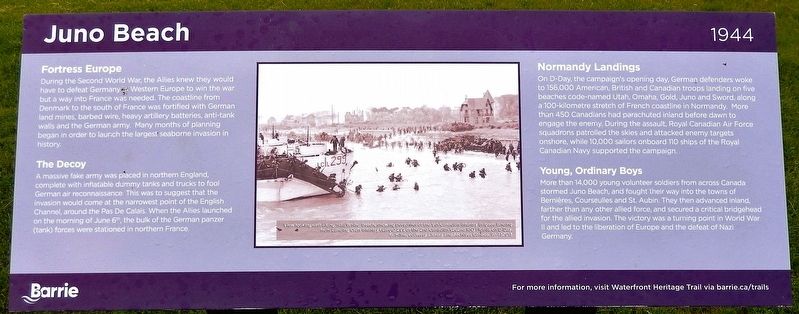
Fortress Europe
During the Second World War, the Allies knew they would have to defeat Germany in Western Europe to win the war but a way into France was needed. The coastline from Denmark to the south of France was fortified with German land mines, barbed wire, heavy artillery batteries, anti-tank walls and the German army. Many months of planning began in order to launch the largest seaborne invasion in history.
The Decoy
A massive fake army was placed in northern England, complete with inflatable dummy tanks and trucks to fool German air reconnaissance. This was to suggest that the invasion would come at the narrowest point of the English Channel, around the Pas De Calais. When the Allies launched on the morning of June 6th, the bulk of the German panzer (tank) forces were stationed in northern France.
Normandy Landings
On D-Day, the campaign's opening day, German defenders woke to 156,000 American, British and Canadian troops landing on five beaches code-named Utah, Omaha, Gold, Juno and Sword, along a 100-kilometre stretch of French coastline in Normandy. More than 450 Canadians had parachuted inland before dawn to engage
this page online
Young, Ordinary Boys
More than 14,000 young volunteer soldiers from across Canada stormed Juno Beach, and fought their way into the towns of Bernières, Courseulles and St. Aubin. They then advanced inland, farther than any other allied force, and secured a critical bridgehead for the allied invasion. The victory was a turning point in World War II and led to the liberation of Europe and the defeat of Nazi Germany.
Erected by Barrie Waterfront Heritage Trail.
Topics. This historical marker is listed in these topic lists: Air & Space • War, World II • Waterways & Vessels. A significant historical date for this entry is June 6, 1944.
Location. 44° 22.456′ N, 79° 40.759′ W. Marker is in Barrie, Ontario, in Simcoe County. It can be reached from Lakeshore Drive 0.9 kilometers west of Minet's Point Road, on the right when traveling west. The marker is on the Barrie Waterfront Heritage Trail, in Military Heritage Park. Touch for map.
G. Milne, Library and Archives Canada, PA-137013
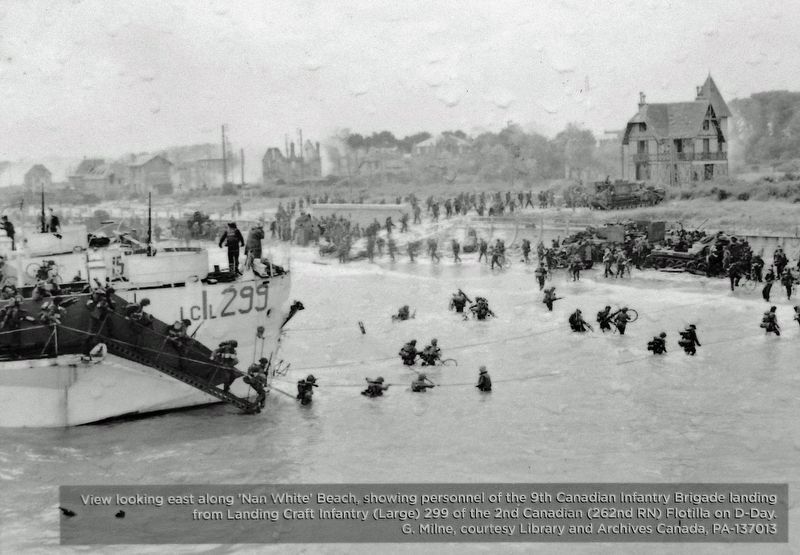
2. Marker detail: View looking east along ‘Nan White’ Beach on D-Day
Showing personnel of the 9th Canadian Infantry Brigade landing from Landing Craft Infantry (Large) 299 of the 2nd Canadian (262nd RN) Flotilla on D-Day.

Regionally, this marker is in Central Ontario Cottage Country and specifically in Georgian Bay Country. It is also in Central Canada. Globally, it is in North America, on the Great Lakes, in the Western Hemisphere, in the Western World, and in the Anglosphere. Historically, it finds itself in what was once a British colony, the Viceroyalty of New France, the Haudenosaunee (Iroquois) Confederacy, and Rupert’s Land.
Other nearby markers. At least 8 other markers are within walking distance of this marker: Dieppe (here, next to this marker); HMCS Barrie (here, next to this marker); Merchant Navy (here, next to this marker); Francis Pegahmagabow (within shouting distance of this marker); Tulips (within shouting distance of this marker); Military Heritage Park (within shouting distance of this marker); Barrie's Military Heritage Park (within shouting distance of this marker); Vimy Oaks (within shouting distance of this marker). Touch for a list and map of all markers in Barrie.
Related markers. Click
Photographed by Cosmos Mariner, June 5, 2024
3. Juno Beach Marker
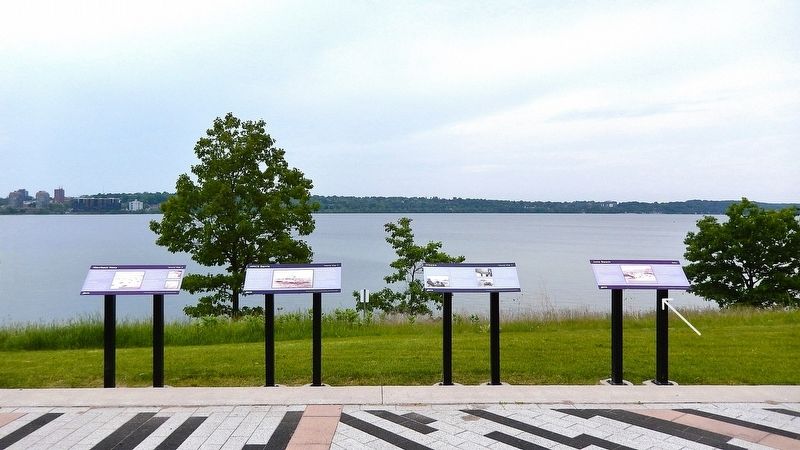
Looking north from Military Heritage Park across Kempenfelt Bay, Lake Simcoe. This is the rightmost of four related markers at this location.
Also see . . . Juno Beach (Wikipedia).
Excerpt: The beach spanned from Courseulles, a village just east of the British beach Gold, to Saint-Aubin-sur-Mer, and just west of the British beach Sword. Taking Juno was the responsibility of the First Canadian Army, with sea transport, mine sweeping, and a naval bombardment force provided by the Royal Canadian Navy and the British Royal Navy as well as elements from the Free French, Norwegian, and other Allied navies. The objectives of the 3rd Canadian Infantry Division on D-Day were to cut the Caen-Bayeux road, seize the Carpiquet airport west of Caen, and form a link between the two British beaches on either flank.(Submitted on June 10, 2025, by Cosmos Mariner of Cape Canaveral, Florida.)
Credits. This page was last revised on June 21, 2025. It was originally submitted on June 8, 2025, by Cosmos Mariner of Cape Canaveral, Florida. This page has been viewed 117 times since then and 11 times this year. Photos: 1, 2, 3. submitted on June 10, 2025, by Cosmos Mariner of Cape Canaveral, Florida.
