Bremen-Mitte in Mitte, Germany — Central Europe
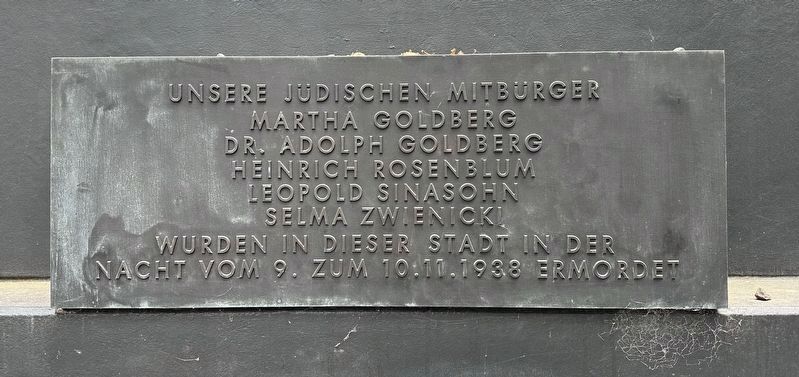
Bremen Kristalnacht Victims Memorial
Mahnmal für die Opfer der Novemberpogrome 1938
Photographed by Andrew Ruppenstein, May 18, 2025
1. Bremen Kristalnacht Victims Memorial

Martha Goldberg
Dr. Adolph Goldberg
Heinrich Rosenblum
Leopold Sinasohn
Selma Zwienicki
wurden in dieser Stadt in der Nacht vom 9. zum 10.11.1938 ermordet
Topics and series. This memorial is listed in this topic list: Notable Events. In addition, it is included in the The Holocaust series list. A significant historical year for this entry is 1938.
Location. 53° 4.438′ N, 8° 48.55′ E. Memorial is in Bremen, in Mitte. It is in Bremen-Mitte. It is at the intersection of Dechanatstraße and Am Lanherrnamt, on the right when traveling east on Dechanatstraße. Touch for map. Memorial is at or near this postal address: Dechanatstraße 9, Bremen 28195, Germany. Touch for directions.

Regionally, it is in Europe, the European Union, Atlantic Europe, Central Europe, the Schengen Area, Western Europe, and the Western World. Historically, it finds itself in what was once the Holy Roman Empire.
Other nearby markers. At
this page online
Also see . . . Jüdische Bevölkerung in Bremen (Spurensuche Bremen). Excerpt (in translation):
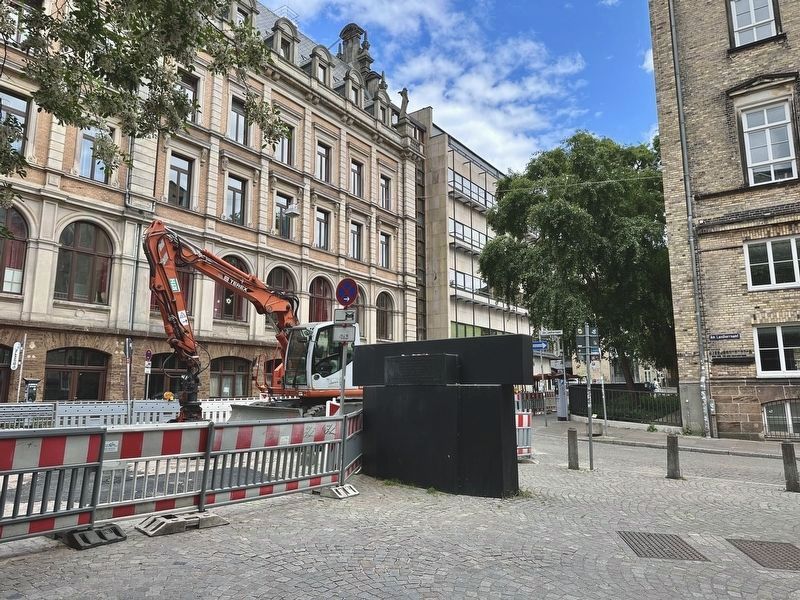
The main synagogue was located at Gartenstraße 6 (today Kolpingstraße). Another, smaller synagogue, with a capacity of around 100, was located in the Aumund district. The community also had its own burial ground, the Jewish cemetery on Deichbruchstraße in(Submitted on June 9, 2025.)Hastedt. According to the 1933 census, the Jewish community had 1,314 members; by 1939, this number had fallen to just 684.Photographed by Andrew Ruppenstein, May 18, 20252. Bremen Kristalnacht Victims Memorial - wide viewThe lack of contrast makes it difficult to see here, but the plaque with text is attached to the black monument.
As in the entire German Reich, Jews were discriminated against and persecuted here as well. Just a few weeks after the Nazi Party seized power, open hostilities erupted, culminating on April 1, 1933, in a boycott of Jewish businesses organized and supervised by the SA. During the Kristallnacht (Pogrom Night) on November 9/10, 1938, five people were murdered, businesses were demolished and looted, and both synagogues and the cemetery chapel were burned down. 178 men were sent to the Sachsenhausen concentration camp. Deportations began in 1941, with deportations to the Minsk ghetto on November 18, 1941, and to the Theresienstadt ghetto on July 23, 1942, and February 14, 1945. A total of 3,733 people are listed in a memorial book who were persecuted as members of the Jewish faith or as Jews according to the criteria of Nazi racial legislation. Of these, 765 men and women were murdered in the camps. 1,034 people were able to emigrate in time.
Credits. This page was last revised on June 9, 2025. It was originally submitted on June 8, 2025, by Andrew Ruppenstein of Lamorinda, California. This page has been viewed 113 times since then and 21 times this year. Photos: 1, 2. submitted on June 8, 2025, by Andrew Ruppenstein of Lamorinda, California.
