Jackson in Amador County, California — The American West (Pacific Coastal)
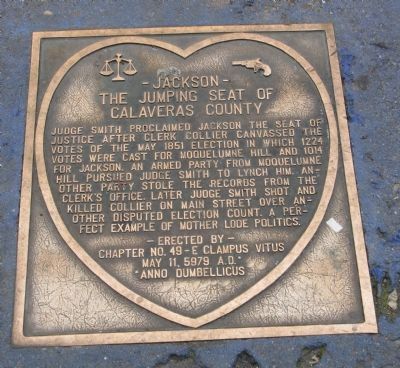
- Jackson -
The Jumping Seat of Calaveras County
Photographed by Syd Whittle, February 13, 2010
1. - Jackson - The Jumping Seat of Calaveras County Marker
Chapter No.49 – E Clampus Vitus
May 11, 5979 A.D.
Anno Dumbellicus
Erected 1974 by E Clampus Vitus, Chapter 49.
Topics and series. This historical marker is listed in these topic lists: Government & Politics • Notable Events. In addition, it is included in the E Clampus Vitus series list. A significant historical month for this entry is May 1851.
Location. 38° 20.937′ N, 120° 46.456′ W. Marker is in Jackson, California, in Amador County. It can be reached from Main Street near Court Street, on the right when traveling south. Touch for map. Marker is at or near this postal address: 105 Main Street, Jackson CA 95642, United States of America. Touch for directions.

Regionally,
this page online
Other nearby markers. At least 8 other markers are within walking distance of this marker: Brumel's Building (here, next to this marker); Levy & Co. (a few steps from this marker); Pioneer Hall (a few steps from this marker); Steckler's Building (a few steps from this marker); Weller Hardware, Pioneer Hall (a few steps from this marker); Stampfly's Tent, Republic House (a few steps from this marker); S. Harris Clothing Store (within shouting distance of this marker); U.S. Bakery, Early Amador Dispatch (within shouting distance of this marker). Touch for a list and map of all markers in Jackson.
More about this marker. The marker is embedded in the sidewalk on the west side of Main Street.
Note the difference in spelling of Mokelumne between this article (the current spelling) and the spelling on the

Photographed by Syd Whittle, February 13, 2010
2. - Jackson - The Jumping County Seat of Calaveras County
From the Jackson Walking Tour Brochure:
"Proceedings of the Calaveras County Court of Sessions or supervisors were held near here in the then French Hotel. Jackson was county seat of Calaveras County briefly from July 1851 until about May, 1852 before Mokelumne Hill claimed the prize."
"Proceedings of the Calaveras County Court of Sessions or supervisors were held near here in the then French Hotel. Jackson was county seat of Calaveras County briefly from July 1851 until about May, 1852 before Mokelumne Hill claimed the prize."
Regarding - Jackson -. In 1854 Amador County was carved out of parts of El Dorado and Calaveras Counties and Jackson became the official county seat of Amador County.
Additional commentary.
1. The Theft of the County Seat
When Calaveras County was organized the town of Double Springs was named as the county seat. This town had but one house which served as the courthouse, saloon, hotel and general store. The people of Jackson felt that their town would make a better location for the county seat as the town was larger with the existence of a few more houses – less than a dozen. At the same time Mokelumne Hill, an even much larger town was also attemping to gain the title of county seat.
An election was held and Mokelumne Hill received the most votes. This did not sit well with the citizens of Jackson, as the votes for Mokelumne Hill numbered more than the population. A group from Jackson, headed by Charles Boynton and Theodore Mudge, paid a visit to the saloon in Double Springs and bought drinks for everyone. Colonel Collier, the Clerk of the Court, was known as “a rather pompous, portly
Photographed by Syd Whittle
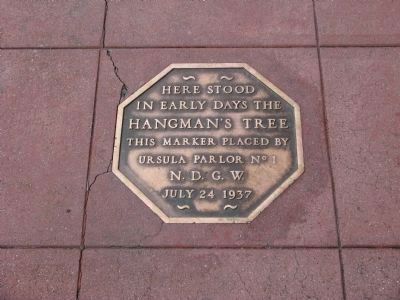
3. Hangman's Tree Marker
This marks the location of the "Hangman's Tree" near the site of the Colonel Collier shooting.
Click for more information.
Click for more information.
A shanty had been prepared at the foot of Court Street in Jackson to house the records of Calaveras County. Judge Smith, the County Judge, was on hand to administer justice. It is said that Judge Smith was part of the conspiracy to move the county seat.
Soon afterwards an election was held to name new county officers. Joe Douglass, a candidate running against Colonel Collier, received the larger number of votes. Colonel Collier locked up the ballets in his desk, in order to hold his position until Douglass was qualified and that the official counting of the votes was certified by his signature. Judge Smith broke into Collier’s office and stole the ballets, counted the returns and issued the certificates to the new office holders – Douglass being one.
This incident continued the feud between Smith and Collier which was finally ended when Judge Smith shot and killed Collier near the site of the “hanging tree” in Jackson. Judge Smith was never tried for this incident, but public indignation was so strong that he was forced to resign.
— Submitted February 17, 2010.
Credits. This page was last revised on June 24, 2024. It was originally submitted on February 14, 2010, by Syd Whittle of Mesa, Arizona. This page has been viewed 1,882 times since then and 47 times this year. Photos: 1, 2. submitted on February 14, 2010, by Syd Whittle of Mesa, Arizona. 3. submitted on February 23, 2010, by Syd Whittle of Mesa, Arizona.
