Port Hope in Northumberland County, Ontario — Central Canada (North America)
The Great Farini
Photographed by Tim Boyd, June 7, 2025
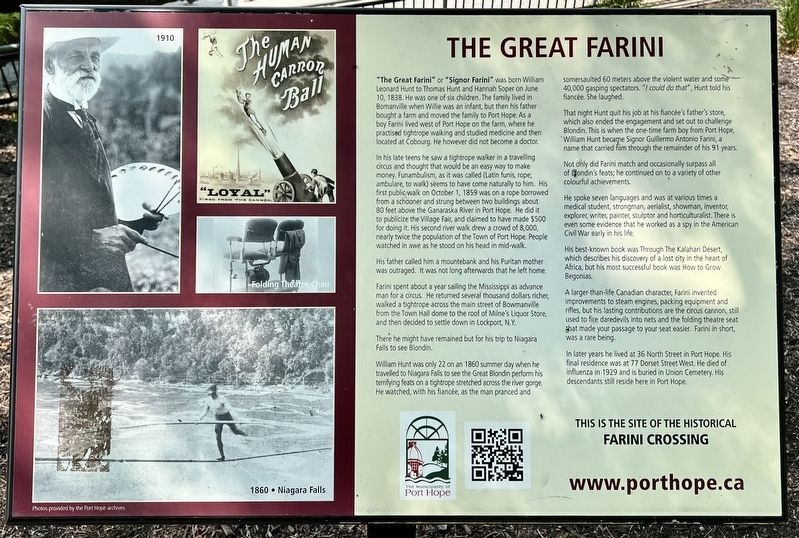
1. The Great Farini Marker
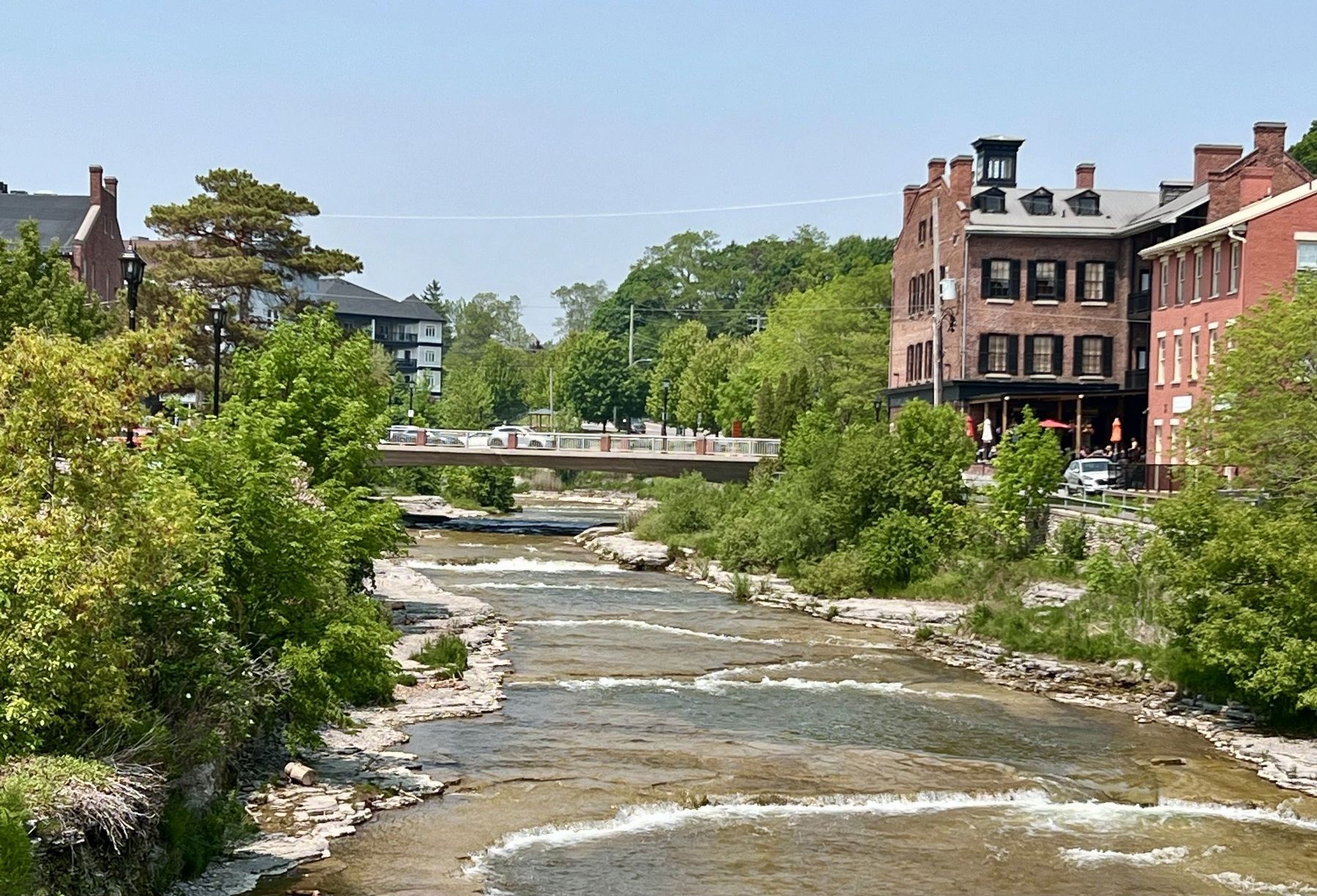
In his late teens he saw a tightrope walker in a travelling circus and thought that would be an easy way to make money. Funambulism, as it was called (Latin funis, rope; ambulare, to walk) seems to have come naturally to him. His first public walk on October 1, 1859 was on a rope borrowed from a schooner and strung between two buildings about 80 feet above the Ganaraska River in Port Hope. He did it to publicize the Village Fair, and claimed to have made $500 for doing it. His second river walk drew a crowd of 8,000, nearly twice the population of the Town of Port Hope. People watched in awe as he stood on his head in mid-walk.
His father called him a mountebank and his Puritan
this page online
Farini spent about a year sailing the Mississippi as advance man for a circus. He returned several thousand dollars richer, walked a tightrope across the main street of Bowmanville from the Town Hall dome to the roof of Milne's Liquor Store, and then decided to settle down in Lockport, N.Y.
There he might have remained but for his trip to Niagara Falls to see Blondin. William Hunt was only 22 on an 1860 summer day when he travelled to Niagara Falls to see the Great Blondin perform his terrifying feats on a tightrope stretched across the river gorge. He watched, with his fiancée, as the man pranced and somersaulted 60 meters above the violent water and some 40,000 gasping spectators. "I could do that", Hunt told his fiancée. She laughed.
That night Hunt quit his job at his fiancée's father's store, which also ended the engagement and set out to challenge Blondin. This is when the one-time farm boy from Port Hope, William Hunt became Signor Guillermo Antonio Farini, a name that carried him through the remainder of his 91 years.
Not only did Farini match and
Photographed by Tim Boyd, June 7, 2025
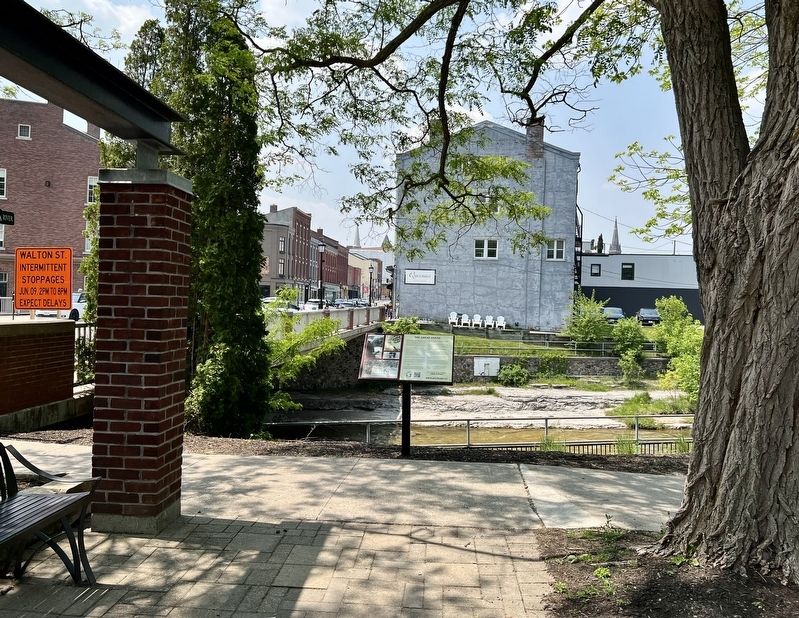
2. The Great Farini Marker
He spoke seven languages and was at various times a medical student, strongman, aerialist, showman, inventor, explorer, writer, painter, sculptor and horticulturalist. There is even some evidence that he worked as a spy in the American Civil War early in his life.
His best-known book was Through The Kalahari Desert, which describes his discovery of a lost city in the heart of Africa, but his most successful book was How to Grow Begonias.
A larger-than-life Canadian character, Farini invented improvements to steam engines, packing equipment and rifles, but his lasting contributions are the circus cannon, still used to fire daredevils into nets and the folding theatre seat that made your passage to your seat easier. Farini in short, was a rare being.
In later years he lived at 36 North Street in Port Hope. His final residence was at 77 Dorset Street West. He died of influenza in 1929 and is buried in Union Cemetery. His descendants still reside here in Port Hope.
Erected by The Municipality of Port Hope.
Topics.
Photographed by Tim Boyd, June 7, 2025
3. The Ganaraska River in Port Hope looking towards the site of Farini’s first tight-rope walk
Location. 43° 57.064′ N, 78° 17.52′ W. Marker is in Port Hope, Ontario, in Northumberland County. It is at the intersection of Walton Street and Mill Street North, on the right when traveling west on Walton Street. Touch for map. Marker is at or near this postal address: 2 Walton Street, Port Hope ON L1A 1M8, Canada. Touch for directions.

Regionally, this marker is in the Kawarthas Northumberland Area and in Eastern Ontario. It is also in Central Canada. Globally, it is in North America, on the Great Lakes, in the Western Hemisphere, in the Western World, and in the Anglosphere. Historically, it finds itself in what was once a British colony, the Viceroyalty of New France, the Haudenosaunee (Iroquois) Confederacy, and Rupert’s Land.
Other nearby markers. At least 8 other markers are within walking distance of this marker: Port Hope Early Settlement (here, next to this marker); Aboriginal Settlement (here, next to this marker); Signor Farini (William Leonard Hunt) 1838-1929 (here, next to this marker); Port Hope Capitol Theatre / Le Théâtre Capitol de Port Hope (about 90 meters away, measured in a direct line); Farley Mowat (about 150 meters away); St. Mark’s Church 1822 (about 150 meters away); Myndert Harris 1748-1823 (about 150 meters away); History of the Ganaraska Watershed (about 150 meters away). Touch for a list and map of all markers in Port Hope.
Credits. This page was last revised on June 10, 2025. It was originally submitted on June 10, 2025, by Tim Boyd of Hamilton, Ontario. This page has been viewed 169 times since then and 35 times this year. Photos: 1, 2, 3. submitted on June 10, 2025, by Tim Boyd of Hamilton, Ontario. • Andrew Ruppenstein was the editor who published this page.
