
Central Business District in New Orleans in Orleans Parish, Louisiana — The American South (West South Central)
Louis André Martinet
⎯⎯⎯
Office of L.A. Martinet, The Crusader & Comité Des Citoyens
Photographed by Brian Martinet
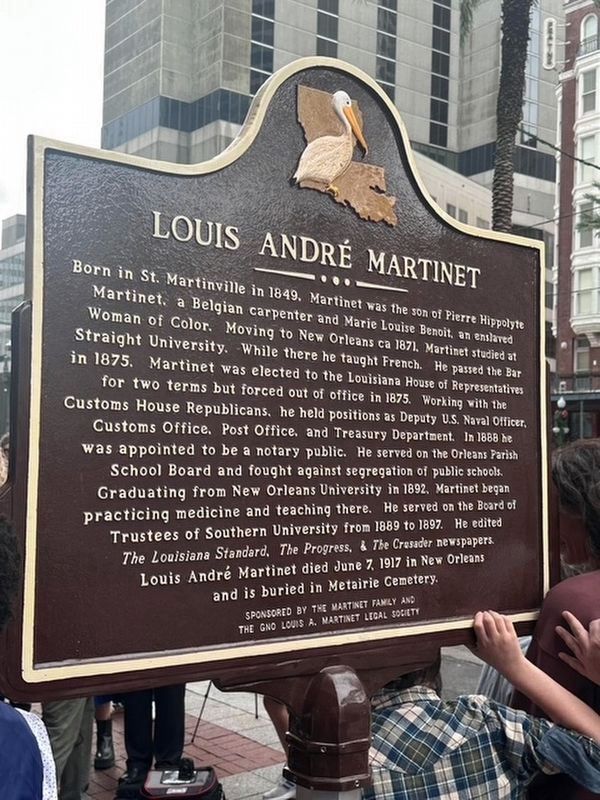
1. Louis André Martinet Marker - Front Side
Louis André Martinet
Born in St. Martinville in 1849. Martinet was the son of Pierre Hippolyte Martinet, a Belgian carpenter and Marie Louise Benoit, an enslaved Woman of Color. Moving to New Orleans ca 1871. Martinet studied at Straight University. While there he taught French. He passed the Bar in 1875. Martinet was elected to the Louisiana House of Representatives for two terms but forced out of office in 1875. Working with the Customs House Republicans, he held positions as Deputy U.S. Naval Officer, Customs Office, Post Office, and Treasury Department. In 1888 he was appointed to be a notary public. He served on the Orleans Parish School Board and fought against segregation of public schools. Graduating from New Orleans University in 1892. Martinet began practicing medicine and teaching there. He served on the Board of Trustees of Southern University from 1889 to 1897. He edited The Louisiana Standard, The Progress, & The Crusader newspapers. Louis André Martinet died June 7, 1917 in New Orleans and is buried in Metairie Cemetery.
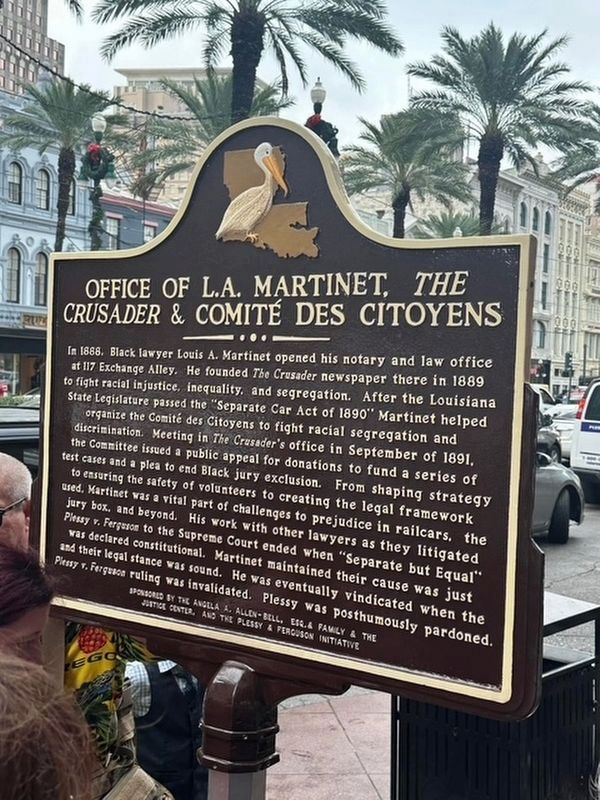
Office of L.A. Martinet, The Crusader & Comité Des Citoyens
In
this page online
Erected 2024.
Photographed by Brian Martinet
2. Louis André Martinet Marker - Reverse Side
Topics. This historical marker is listed in these topic lists: African Americans • Civil Rights • Industry & Commerce. A significant historical date for this entry is June 7, 1917.
Location. 29° 57.181′ N, 90° 4.109′ W. Marker is in New Orleans, Louisiana, in Orleans Parish. It is in the Central Business District. It is at the intersection of Canal Street and Exchange Pl., on the right when traveling west on Canal Street. The marker is located at Canal and Exchange. Touch for map. Marker is at or near this postal address: 619 Canal St, New Orleans LA 70130, United States of America. Touch for directions.

Regionally, this marker is in one of Louisiana’s River Parishes. It is also in the American South, specifically in the Deep South, on the Gulf Coast, and in the Great River Road Region. Globally, it is in North America, a Gulf of Mexico state, the Western Hemisphere, the Western World, and the Anglosphere. Historically, it finds itself in what was once New Spain, the Viceroyalty of New France, the territory of the Mississippian Culture, the Louisiana Purchase, one of the Confederate States of America, and the
Photographed by Jeff Leichsenring, July 11, 2025
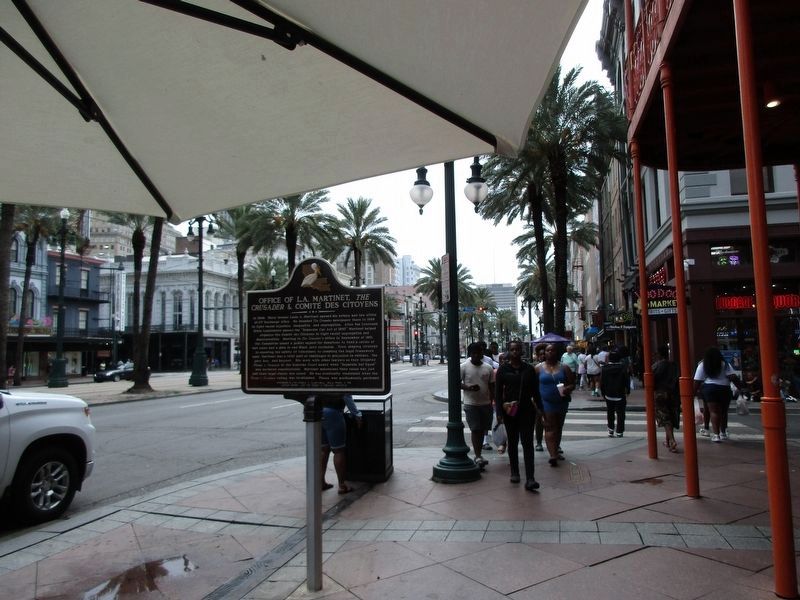
3. Louis André Martinet / Office of L.A. Martinet, The Crusader & Comité Des Citoyens Marker
Other nearby markers. At least 8 other markers are within walking distance of this marker: America's First Movie Theater / Vitascope Hall (a few steps from this marker); Merchants Mutual Insurance Company Building (within shouting distance of this marker); The Birthplace of “Dixie” (about 300 feet away, measured in a direct line); UpStairs Lounge Memorial (about 400 feet away); Jefferson Highway (about 500 feet away); Canal Street Under French and Spanish Rule (1718-1803) (about 600 feet away); Conway’s Court (about 700 feet away); 127-129 Carondelet Street (about 700 feet away). Touch for a list and map of all markers in New Orleans.
Credits. This page was last revised on July 17, 2025. It was originally submitted on June 10, 2025, by Brian Martinet of Bellingham, Washington. This page has been viewed 1,880 times since then and 138 times this year. Photos: 1, 2. submitted on June 10, 2025, by Brian Martinet of Bellingham, Washington. 3. submitted on July 14, 2025, by Jeff Leichsenring of Garland, Texas. • James Hulse was the editor who published this page.
