Boggs Township near Holters Crossing in Centre County, Pennsylvania — The American Northeast (Mid-Atlantic)
Workers Village
Established 1825 • Enlarged Beginning 1848
Photographed by William Fischer, Jr., June 10, 2025
1. Workers Village Marker
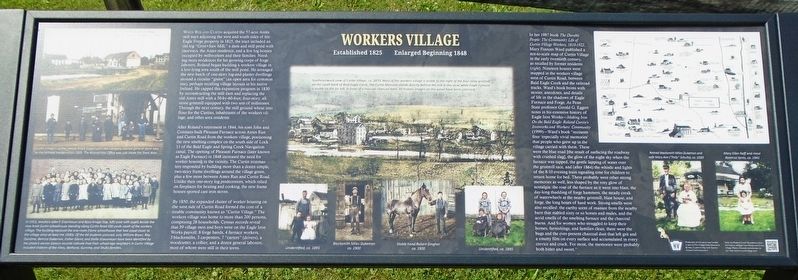
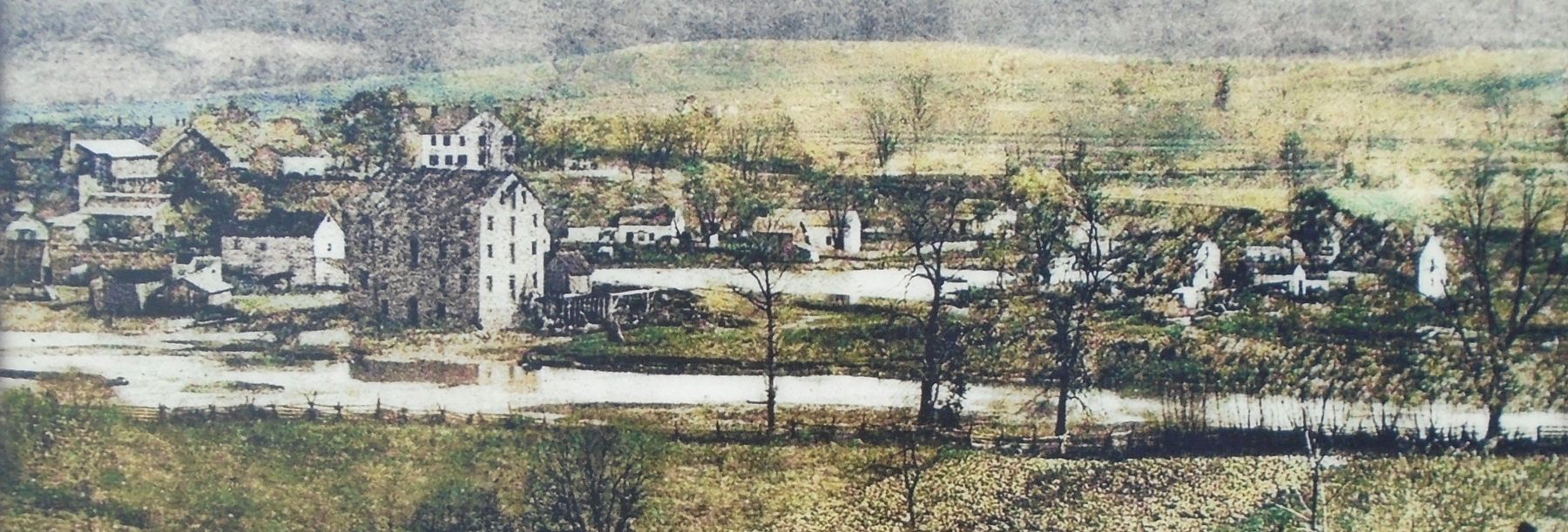
When Roland Curtin acquired the 57-acre Antes mill tract adjoining the west and south sides of his Eagle Forge property in 1825, the tract included an old log "Grist+Saw Mill," a dam and mill pond with raceways, the Antes residence, and a few log houses occupied by millworkers and their families. Needing more residences for his growing corps of forge laborers, Roland began building a workers village in a low-lying area south of the mill pond. He arranged the new batch of one-story log-and-plaster dwellings around a circular "green" (an open area for common use), perhaps recalling village layouts in his native Ireland. He capped this expansion program in 1830 by reconstructing the mill dam and replacing the old Antes mill with a 50-by-60-foot, four-story, all-stone gristmill equipped with two sets of millstones. Through the next century, the mill ground wheat into flour for the Curtins, inhabitants of the workers village, and other area residents.
After Roland's retirement in 1844, his sons John and Constans built Pleasant Furnace across Antes Run and Curtin Road from the workers village, positioning the new smelting
this page online
By 1850, the expanded cluster of worker housing on the west side of Curtin Road formed the core of a sizable community known as "Curtin Village." The workers village was home to more than 200 persons, comprising 28 households. Census records reveal that 39 village men and boys were on the Eagle Iron Works payroll: 8 forge hands, 4 furnace workers, 3 blacksmiths, 3 carpenters, 7 "carters" (drivers), a woodcutter, a collier, and a dozen general laborers, most of whom were still in their teens.
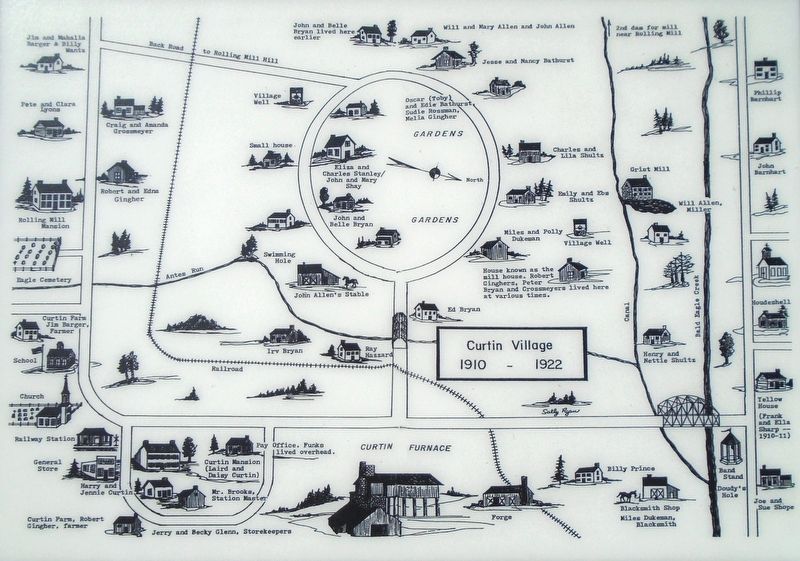
In her 1987 book The Durable People: The Community Life of Curtin Village Workers, 1810-1922, Mary Frances Ward published
Photographed by William Fischer, Jr., June 10, 2025
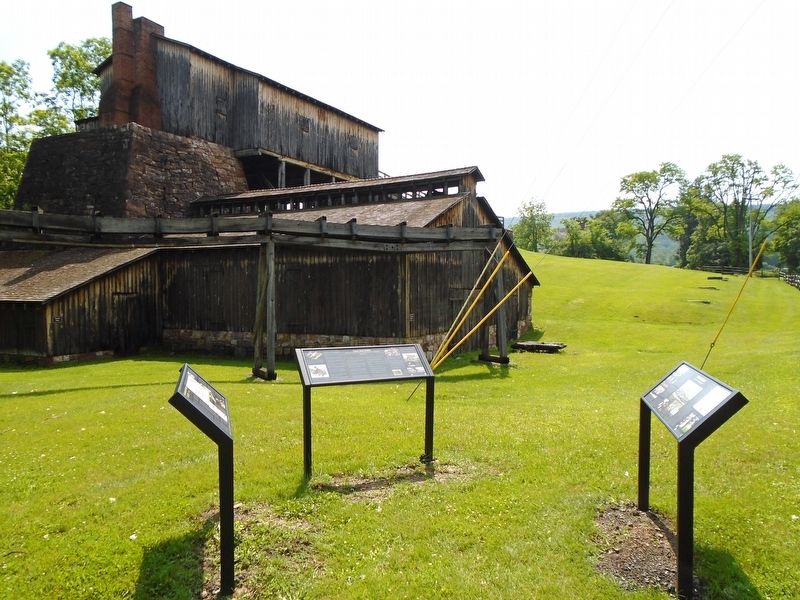
2. Workers Village Marker
Photographed by William Fischer, Jr., June 10, 2025
3. Southeastward view of Curtin Village, ca. 1870 on Workers Village Marker
[Left side photo captions, top to bottom, read]
• View across Antes Run toward the eastern end of the workers village, with Curtin Mansion on the far right, and Eagle Furnace on the left, ca. 1915
• Curtin Villagers gather beside Eagle Emporium-the company-owned general store next to the railroad tracks-circa 1895. The Roland Post Office was just inside the front door.
• In 1911, teachers John F. Eisenhauer and Rosa Knepp (top, left) pose with pupils beside the new brick Curtin schoolhouse standing along Curtin Road 500 yards south of the workers village. The building replaced the one-room frame schoolhouse that had stood closer to the village since at least the 1830s. Of the 44 students pictured, only William Bryan, Roy Durstine, Bernice Dukeman, Esther Glenn, and Stella Grassmeyer have been identified by the photo's owner. Census records indicate that their school-age neighbors in Curtin Village included children of the Aikey, Bathurst, Gummo, and Shultz families.
[Center photo captions, clockwise from top, read]
Photographed by William Fischer, Jr., June 10, 2025
4. Ward's Workers Village Map on Marker
• Unidentified [girls], ca. 1895
• Stable hand Robert Gingher ca. 1900
• Blacksmith Miles Dukeman ca. 1900
• Unidentified [father and children], ca. 1895
[Right side captions, top to bottom, read]
• [Mary Frances Ward's map of Curtin Village]
• Retired blacksmith Miles Dukeman and wife Mary Ann ("Polly" Schultz), ca. 1920
• Mary Ellen Neff and niece Beatrice Sents, ca. 1941
Erected by Roland Curtin Foundation, Happy Valley Adventure Bureau, Centre County Commissioners, and PHMC.
Topics. This historical marker is listed in these topic lists: Immigration • Industry & Commerce • Settlements & Settlers. A significant historical year for this entry is 1825.
Location. 40° 58.453′ N, 77° 44.474′ W. Marker is near Holters Crossing, Pennsylvania, in Centre County. It is in Boggs Township. It is on Curtin Road (Pennsylvania Route 1003) 0.1 miles Eagle Valley Road ( Route 150), on the left when traveling south. Marker is on the Eagle Iron Works and Curtin Village grounds. Touch for map. Marker is at or near this postal address: 251 Curtin Road, Howard PA 16841, United States of America. Touch for directions.

Regionally, this marker is in the Pennsylvania Wilds. It is also in the American Northeast, in the Mid-Atlantic, in Appalachia, and specifically in Northern Appalachia. Globally, it is in North America, the Western Hemisphere, the Western World, and the Anglosphere. Historically, it finds itself in what was once the Haudenosaunee (Iroquois) Confederacy and also one of the original Thirteen Colonies.
Other nearby markers. At least 8 other markers are within 4 miles of this marker, measured as the crow flies: Eagle Iron Works (here, next to this marker); Bald Eagle and Spring Creek Navigation Canal Lock 11 (here, next to this marker); Last Charcoal Iron (a few steps from this marker); Eagle Iron Works and Curtin Village (about 500 feet away, measured in a direct line); Curtin Mansion (about 600 feet away); Site of Curtin Station, Bald Eagle Valley Railroad (about 800 feet away); Eagle Ironworks (approx. 0.2 miles away); War Memorial (approx. 3.2 miles away). Touch for a list and map of all markers in Holters Crossing.
Also see . . .
1. Eagle Ironworks (Centre County Encyclopedia of History & Culture). (Submitted on June 12, 2025, by William Fischer, Jr. of Reynoldsburg, Ohio.)
2. Eagle Iron Works and Curtin Mansion. (Submitted on June 12, 2025, by William Fischer, Jr. of Reynoldsburg, Ohio.)
Credits. This page was last revised on June 12, 2025. It was originally submitted on June 12, 2025, by William Fischer, Jr. of Reynoldsburg, Ohio. This page has been viewed 155 times since then and 45 times this year. Photos: 1, 2, 3, 4. submitted on June 12, 2025, by William Fischer, Jr. of Reynoldsburg, Ohio.
