Carolina Beach in New Hanover County, North Carolina — The American South (South Atlantic)
For a little while it was a lively and interesting fight
Photographed by Evan Dwyer, January 24, 2025
1. "For a little while it was a lively and interesting fight." Marker
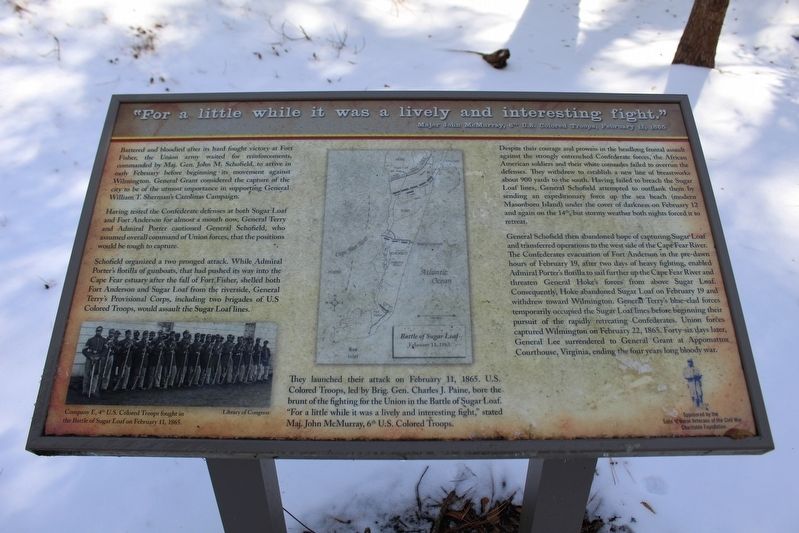
"For a little while it was a lively and interesting fight." Major John McMurray, 6th U.S. Colored Troops, February 11, 1865
Battered and bloodied after its hard fought victory at Fort Fisher, the Union army waited for reinforcements, commanded by Maj. Gen. John M. Schofield, to arrive in early February before beginning its movement against Wilmington. General Grant considered the capture of the city to be of the utmost importance in supporting General William T. Sherman's Carolinas Campaign.
Having tested the Confederate defenses at both Sugar Loaf and Fort Anderson for almost a month now, General Terry and Admiral Porter cautioned General Schofield, who assumed overall command of Union forces, that the positions would be tough to capture.
Schofield organized a two pronged attack. While Admiral Porter's flotilla of gunboats, that had pushed its way into the Cape Fear estuary after the fall of Fort Fisher, shelled both Fort Anderson and Sugar Loaf from the riverside, General Terry's Provisional Corps, including two brigades of U.S. Colored Troops, would assault the Sugar Loaf lines.
They launched their attack
this page online
Despite their courage and prowess in the headlong frontal assault against the strongly entrenched Confederate forces, the African American soldiers and their white comrades failed to overrun the defenses. They withdrew to establish a new line of breastworks about 900 yards to the south. Having failed to breach the Sugar Loaf lines, General Schofield attempted to outflank them by sending an expeditionary force up the sea beach (modern Masonboro Island) under the cover of darkness on February 12 and again on the 14th, but stormy weather both nights forced it to retreat.
General Schofield then abandoned hope of capturing Sugar Loaf and transferred operations to the west side of the Cape Fear River. The Confederates evacuation of Fort Anderson in the pre-dawn hours of February 19, after two days of heavy fighting, enabled Admiral Porter's flotilla to sail further up the
Photographed by Evan Dwyer, January 24, 2025
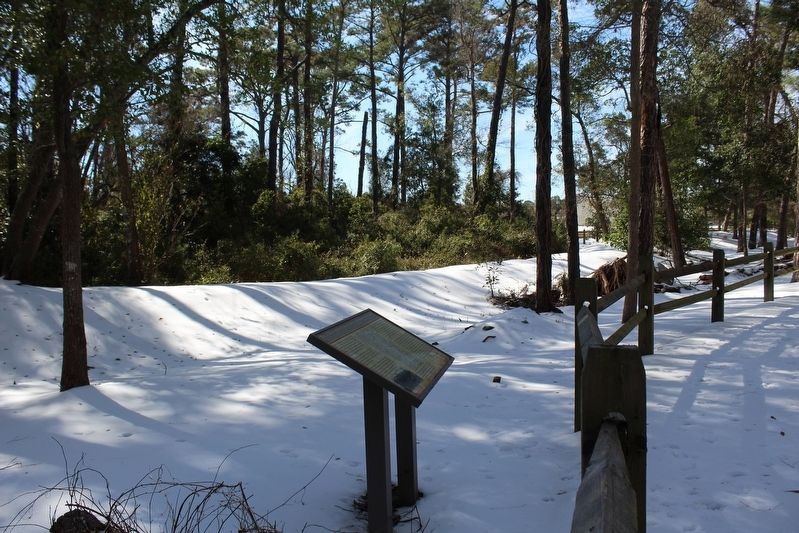
2. Marker & Sugar Loaf Line Earthworks
(captions) Company E, 4th U.S. Colored Troops fought in the Battle of Suga Loaf on February 11, 1865. Library of Congress
Erected 2021 by Sons of Union Veterans of the Civil War Charitable Foundation, City of Carolina Beach.
Topics. This historical marker is listed in these topic lists: African Americans • War, US Civil. A significant historical date for this entry is February 11, 1865.
Location. 34° 2.757′ N, 77° 53.79′ W. Marker is in Carolina Beach, North Carolina, in New Hanover County. It can be reached from North Lake Park Boulevard 0.2 miles north of Bennet Lane, on the right when traveling north. Located in Joseph Ryder Lewis Jr. Civil War Park north of the Publix Super Market Commons at Federal Point. Touch for map. Marker is at or near this postal address: 1018 N Lake Park Blvd, Carolina Beach NC 28428, United States of America. Touch for directions.

Regionally, this marker is in the Coastal Plain and on the Cape Fear Coast. It is also in the American South, specifically in the Upper South, in the Tidewater, and on the Eastern Seaboard. Globally, it is in the North Atlantic Region, North America, the Western Hemisphere, the Western World, and the Anglosphere. Historically, it finds itself in what was once the territory of the Mississippian Culture, one of the original Thirteen Colonies, one of the Confederate States of America, and the Antebellum South.
Other nearby markers. At least 8 other markers are within walking distance of this marker: I hope we can hold Wilmington (within shouting distance of this marker); Such parts of the Sugar Loaf line... (within shouting distance of this marker); We are strongly entrenched here... (within shouting distance of this marker); To close the port of Wilmington... (within shouting distance of this marker); Joseph Ryder Lewis Jr. Civil War Park (about 300 feet away, measured in a direct line); Battlefield of Sugar Loaf (about 400 feet away); Sugar Loaf Line (about 400 feet away); Civil War Fortifications (approx. 0.3 miles away). Touch for a list and map of all markers in Carolina Beach.
More about this marker. Note: Contrary to the marker's statement, Lee's surrender at Appomattox did not end the Civil War. General Joe Johnston surrendered his army, in North Carolina, seventeen days after Lee surrendered at Appomattox. The last major battle occurred in Texas on 12-13 May, another 16 days after Johnston's surrender. The Department of the Trans-Mississippi surrendered on 26 May, a month after Johnston, and the last Confederate surrender of land forces occurred on 23 June. CSS Shenandoah only surrendered on 6 November, almost seven months after Lee. The legal end to the war came the following year.
Credits. This page was last revised on June 16, 2025. It was originally submitted on June 15, 2025, by Evan Dwyer of Richmond, Virginia. This page has been viewed 195 times since then and 26 times this year. Photos: 1, 2. submitted on June 15, 2025, by Evan Dwyer of Richmond, Virginia. • Bernard Fisher was the editor who published this page.
