
Pulaski in Giles County, Tennessee — The American South (East South Central)
Fort Lilly
Guarding Vital Roads and Railways
Photographed by Sandra Hughes Tidwell, May 2, 2024
1. Fort Lilly Marker
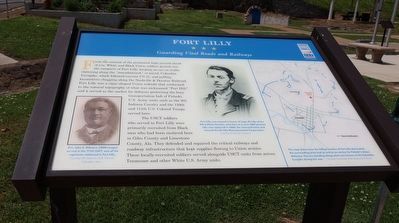
From the summit of the prominent high ground ahead of you, White and Black Union soldiers peered over the ramparts of Fort Lilly, keeping an eye on traffic clattering along the "macadamized," or paved, Columbia Turnpike, which followed the current US 31, and puffing locomotives chugging along the National & Decatur Railroad. Fort Lilly was a cigar-shaped Union redoubt that conformed to the natural topography of what was nicknamed "Fort Hill," it served as the anchor for defenses protecting the busy transportation hub of Pulaski. U.S. Army units such as the 9th Indiana Cavalry and the 110th and 111th U.S. Colored Troops served here.
The USCT soldiers who served in Fort Lilly were primarily recruited from Black men who had been enslaved here in Giles County and Limestone County, Ala. They defended and repaired the critical railways and roadway infrastructure that kept supplies flowing to Union armies. These locally recruited soldiers served alongside USCT units from across Tennessee and other White U.S. Army units.
[Captions:]
Pvt. John S. Gilmore (1880 image) served in the 111th USCT, one of the regiments stationed in Fort Lilly. Courtesy Mt. Lebanon M.B. Church, Columbia, Tenn.
Fort Lilly was named in honor of Capt. Eli Lilly of the 9th Indiana Cavalry, seen here in a circa 1862 portrait. Lilly was captured in 1864. He returned home and formed the Eli Lilly Pharmaceutical Corporation. Courtesy Eli Lilly & Company
This map shows how the hilltop location of Fort Lilly dominated the surrounding area and served as an anchor for Pulaski's Union defenses. You are standing along what was known as the Columbia Turnpike during the war. - Courtesy Tennessee State Library & Archives
Erected by Tennessee
this page online
Topics and series. This historical marker is listed in these topic lists: African Americans • Forts and Castles • War, US Civil. In addition, it is included in the Tennessee Civil War Trails series list. A significant historical year for this entry is 1862.
Location. 35° 12.295′ N, 87° 1.722′ W. Marker is in Pulaski, Tennessee, in Giles County. It is at the intersection of North First Street (U.S. 31) and Spear Street, on the left when traveling north on North First Street. Located in Cave Spring Heritage Park. Touch for map. Marker is at or near this postal address: 590 N 1st St, Pulaski TN 38478, United States of America. Touch for directions.

Regionally, this marker is in Middle Tennessee and in the Highland Rim. It is also in the American South and specifically in the Upper South. Globally, it is in North America, the Western Hemisphere, the Western World, and the Anglosphere. Historically, it finds itself in what was once the territory of the Mississippian Culture, one of the Confederate States of America, and the Antebellum South.
Other nearby markers. At least 8 other markers are within

Photographed by Sandra Hughes Tidwell, May 2, 2024
2. Fort Lilly Marker
Also see . . . Giles Co. Chamber to Unveil New Civil War Trails Marker Recognizing Service of U.S. Colored Troops. The Civil War Trails interpretive sign, titled “Fort Lilly: Guarding Vital Roads and Railways,” commemorates and educates about the U.S. Army’s Fort Lilly. Fort Lilly was located on what is today known as Fort Hill, visible from much of Pulaski. At Fort Lilly, local U.S. Colored Troops served alongside U.S. soldiers from across the country to maintain the U.S. Army presence in Giles County during the Civil War. (Submitted on May 3, 2024, by Sandra Hughes Tidwell of Killen, Alabama, USA.)
Credits. This page was last revised on June 16, 2025. It was originally submitted on May 3, 2024, by Sandra Hughes Tidwell of Killen, Alabama, USA. This page has been viewed 627 times since then and 92 times this year. Last updated on June 16, 2025, by John D Grabenstein of Easton, Maryland. Photos: 1, 2. submitted on May 3, 2024, by Sandra Hughes Tidwell of Killen, Alabama, USA. • Devry Becker Jones was the editor who published this page.
