Bremen-East in Schwachhausen, Germany — Central Europe
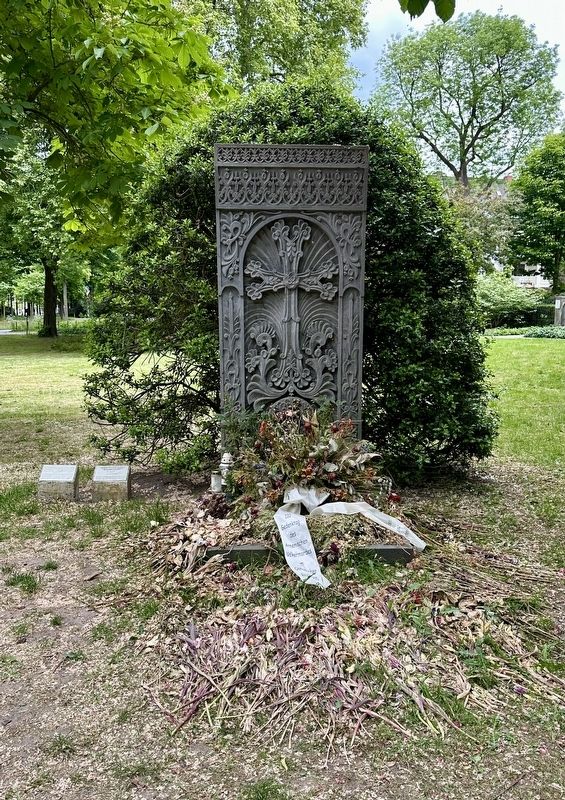
Khatchkar - Armenian Genocide Memorial
Photographed by Andrew Ruppenstein, May 19, 2025
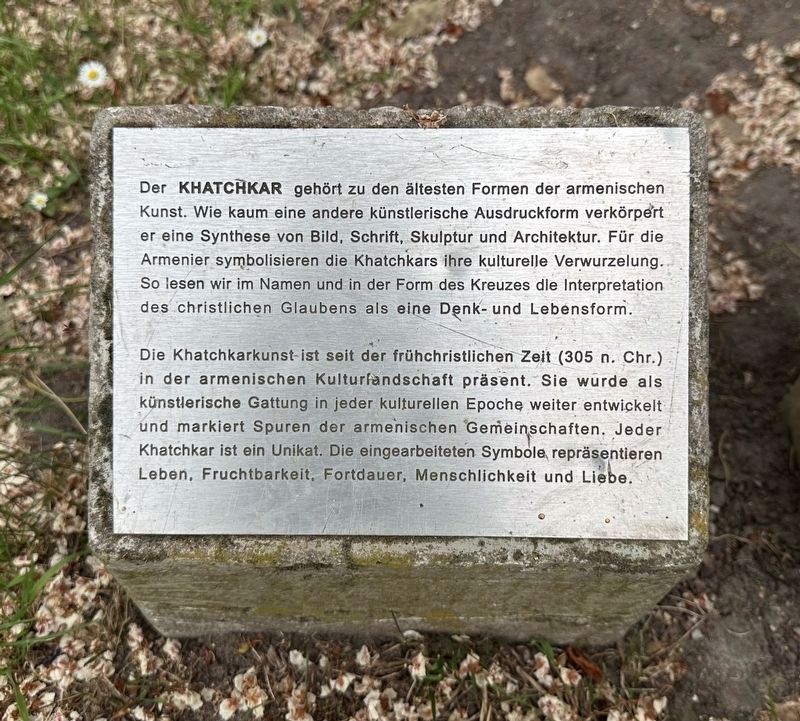
1. Khatchkar - Armenian Genocide Memorial (first panel)

Die Khatchkarkunst ist seit der frühchristlichen Zeit (305 n. Chr.) in der armenischen Kulturfandschaft präsent. Sie wurde als künstlerische Gattung in jeder kulturellen Epoche weiter entwickelt und markiert Spuren der armenischen Gemeinschaften. Jeder Khatchkar ist ein Unikat. Die eingearbeiteten Symbole, repräsentieren Leben, Fruchtbarkeit, Fortdauer, Menschlichkeit und Liebe.
(Armenian text not transcribed)
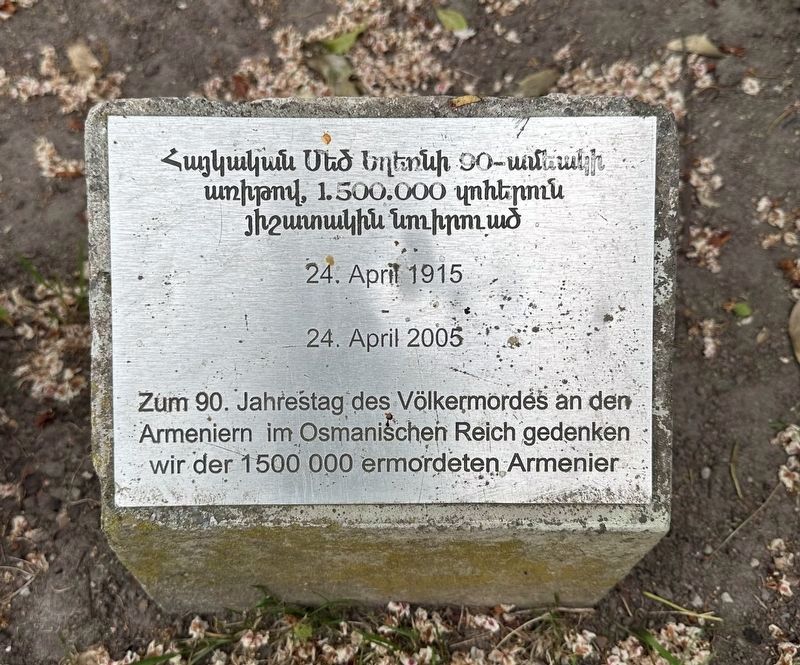
24. April 1915
24. April 2005
Zum 90. Jahrestag des Völkermordes an den Armeniern im Osmanischen Reich gedenken wir der 1500 000 ermordeten Armenier
The khachkar is one of the oldest forms of Armenian art. Like few other forms of artistic expression, it embodies a synthesis
this page online
Khachkar art has been present in Armenian culture since the early Christian period (305 AD). It has been further developed as an artistic genre in every cultural era and marks traces of Armenian communities. Each khatchkar is unique. The symbols incorporated into it represent life, fertility, permanence, humanity, and love.
April 24, 1915 - April 24, 2005
On the 90th anniversary of the Armenian Genocide in the Ottoman Empire, we commemorate the 1,500,000 murdered Armenians
Erected 2015.
Topics. This memorial is listed in these topic lists: Arts, Letters, Music • Wars, Non-US. A significant historical date for this entry is April 24, 1915.
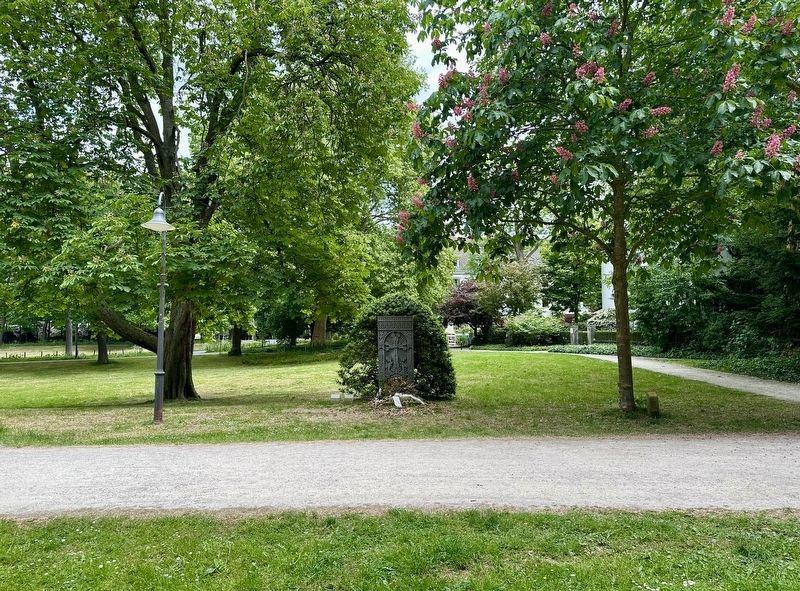
Location. 53° 5.145′ N, 8° 49.149′ E. Memorial is in Bremen, in Schwachhausen. It is in Bremen-East. It is on Parkstraße. The marker is in Bremen Bürgerpark, about 20 meters west of the intersection of Parkstrasse and Blumenthalstrasse. Touch for map. Memorial is at
Photographed by Andrew Ruppenstein, May 19, 2025
2. Khatchkar - Armenian Genocide Memorial (second panel)

Regionally, it is in Europe, the European Union, Atlantic Europe, Central Europe, the Schengen Area, Western Europe, and the Western World. Historically, it finds itself in what was once the Holy Roman Empire and also the former West Germany.
Other nearby markers. At least 8 other markers are within walking distance of this marker: Antikolonialdenkmal „Der Elefant“ / Anticolonial Memorial “The Elephant” (about 210 meters away, measured in a direct line); Ohamakari (about 240 meters away); Hermann-Böse-Gymnasium (about 240 meters away); Hauptbahnhof / Main Railway Station (approx. half a kilometer away); Bremen-Minsk Jewish Deportation Memorial (approx. half a kilometer away); Übersee-Museum / Overseas Museum (approx. 0.6 kilometers away); Schlachthof (approx. 0.7 kilometers away); Familie-Schwarz-Platz (approx. 0.7 kilometers away). Touch for a list and map of all markers in Bremen.
Also see . . . Armenian genocide (Wikipedia). Excerpt:
The Armenian genocide was the systematic destruction of the Armenian people and identity(Submitted on June 17, 2025.)in the Ottoman Empire during World War I. Spearheaded by the ruling Committee of Union and Progress (CUP), it was implemented primarily through the mass murder of around one million Armenians during death marches to the Syrian Desert and the forced Islamization of others, primarily women and children.Photographed by Andrew Ruppenstein, May 19, 20253. Khatchkar - Armenian Genocide Memorial
On 24 April 1915, the Ottoman authorities arrested and deported hundreds of Armenian intellectuals and leaders from Constantinople. At the orders of Talaat Pasha, an estimated 800,000 to 1.2 million Armenians were sent on death marches to the Syrian Desert in 1915 and 1916. Driven forward by paramilitary escorts, the deportees were deprived of food and water and subjected to robbery, rape, and massacres. In the Syrian Desert, the survivors were dispersed into concentration camps. In 1916, another wave of massacres was ordered, leaving about 200,000 deportees alive by the end of the year. Around 100,000 to 200,000 Armenian women and children were forcibly converted to Islam and integrated into Muslim households. Massacres and ethnic cleansing of Armenian survivors continued through the Turkish War of Independence after World War I, carriedout by Turkish nationalists.Photographed by Andrew Ruppenstein, May 19, 20254. Khatchkar - Armenian Genocide Memorial - wide view
Credits. This page was last revised on June 17, 2025. It was originally submitted on June 17, 2025, by Andrew Ruppenstein of Lamorinda, California. This page has been viewed 84 times since then and 13 times this year. Photos: 1, 2, 3, 4. submitted on June 17, 2025, by Andrew Ruppenstein of Lamorinda, California.
