Speckmannshof in Amberg, Bavaria, Germany — Central Europe
Nabburger Tor
⎯⎯⎯
Nabburg Gate
Amber
Photographed by James Hulse, May 30, 2025
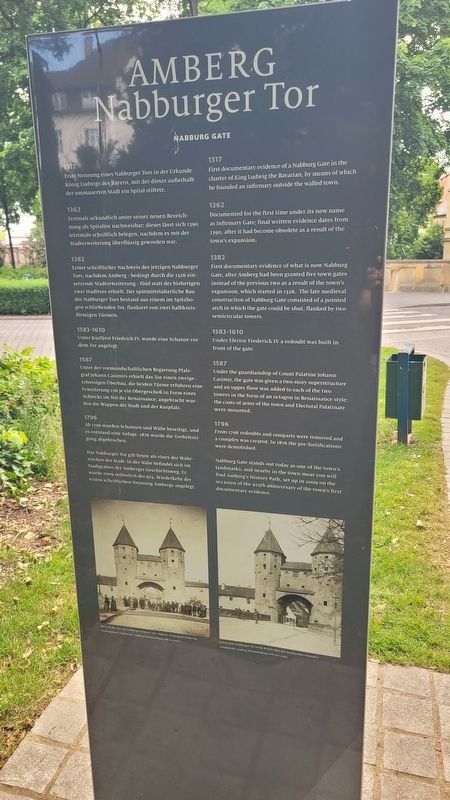
1. Nabburger Tor / Nabburg Gate Marker

1317
Erste Nennung eines Nabburger Tors in der Urkunde König Ludwigs des Bayern, mit der dieser außerhalb der ummauerten Stadt ein Spital stiftete.
1362
Erstmals urkundlich unter seiner neuen Bezeichnung als Spitaltor nachweisbar; dieses lässt sich 1390 letztmals schriftlich belegen, nachdem es mit der Stadterweiterung überflüssig geworden war.
1382
Erster schriftlicher Nachweis des jetzigen Nabburger Tors, nachdem Amberg - bedingt durch die 1326 einsetzende Stadterweiterung - fünf statt der bisherigen zwei Stadttore erhielt. Der spätmittelalterliche Bau des Nabburger Tors bestand aus einem im Spitzbo-gen schließenden Tor, flankiert von zwei halbkreisförmigen Türmen.
1583-1610
Unter Kurfürst Friedrich IV. wurde eine Schanze vor dem Tor angelegt.
1587
Unter der vormundschaftlichen Regierung Pfalzgraf Johann Casimirs erhielt das Tor einen zweigeschossigen Überbau, die beiden Türme erfuhren eine Erweiterung um je ein Obergeschoß in Form eines Achtecks im Stil der Renaissance; angebracht wurden die Wappen der Stadt und der Kurpfalz.
1796
Ab 1796 wurden Schanzen und Wälle beseitigt, und es entstand eine Anlage. 1876 wurde die Vorbefestigung abgebrochen.
Das Nabburger Tor gilt heute als eines der Wahrzeichen der Stadt. In der Nähe befindet sich im Stadtgraben der Amberger Geschichtsweg. Er wurde 2009 anlässlich der 975. Wiederkehr der ersten schriftlichen Nennung Ambergs angelegt.
Bildunterschriften
(Foto #1) Blick auf das Tor vom Nabburger Torplatz aus. Männer, Frauen und Kinder im Sonntagsstaat (Stadtarchiv Amberg Fotosammlung 106-021-002).
(Foto #2) Neben dem Nabburger Tor ist die Brücke über den Stadtgraben erkennbar (Stadtarchiv Amberg Fotosammlung 106-021-004).
1317
First documentary evidence of a Nabburg Gate in the charter of King Ludwig the Bavarian,
this page online
1362
Documented for the first time under its new name as Infirmary Gate; final written evidence dates from 1390, after it had become obsolete as a result of the town's expansion.
1382
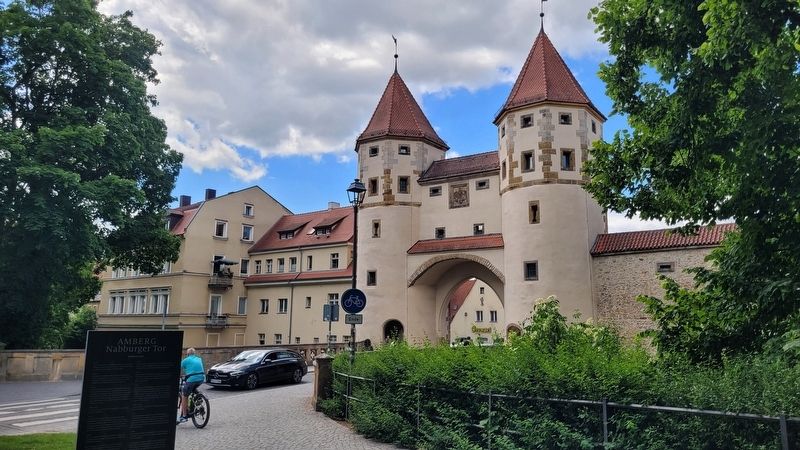
First documentary evidence of what is now Nabburg Gate, after Amberg had been granted five town gates instead of the previous two as a result of the town's expansion, which started in 1326. The late medieval construction of Nabburg Gate consisted of a pointed arch in which the gate could be shut, flanked by two semicircular towers.
1583-1610
Under Elector Frederick IV a redoubt was built in front of the gate.
1587
Under the guardianship of Count Palatine Johann Casimir, the gate was given a two-story superstructure and an upper floor was added to each of the two towers in the form of an octagon in Renaissance style; the coats of arms of the town and Electoral Palatinate were mounted.
1796
From 1796 redoubts and ramparts were removed and a complex was created. In 1876 the pre-fortifications were demolished.
Nabburg Gate stands out today as one of the town's landmarks,
Photographed by James Hulse, May 30, 2025
2. The Nabburg Gate and Marker
Captions
(Photo #1) View of the gate from Nabburg Gate Square. Men, women, and children in their Sunday best (Amberg City Archives Photo Collection 106-021-002).
(Photo #2) Next to the Nabburg Gate, the bridge over the city moat is visible. (Amberg City Archives Photo Collection 106-021-004).
Erected by Amberg Stadt.
Topics. This historical marker is listed in this topic list: Forts and Castles. A significant historical year for this entry is 1317.
Location. 49° 26.672′ N, 11° 51.787′ E. Marker is in Amberg, Bayern (Bavaria). It is in Speckmannshof. It is at the intersection of Nabburger Torpl. and Kaiser-Ludwig-Ring on Nabburger Torpl.. The marker is located in front of the Nabburg Gate along the walkway. Touch for map. Marker is in this post office area: Amberg BY 92224, Germany. Touch for directions.

Regionally, it is in Europe, the European Union, Atlantic Europe, Central Europe, the Schengen Area, Western Europe, and the Western World. Historically,
Photographed by James Hulse, May 30, 2025
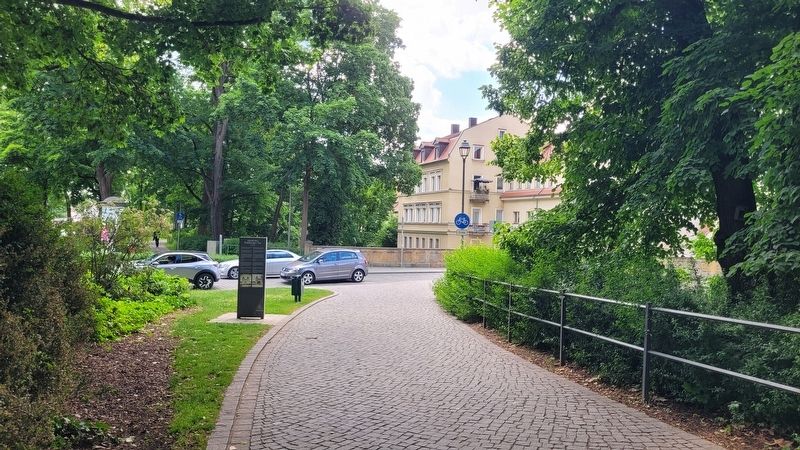
3. The view of the Nabburg Gate Marker along the walkway
Other nearby markers. At least 8 other markers are within walking distance of this marker: Nabburgertor / Nabburg Gate (within shouting distance of this marker); a different marker also named Nabburger Tor / Nabburg Gate (within shouting distance of this marker); Jakob Kirschbaum (about 120 meters away, measured in a direct line); Ilse Gerda Funkenstein (about 150 meters away); Siegfried Funkenstein (about 150 meters away); Paula Funkenstein (about 150 meters away); Rolf Herbert Leo Funkenstein (about 150 meters away); Paulanerkirche / Paulans Church (about 210 meters away). Touch for a list and map of all markers in Amberg.
Credits. This page was last revised on June 18, 2025. It was originally submitted on June 17, 2025, by James Hulse of Medina, Texas. This page has been viewed 87 times since then and 27 times this year. Photos: 1, 2, 3. submitted on June 18, 2025, by James Hulse of Medina, Texas.
