New York Botanical Garden in the Bronx in Bronx County, New York — The American Northeast (Mid-Atlantic)
New York Lilacs
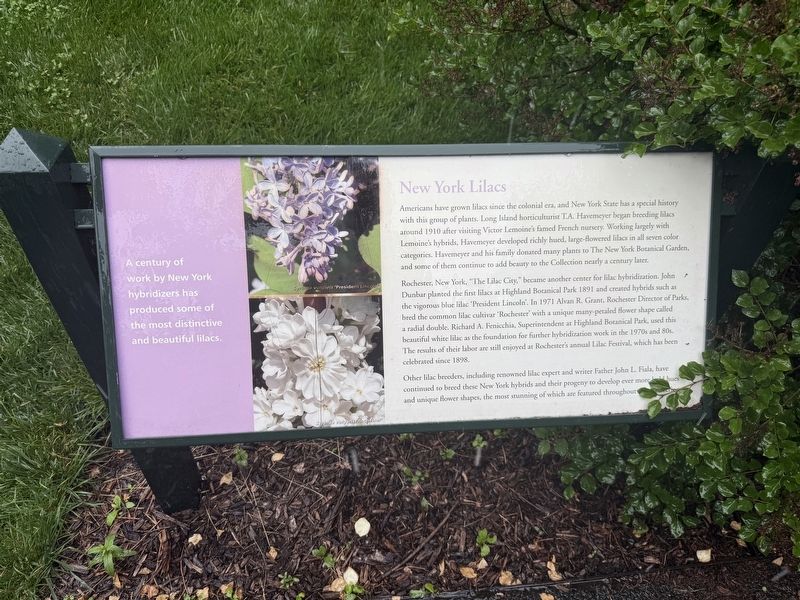
A century of work by New York hybridizers has produced some of the most distinctive and beautiful lilacs.
Americans have grown lilacs since the colonial era, and New York State has a special history with this group of plants. Long Island horticulturist T.A. Havemeyer began breeding lilacs around 1910 after visiting Victor Lemoine's famed French nursery. Working largely with Lemoine's hybrids, Havemeyer developed richly hard, large-flowered lilacs in all seven color categories. Havemeyer and his family donated many plants to The New York Botanical Garden, and some of them continue to add beauty to the Collection nearly a century later.
Rochester, New York, "The Lilac City," became another center for lilac hybridization. John Dunbur planted the first lilacs at Highland Botanical Park 1891 and created hybrids such a the vigorous blue lilac President Lincoln. In 1971 Alvan R. Grant, Rochester Director of Parks, bred the common lilac cultivar Rochester' with a unique many-petaled flower shape called a radial double. Richard A. Fenicchia, Superintendent at Highland Botanical Park, used this beautiful white lilac as the
this page online
Other lilac breeders, including renowned lilac expert and writer Father John L. Fiala, have continued so breed these New York hybrids and their progeny to develop ever more bold hues and unique flower shapes, the most stunning of which are featured throughout the Collection.
Erected by New York Botanical Garden.
Topics. This historical marker is listed in these topic lists: Horticulture & Forestry • Notable Events. A significant historical year for this entry is 1910.
Location. 40° 51.607′ N, 73° 52.437′ W. Marker is in Bronx, New York, in Bronx County. It is in New York Botanical Garden. It can be reached from the intersection of Southern Boulevard and Xavier Way, on the right when traveling north. Touch for map. Marker is at or near this postal address: 2853 Bronx Park Rd, Bronx NY 10467, United States of America. Touch for directions.

Regionally, this marker is in New York City. It is also in the American Northeast, in the Mid-Atlantic, and on the Eastern Seaboard. Globally, it is in the North Atlantic Region, North America, the Western Hemisphere, the Western World, and the Anglosphere. Historically, it finds itself in what was once New Netherland and also one of the original Thirteen Colonies.
Other nearby markers. At least 8 other markers are within walking distance of this marker: A World of Lilacs (here, next to this marker); Syringa vulgaris 'Sensation' (within shouting distance of this marker); Burns Family Lilac Collection (within shouting distance of this marker); Dr. Frank Skinner's Lilacs (within shouting distance of this marker); Hybridizing Lilacs (within shouting distance of this marker); Lilacs and Climate Study (within shouting distance of this marker); T. A. Havemeyer's Lilacs (within shouting distance of this marker); a different marker also named Burns Family Lilac Collection (within shouting distance of this marker). Touch for a list and map of all markers in Bronx.
Credits. This page was last revised on June 17, 2025. It was originally submitted on June 17, 2025, by Devry Becker Jones of Washington, District of Columbia. This page has been viewed 119 times since then and 22 times this year. Photo 1. submitted on June 17, 2025, by Devry Becker Jones of Washington, District of Columbia.
