Kendal in Westmorland and Furness, England, United Kingdom — Northwestern Europe (the British Isles)
Explore the history around Kirkland
Photographed by Ray Gurganus, April 12, 2025
1. Explore the history around Kirkland Marker
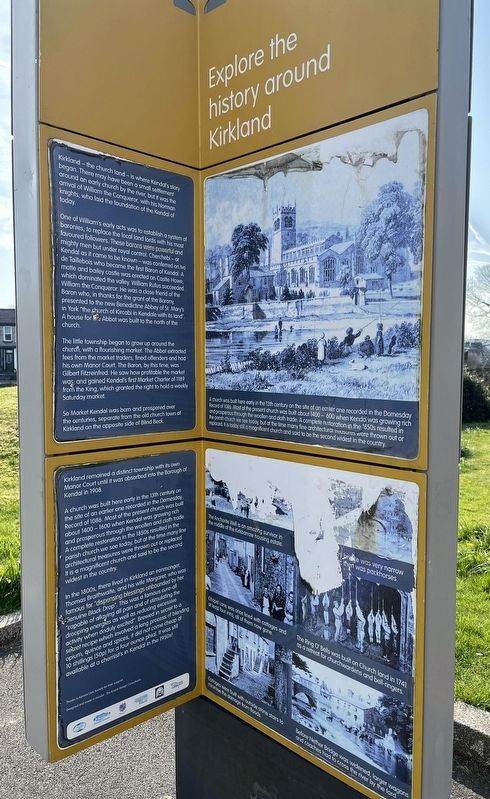
One of William's early acts was to establish a system of baronies, to replace the local land lords with his most favoured followers. These barons were powerful and mighty men but under royal control. Cherchebi - or Kendal as it came to be known - was conferred on Ivo de Toillebois who become the first Baron of Kendal. A motte and bailey castle was erected on Castle Howe, which dominated the valley. William Rufus succeeded William the Conqueror. He was a close friend of the Baron who, in thanks for the grant of the Barony, presented to the new Benedictine Abbey of St Mary's in York "the church of Kircabi in Kendale with its land." A house for the Abbot was built to the north of the church.
The little township began to grow up around the church, with a flourishing market. The Abbot extracted fees from the market traders, fined offenders and had his own Manor Court. The Baron, by this time, was Gilbert Fitzreinfred. He saw how profitable the market was, kind gained Kendal's first Market Charter of 1189 from the King, which granted the right to hold a weekly Saturday market.
So Market Kendal was born and prospered over the centuries, separate from the old church town of Kirkland on the opposite side of Blind Beck.
Kirkland remained a distinct township with its own Manor Court until it was absorbed into the Borough of Kendal in 1908.
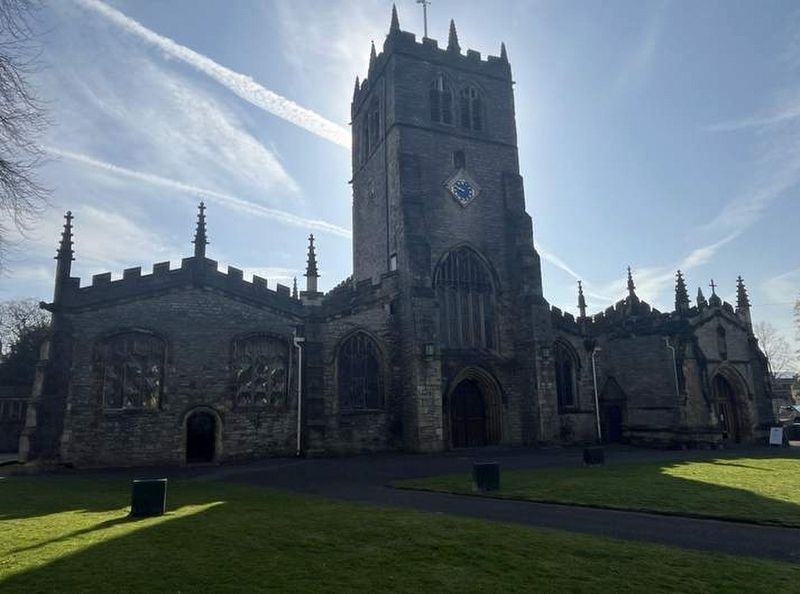
A church was built here early in the 13th century on the site of an earlier one recorded in the Domesday Record 1086. Most of the present church was built about 1400 - 1600 when Kendal was growing rich and prosperous
this page online
Topics. This historical marker is listed in these topic lists: Religion & Religious Structures • Science & Medicine • Settlements & Settlers. A significant historical year for this entry is 1086 CE.
Location. 54° 19.272′ N, 2° 44.696′ W. Marker is in Kendal, England, in Westmorland and Furness. It is on Kirkland,
Photographed by Ray Gurganus, April 12, 2025
2. Kendal Holy Trinity Parish Church

Regionally, this marker is in North West England. Globally, it is on the Atlantic Ocean, in the North Atlantic Region, in Europe, in Atlantic Europe, on one of the British Isles, in the Western World, and in the Anglosphere. Historically, it finds itself in what was once the Roman Empire.
Other nearby markers. At least 8 other markers are within walking distance of this marker: Nether Bridge (within shouting distance of this marker); Explore the history around K Village (about 90 meters away, measured in a direct line); Welcome to Kirkland (about 210 meters away); Explore the history around Gillinggate (approx. 0.3 kilometers away); Bishop Blaize Inn (approx. 0.3 kilometers away); 134-136 Highgate (approx. 0.4 kilometers away); Castle Hill (approx. 0.4 kilometers away); Oddfellows Hall (approx. 0.4 kilometers away). Touch for a list and map of all markers in Kendal.
Credits. This page was last revised on June 18, 2025. It was originally submitted on June 17, 2025, by Ray Gurganus of Washington, District of Columbia. This page has been viewed 173 times since then and 43 times this year. Photos: 1. submitted on June 17, 2025, by Ray Gurganus of Washington, District of Columbia. 2. submitted on June 18, 2025, by Ray Gurganus of Washington, District of Columbia. • Andrew Ruppenstein was the editor who published this page.
