Piqua in Miami County, Ohio — The American Midwest (Great Lakes)
Shawnee Bridge
Photographed by Craig Doda, June 14, 2025
1. Shawnee Bridge Marker
this page online
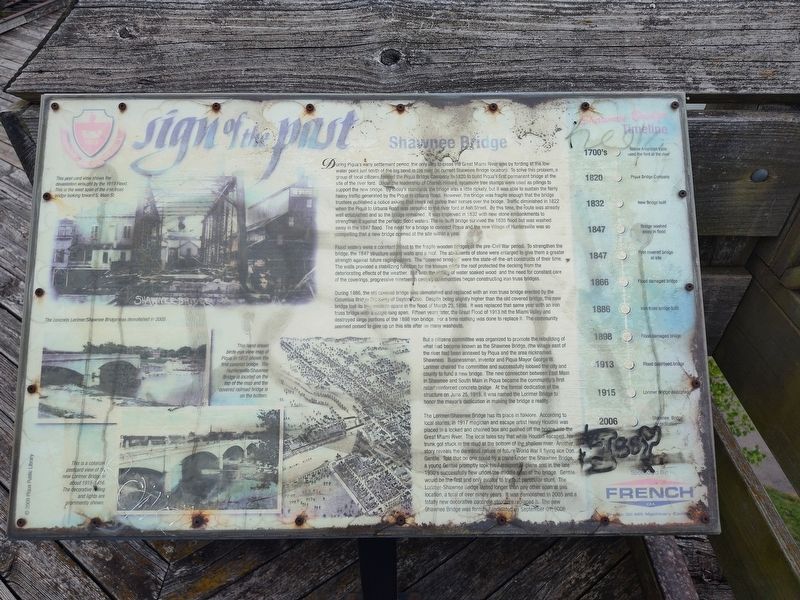
Flood waters were a constant threat to the fragile wooden bridges of the pre-Civil War period. To strengthen the bridge, the 1847 structure added walls and a roof. The abutments of stone were enlarged to give them a greater strength against future raging waters. The “covered bridges” were the state-of-the-art constructs of their time. The walls provided a stabilizing function for the trusses while the roof protected the decking from the deteriorating effects of the weather. But with the testing of water soaked wood and the need for constant care of the coverings, progressive nineteenth century communities began constructing iron truss bridges.
During 1886, the old covered bridge was demolished and replaced with an iron truss bridge erected by the Columbia Bridge Company of Dayton, Ohio. Despite being slightly higher than the old covered bridge, the new bridge lost its two truss spans in the flood of March 23, 1898. It was replaced that same year with an iron truss bridge with a large long span.
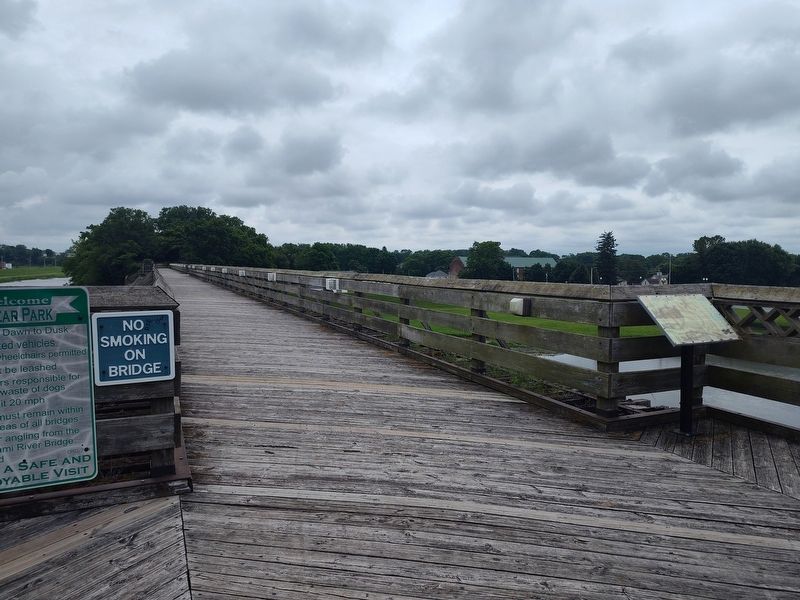
Photographed by Craig Doda, June 14, 2025
2. Shawnee Bridge Marker
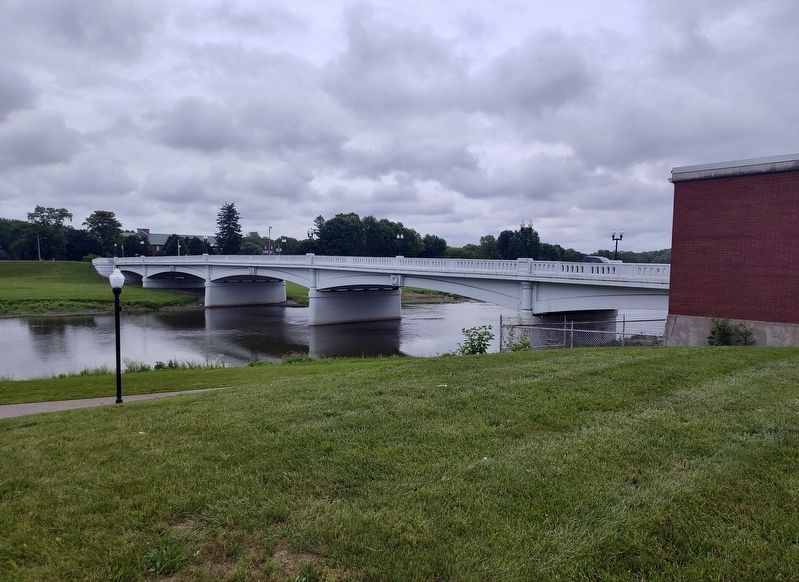
But a citizens committee was organized to promote the rebuilding of what had become known as the Shawnee Bridge, (the village east of the river had been annexed by Piqua and the area nicknamed Shawnee). Businessman, inventor and Piqua Mayor George W. Lorimer chaired the committee and successfully lobbied the city and county to fund a new bridge. The new connection between East Main in Shawnee and South Main in Piqua became the community's first rebar reinforced concrete bridge. At the formal dedication of the structure on June 25, 1915, it was named the Lorimer Bridge to honor the mayor's dedication in making the bridge a reality.
The Lorimer/Shawnee Bridge has its place in folklore. According to local stories, in 1917 magician and escape artist Henry Houdini was placed in a locked and chained box and pushed off the bridge into the Great Miami River. The local tales say that while Houdini
Photographed by Craig Doda, June 14, 2025
3. Shawnee Bridge
Timeline
1700's Native American trails used the ford at the river
1820 Piqua Bridge Company
1832 New Bridge built
1847 Bridge washed away in flood
1847 First covered bridge at site
1866 Flood damaged bridge
1886 Iron truss bridge built
1898 Flood damaged bridge
1913 Flood destroyed bridge
1915 Lorimer Bridge dedicated
2006 Shawnee Bridge dedicated
Topics. This historical marker is listed in these topic lists: Bridges & Viaducts • Waterways & Vessels. A significant historical date for this entry is March 23, 1898.
Location. 40° 8.8′ N, 84° 14.337′ W. Marker is in Piqua, Ohio, in Miami County. It is at the intersection of North Main Street and East Water Street, on the right when traveling north on North Main Street. Touch for map. Marker is at or near this postal address: 111 N Main Street, Piqua OH 45356, United States of America. Touch for directions.

Regionally, this marker is in the Dayton Metro, in the Miami Valley, and in the Till Plains. It is also in the American Midwest and in the Corn Belt. Globally, it is in North America, the Western Hemisphere, the Western World, and the Anglosphere. Historically, it finds itself in what was once the Haudenosaunee (Iroquois) Confederacy, the territory of the Mississippian Culture, and the Northwest Territory.
Other nearby markers. At least 8 other markers are within walking distance of this marker: Main Street (within shouting distance of this marker); Public Square (within shouting distance of this marker); Lock Nine Riverfront Park (about 400 feet away); a different marker also named Shawnee Bridge (about 500 feet away); a different marker also named Shawnee Bridge (about 600 feet away); The Mills Brothers (about 700 feet away); Vice Admiral Stephen Clegg Rowan (about 700 feet away); The Village of Huntersville (about 800 feet away). Touch for a list and map of all markers in Piqua.
Other markers no longer nearby. The 1913 Flood (was within shouting distance of this marker but has been permanently removed); Lock Nine (was about 300 feet away, measured in a direct line but has been confirmed missing).
Credits. This page was last revised on June 24, 2025. It was originally submitted on June 20, 2025, by Craig Doda of Napoleon, Ohio. This page has been viewed 302 times since then and 82 times this year. Photos: 1, 2, 3. submitted on June 20, 2025, by Craig Doda of Napoleon, Ohio. • Andrew Ruppenstein was the editor who published this page.
