Bloomfield in Davis County, Iowa — The American Midwest (Upper Plains)
The Weaver House
Historic Hills Scenic Byway
Photographed by Jason Voigt, June 16, 2025
1. The Weaver House Marker
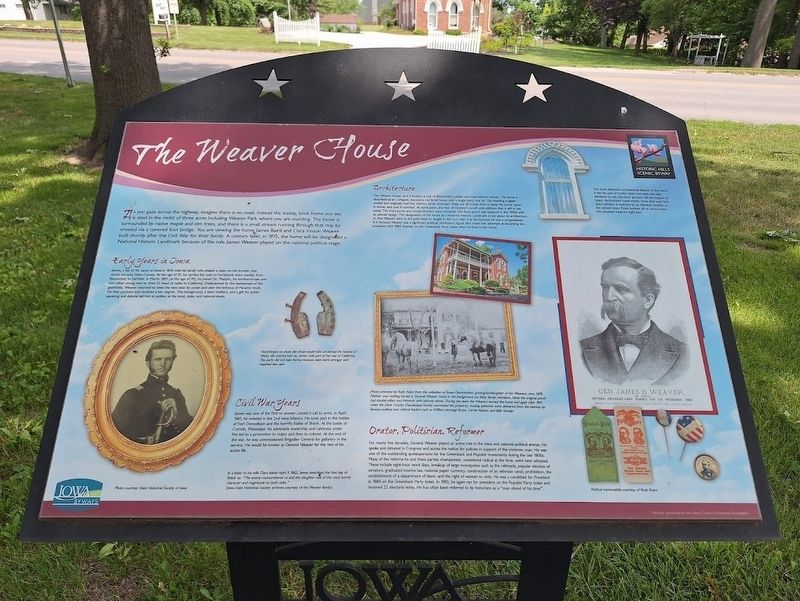
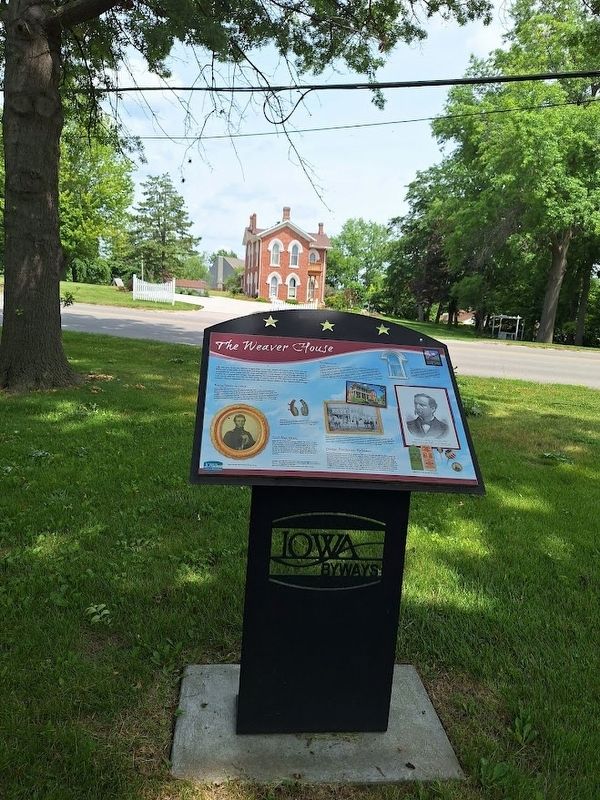
As you gaze across the highway, imagine there is no road. Instead the stately, brick home you see is sited in the midst of three acres including Weaver Park where you are standing. The home is surrounded by native maple and elm trees, and there is a small stream running through that may be crossed via a covered foot bridge. You are viewing the home James Baird and Clara Vinson Weaver built shortly after the Civil War for their family. A century later, in 1975, the home will be designated a National Historic Landmark because of the role James Weaver played on the national political stage.
Early Years in Iowa
James, a lad of 10, came to Iowa in 1843 with his family who staked a claim on the frontier that would become Davis County. At the age of15, he carried the mail on horseback twice weekly from Bloomfield to Fairfield. In March 1853 (at the age of 19), he joined Dr. Phelphs, his brother-in-law and two other young men to drive 52 head of cattle to California. Disillusioned by the lawlessness of the goldfields, Weaver returned to Iowa the next year by ocean and over the Isthmus of Panama route. He then pursued and
this page online
Civil War Years
James was one of the first to answer Lincoln's call to arms. In April 1861, he enlisted in the 2nd Iowa Infantry. He took part in the battles of Fort Donnellson and the horrific battle of Shiloh. At the battle of Corinth, Mississippi, his admirable leadership and calmness under fire led to a promotion to major and then to colonel. At the end of the war, he was commissioned Brigadier General for gallantry in the service. He would be known as General Weaver for the rest of his active life.
Architecture
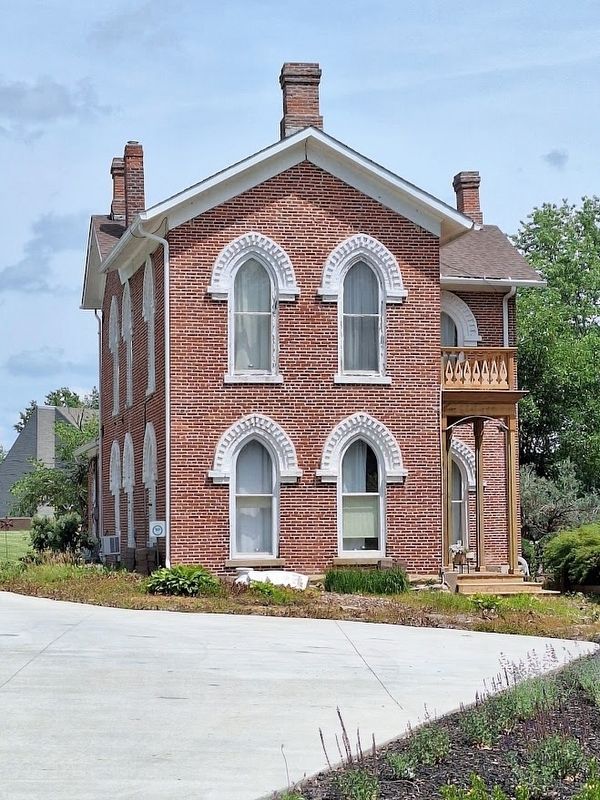
The Weaver House, as it is known, is one of Bloomfield's oldest and most historic homes. The home is described as an L-shaped, two-story, red brick house with a single story rear ell. The dwelling is gable roofed and originally had five, interior, brick chimneys. Walls are 18 inches thick to keep the home warm in winter and cool in summer. At some point, the rear ell received a south side addition that is still in use today. The front porch and ornate shutters
Photographed by Jason Voigt, June 16, 2025
2. The Weaver House Marker
Orator, Politician, Reformer
For nearly five decades, General Weaver played an active role in the Iowa and national political arenas. He spoke and debated in Congress and across the nation for policies in support of the common man. He was one of the outstanding spokespersons for the Greenback and Populist movements during the late 1800s. Many of the reforms he and these parties championed, considered radical at the time, were later adopted. These include eight-hour work days, breakup of large monopolies such as the railroads, popular election of senators, graduated income tax, national paper currency, construction of an isthmian canal, prohibition, the establishment
Photographed by Jason Voigt, June 16, 2025
3. The Weaver House
(photo captions:)
·Hand-forged ox shoes like these would have protected the hooves of Rhino, the one-horned ox, James rode part of the way of California. The party did not take horses because oxen were stronger and required less care. ·In a letter to his wife Clara dated April 9, 1862, James described the first day of Shiloh as: "The enemy outnumbered us and the slaughter was the most horrid character and magnitude on both sides." ·Neither man holding horses is General Weaver. Some in the background are likely family members. Note the original porch had double pillars and fretwork with balcony above. During the years the Weavers owned the home and again after 1915 when the Davis County Chautauqua Society purchased the property, rousing speeches were delivered from the balcony by famous political and cultural leaders such as William Jennings Bryan, Carrie Nation, and Billy Sunday. ·The most distinctive architectural feature of the home is the ten pair of Gothic style, one-over-one sash windows on the two-story portion. All are topped by heavy, denticulated hood molds. Note that each first-story window is matched by an identical window on the second story. From bottom sill to center point, the windows measure eight feet.
Erected by Iowa Byways and the Davis County Community Commission.
Topics and series. This historical marker is listed in these topic lists: Architecture • War, US Civil. In addition, it is included in the National Historic Landmarks series list. A significant historical month for this entry is March 1853.
Location. 40° 45.332′ N, 92° 24.811′ W. Marker is in Bloomfield, Iowa, in Davis County. It is at the intersection of North Washington Street and Weaver Street (U.S. 63), on the right when traveling north on North Washington Street. Marker is in a triangular grassy area across from the house. Touch for map. Marker is at or near this postal address: 410 N Washington St, Bloomfield IA 52537, United States of America. Touch for directions.

Regionally, this marker is in Southern Iowa. It is also in the American Midwest and in the Corn Belt. Globally, it is in North America, the Western Hemisphere, the Western World, and the Anglosphere. Historically, it finds itself in what was once the territory of the Mississippian Culture and also the Louisiana Purchase.
Other nearby markers. At least 8 other markers are within 5 miles of this marker, measured as the crow flies: In Memory of General and Mrs. James B. Weaver (a few steps from this marker); Veterans Memorial (approx. 0.3 miles away); Replica of the Statue of Liberty (approx. 0.3 miles away); Davis County Courthouse (approx. 0.3 miles away); Bloomfield Square (approx. 0.3 miles away); The Confederate Invasion of Iowa Monument (approx. one mile away); A New Route (approx. 4.7 miles away); Davis County Freedom Rock (approx. 4.7 miles away). Touch for a list and map of all markers in Bloomfield.
Also see . . . James B. Weaver House on Wikipedia. The house had changed hands numerous times, and it recently was a bed and breakfast. It has now been shifted back to private ownership. (Submitted on June 20, 2025, by Jason Voigt of Glen Carbon, Illinois.)
Credits. This page was last revised on June 20, 2025. It was originally submitted on June 20, 2025, by Jason Voigt of Glen Carbon, Illinois. This page has been viewed 215 times since then and 42 times this year. Photos: 1, 2, 3. submitted on June 20, 2025, by Jason Voigt of Glen Carbon, Illinois.
