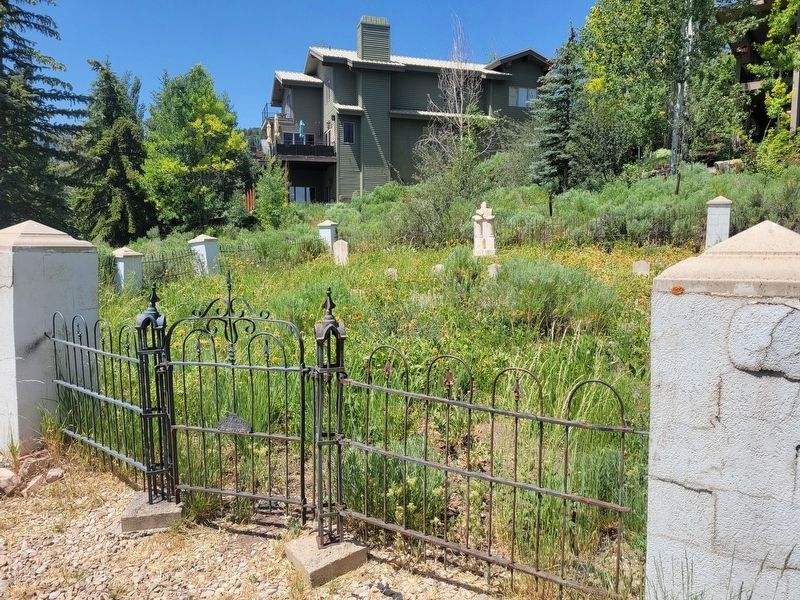
Park City in Summit County, Utah — The American Mountains (Southwest)
Snyderville Pioneer Cemetery
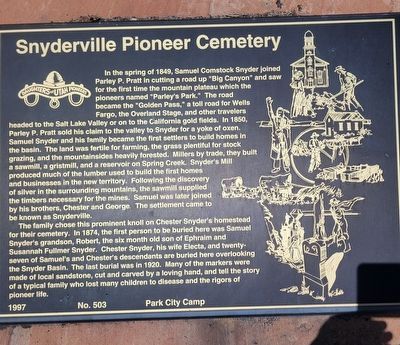
Photographed by Jeremy Snow, June 20, 2025
1. Snyderville Pioneer Cemetery Marker
Inscription.
Snyderville Pioneer Cemetery. . In the spring of 1849, Samuel Comstock Snyder joined Parley P. Pratt in cutting a road up "Big Canyon" and saw for the first time the mountain plateau which the pioneers named "Parley's Park." The road became the "Golden Pass," a toll road for Wells Fargo, the Overland Stage, and other travelers headed to the Salt Lake Valley or on to the California gold fields. In 1850, Parley P. Pratt sold his claim to the valley to Snyder for a yoke of oxen. Samuel Snyder and his family became the first settlers to build homes in the basin. The land was fertile for farming, the grass plentiful for stock grazing, and the mountainsides heavily forested. Millers by trade, they built a sawmill, a gristmill, and a reservoir on Spring Creek. Snyder's Mill produced much of the lumber used to build the first homes and businesses in the new territory. Following the discovery of silver in the surrounding mountains, the sawmill supplied the timbers necessary for the mines. Samuel was later joined by his brothers, Chester and George. The settlement came to be known as Snyderville. , , The family chose this prominent knoll on Chester Snyder's homestead for their cemetery. In 1874, the first person to be buried here was Samuel Snyder's grandson, Robert, the six month old son of Ephraim and Susannah Fullmer Snyder. Chester Snyder, his wife Electa, and twenty- seven of Samuel's and Chester's descendants are buried here overlooking the Snyder Basin. The last burial was in 1920. Many of the markers were made of local sandstone, cut and carved by a loving hand, and tell the story of a typical family who lost many children to disease and the rigors of pioneer life.
In the spring of 1849, Samuel Comstock Snyder joined Parley P. Pratt in cutting a road up "Big Canyon" and saw for the first time the mountain plateau which the pioneers named "Parley's Park." The road became the "Golden Pass," a toll road for Wells Fargo, the Overland Stage, and other travelers headed to the Salt Lake Valley or on to the California gold fields. In 1850,
Parley P. Pratt sold his claim to the valley to Snyder for a yoke of oxen. Samuel Snyder and his family became the first settlers to build homes in the basin. The land was fertile for farming, the grass plentiful for stock grazing, and the mountainsides heavily forested. Millers by trade, they built a sawmill, a gristmill, and a reservoir on Spring Creek. Snyder's Mill produced much of the lumber used to build the first homes and businesses in the new territory. Following the discovery of silver in the surrounding mountains, the sawmill supplied the timbers necessary for the mines. Samuel was later joined by his brothers, Chester and George. The settlement came to be known as Snyderville.
The family chose this prominent knoll on Chester Snyder's homestead
Click or scan to see this page online
for their cemetery. In 1874, the first person to be buried here was Samuel Snyder's grandson, Robert, the six month old son of Ephraim and Susannah Fullmer Snyder. Chester Snyder, his wife Electa, and twenty-
seven of Samuel's and Chester's descendants are buried here overlooking the Snyder Basin. The last burial was in 1920. Many of the markers were made of local sandstone, cut and carved by a loving hand, and tell the story of a typical family who lost many children to disease and the rigors of pioneer life.
Erected 1997 by Daughters of Utah Pioneers. (Marker Number 503.)
Location. 40° 41.872′ N, 111° 32.725′ W. Marker is in Park City, Utah, in Summit County. It is on Roffe Road, on the right when traveling west. Touch for map. Marker is at or near this postal address: 1916 Roffe Road, Park City UT 84098, United States of America. Touch for directions.

Regionally, this
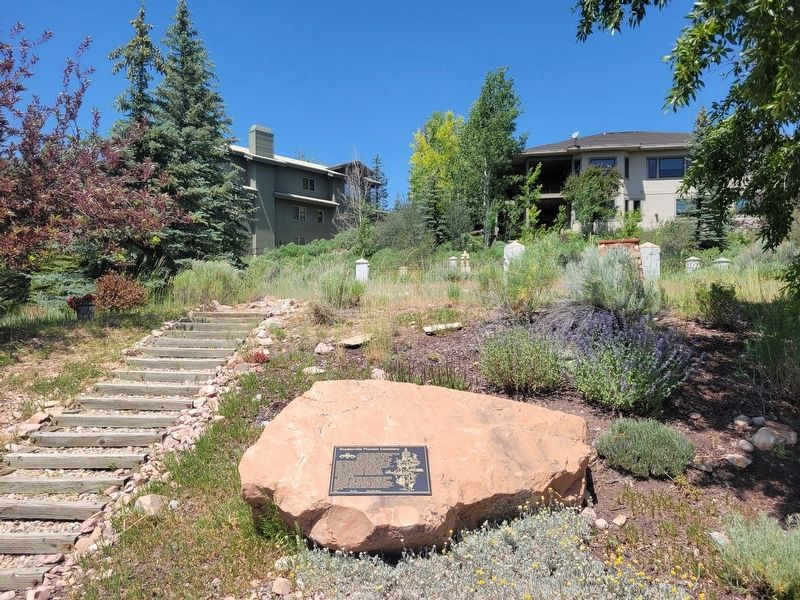
Photographed by Jeremy Snow, June 20, 2025
2. Snyderville Pioneer Cemetery Marker
marker is in Utah’s Uinta Mountains, in the Wasatch Front, and in Greater Provo. It is also in the American Mountain West and in Colorado Plateau. Globally, it is in North America, the Rocky Mountains, the Western Hemisphere, the Western World, and the Anglosphere. Historically, it finds itself in what was once New Spain and also Mexicos Alta California.
Credits. This page was last revised on June 21, 2025. It was originally submitted on June 20, 2025, by Jeremy Snow of Cedar City, Utah. This page has been viewed 113 times since then and 26 times this year. Photos:1, 2, 3. submitted on June 20, 2025, by Jeremy Snow of Cedar City, Utah. • Andrew Ruppenstein was the editor who published this page.