
Apalachicola in Franklin County, Florida — The American South (South Atlantic)
Apalachicola’s Sponge Industry
Photographed by Brandon D Cross, June 17, 2025
1. Apalachicola’s Sponge Industry Marker
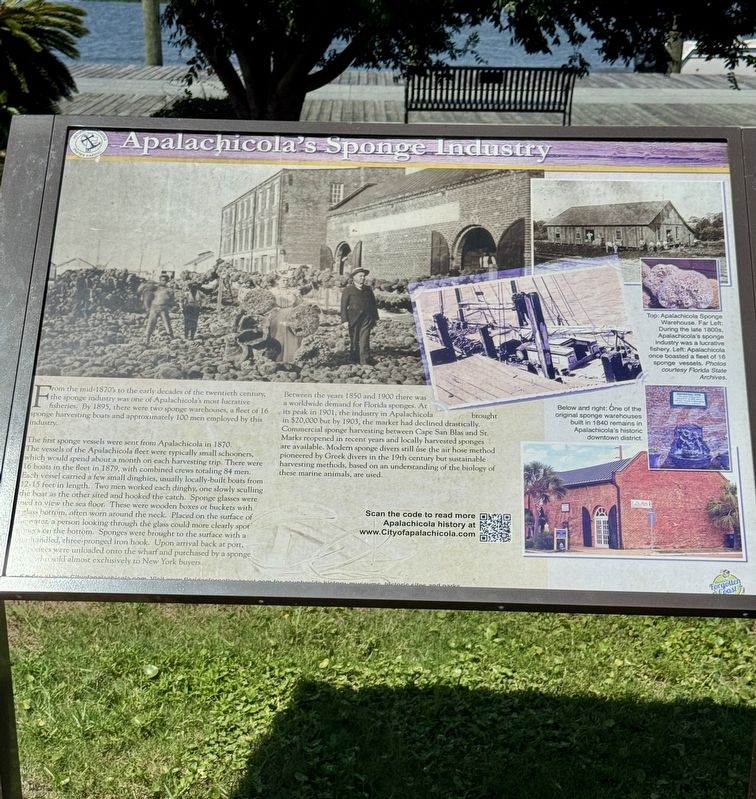
The first sponge vessels were sent from Apalachicola in 1870. The vessels of the Apalachicola fleet were typically small schooners, which would spend about a month on each harvesting trip. There were 16 boats in the fleet in 1879, with combined crews totaling 84 men. Each vessel carried a few small dinghies, usually locally-built boats from 2-15 feet in length. Two men worked each dinghy, one slowly sculling the boat as the other sited and hooked the catch. Sponge glasses were used to view the sea floor. These were wooden boxes or buckets with a glass bottom, often worn around the neck. Placed on the surface of the water a person looking through the glass could more clearly spot sponges on the bottom. Sponges were brought to the surface with a tindled, three-pronged iron hook. Upon arrival back at port, the sponges were unloaded onto the wharf and
this page online
Between the years 1850 and 1900 there was a worldwide demand for Florida sponges. At its peak in 1901, the industry in Apalachicola brought in $20,000 but by 1903, the market had declined drastically. Commercial sponge harvesting between Cape San Blas and St. Marks reopened in recent years and locally harvested sponges are available. Modern sponge divers still use the air hose method pioneered by Greek divers in the 19th century but sustainable harvesting methods, based on an understanding of the biology of these marine animals, are used.
(captions)
Top: Apalachicola Sponge Warehouse. Far Left: During the late 1800s, Apalachicola's sponge industry was a lucrative fishery. Left: Apalachicola once boasted a fleet of 16 sponge vessels. Photos courtesy Florida State Archives
Below and right: One of the original sponge warehouses built in 1840 remains in Apalachicola's historic downtown district.
Scan the code to read more Apalachicola history at www.Cityoapalachicola.com
Erected by City of Apalachicola.
Topics. This historical marker
Photographed by Brandon D Cross, June 17, 2025
2. Apalachicola’s Sponge Industry Marker
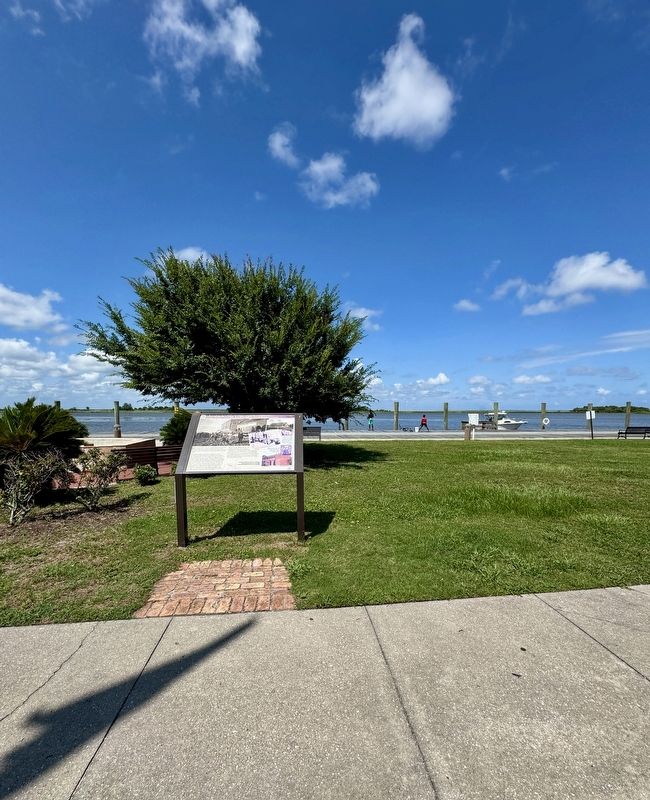
Location. 29° 43.708′ N, 84° 58.991′ W. Marker is in Apalachicola, Florida, in Franklin County. It is at the intersection of Water Street and Avenue E, on the left when traveling east on Water Street. Touch for map. Marker is in this post office area: Apalachicola FL 32320, United States of America. Touch for directions.

Regionally, this marker is on the Florida Panhandle. It is also in the American South, specifically in the Deep South, and on the Gulf Coast. Globally, it is in the North Atlantic Region, North America, a Gulf of Mexico state, the Western Hemisphere, the Western World, and the Anglosphere. Historically, it finds itself in what was once New Spain, the territory of the Mississippian Culture, one of the Confederate States of America, and the Antebellum South.
Other nearby markers. At least 8 other markers are within walking distance of this marker: Apalachicola’s Cotton Era (a few steps from this marker); When the River Was King! (a few steps from this marker); J.E. Grady & Co. (within shouting distance of this marker); Apalachicola City Hall Warehouse (about 300 feet away, measured in a direct line); The Sponge Exchange (about 300 feet away); The Cook Insurance Building (about 400 feet away); Apalachicola Post Office and Customs House (about 400 feet away); The Cook Building (about 500 feet away). Touch for a list and map of all markers in Apalachicola.
Also see . . .
1. A Shadow of Apalachicola’s Past. (Submitted on June 21, 2025, by Brandon D Cross of Flagler Beach, Florida.)
2. Apalachicola Walking Tour. (Submitted on June 21, 2025, by Brandon D Cross of Flagler Beach, Florida.)
Credits. This page was last revised on June 21, 2025. It was originally submitted on June 21, 2025, by Brandon D Cross of Flagler Beach, Florida. This page has been viewed 135 times since then and 26 times this year. Photos: 1, 2. submitted on June 21, 2025, by Brandon D Cross of Flagler Beach, Florida. • Andrew Ruppenstein was the editor who published this page.
