Moravia in Appanoose County, Iowa — The American Midwest (Upper Plains)
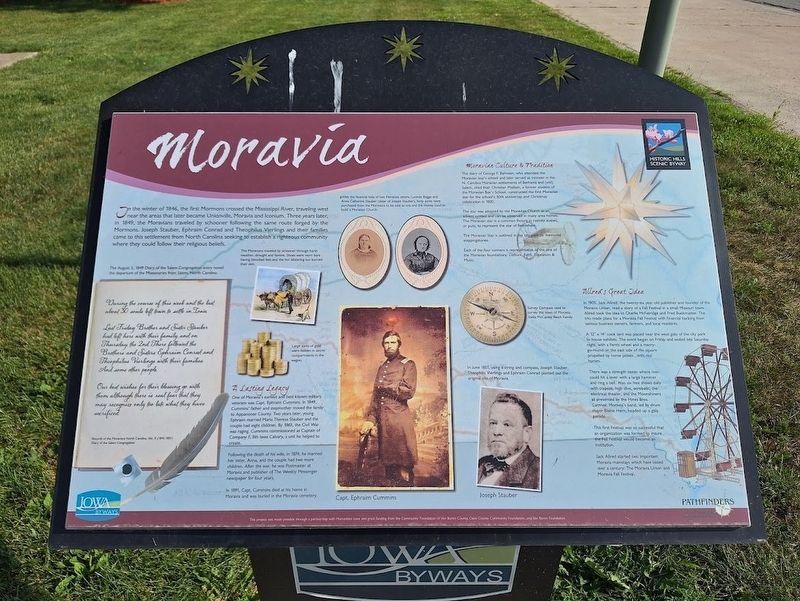
Moravia
Historic Hills Scenic Byway
Photographed by Jason Voigt, June 16, 2025
1. Moravia Marker
In the winter of 1846, the first Mormons crossed the Mississippi River, traveling west near the areas that later became Unionville, Moravia and Iconium. Three years later, in 1849, the Moravians traveled by schooner following the same route forged by the Mormons. Joseph Stauber, Ephraim Conrad and Theophilus Vierlings and their families came to this settlement from North Carolina seeking to establishing a righteous community where they could follow their religious beliefs.
A Lasting Legacy
One of Moravia's earliest and best known military veterans was Capt. Ephraim Cummins. In 1849, Cummins' father and stepmother moved the family to Appanoose County. Two years later, young Ephraim married Maria Theresa Stauber and the couple had eight children. By 1863, the Civil War was raging. Cummins commissioned as Captain of Company F, 8th Iowa Calvary, a unit he helped to create.
Following the death of his wife, in 1874, he married her sister, Anna, and the couple had two more children. After the war, he was Postmaster at Moravia and publisher of The Weekly Messenger newspaper for four years.
In 1891, Capt. Cummins died
this page online
Moravian Culture & Tradition
The diary of George F. Bahnson, who attended the Moravian boy's school and later served as minister in the N. Carolina Moravian settlements of Bethania and (old) Salem, cited that: Christian Madsen, a former student of the Moravian Boy's School, constructed the first Moravian star for the school's 50th anniversary and Christmas celebration in 1820.
The star was adopted by the Moravian Church as an advent symbol and can be observed in many area homes. The Moravian star is a common fixture in nativity scenes, or putz, to represent the star of Bethlehem.
The Moravian Star is outlined in the city park by memorial steppingstones.
Each of the four corners is representative of the one of the Moravian foundations: Culture, Faith, Education & Music.
Allred's Great Idea
In 1905, Jack Allred, the twenty-six year old publisher and founder of the Moravia Union, read a story of a Fall Festival in a small Missouri town. Allred took the idea to Charlie McFatridge and Fred Buckmaster. The trio made plans for a Moravia Fall Festival with financial
Photographed by Jason Voigt, June 16, 2025
2. Moravia Marker
A 12' x 14' cook tent was placed near the west gate of the city park to house exhibits. The events began on Friday and ended late Saturday night, with a Ferris wheel and a merry-go-round on the east side of the square propelled by horse power…with real horses.
There was a strength tester where men could hit a lever with a large hammer and ring a bell. Also six free shows daily with trapeze, high dive, acrobatic, the electrical theater, and the Moonshiners all presented by the Hines Bros. Carnival. Moravia's band, led by drum major Blaine Harn, headed up a gala parade.
The first Festival was so successful that an organization was formed to insure the Fall Festival would become an institution.
Jack Allred started two important Moravia mainstays which have lasted over a century: The Moravia Union and Moravia Fall Festival.
(photo captions:)
·The August 3, 1849 Diary of the Salem Congregation entry noted the departure of the Missionaries from Salem, North Carolina
·The Moravians traveled by schooner through harsh weather, drought and famine. Shoes were worn bare having bloodied feet and the hot blistering sun burned their skin.
·Large sums of gold were hidden in secret compartments in the wagon.
·With the financial help of two Moravian sisters, Lucinda Bagge and Anna Catherine Stauber (sister of Joseph Stauber), forty acres were purchased from the Mormons to be sold as lots and the money used to build a Moravian Church.
·Survey Compass used to survey the town of Moravia.
·In June 1851, using a string and compass, Joseph Stauber, Theophilis Vierlings and Ephraim Conrad plotted out the original site of Moravia.
Erected by Iowa Byways and Pathfinders.
Topics. This historical marker is listed in these topic lists: Parks & Recreational Areas • Religion & Religious Structures • Settlements & Settlers. A significant historical year for this entry is 1846.
Location. 40° 53.458′ N, 92° 48.862′ W. Marker is in Moravia, Iowa, in Appanoose County. It is at the intersection of East Chariton Street and William Street, on the right when traveling east on East Chariton Street. Marker is on the grounds of Moravia Public Library (northwest corner). Touch for map. Marker is at or near this postal address: 114 E Chariton St, Moravia IA 52571, United States of America. Touch for directions.

Regionally, this marker is in Southern Iowa. It is also in the American Midwest and in the Corn Belt. Globally, it is in North America, the Western Hemisphere, the Western World, and the Anglosphere. Historically, it finds itself in what was once the territory of the Mississippian Culture and also the Louisiana Purchase.
Other nearby markers. At least 8 other markers are within walking distance of this marker: Main Station Chapel (approx. half a mile away); James Floyd Stevens (approx. 0.6 miles away); Emergency Siren (approx. 0.6 miles away); Summer Kitchen (approx. 0.6 miles away); Outhouse (approx. 0.6 miles away); Coal Mine Car (approx. 0.6 miles away); Wabash Depot (approx. 0.6 miles away); Section Car (approx. 0.6 miles away). Touch for a list and map of all markers in Moravia.
Credits. This page was last revised on June 21, 2025. It was originally submitted on June 21, 2025, by Jason Voigt of Glen Carbon, Illinois. This page has been viewed 149 times since then and 61 times this year. Photos: 1, 2. submitted on June 21, 2025, by Jason Voigt of Glen Carbon, Illinois.
