Fort Story in Virginia Beach, Virginia — The American South (Mid-Atlantic)
The Emerging Community
⎯⎯⎯
Defending the Chesapeake Bay
Welcome to Fort Story

Photographed by Devry Becker Jones (CC0), June 13, 2025
1. The Emerging Community / Defending the Chesapeake Bay Marker
The Emerging Community
The combination of lighthouses, life-saving stations and the Virginia pilots have guided and assisted many a mariner from the earliest days as they enter and exit the waters of the Chesapeake Bay. They were joined at Cape Henry by a station on the Weather Services and in 1890, the Cape Henry Park and Land Company was chartered to acquire Cape Henry for development and timber interests. The area was commonly referred to as "the desert."
A small community to support these federal activities began to evolve, but the only access was down the beach at low tide. life was made easier by the establishment of a rail line to both Virginia Beach and Norfolk in 1902. A number of residences were built in addition to the Seabreeze Hotel, stores and a post office. O'Keefe's Tavern opened in the area presently occupied by the Cape Henry Cross and drew large crowds.
There were two communities that were established at Cape Henry before the arrival of the U.S. Army. The first, centered around the Hygeia Hotel with a number of substantial buildings, was located to the seaward of the present day post headquarters.
this page online
During the Great Depression, the government sent men of the Civilian Conservation Corps (CCC) to build roads, trails and cabins in the adjacent Seashore State Park. Some of the men lived in the barracks at Fort Story.
With the emerging threat of war in Europe, the Army expanded its ownership of land at Cape Henry. Through condemnation and land sales, the government took over the civilian community. The Coast Guard Station relocated to Little Creek, and the military assumed control of a number of civilian buildings. Today, only a handful of wooden structures remain to tell the story of life at Cape

Photographed by Devry Becker Jones (CC0), June 13, 2025
2. Defending the Chesapeake Bay side of the marker
[Captions:]
In 1918 a brick observatory building was erected to house the weather station at Cape Henry. During World War II, the military used the building as a Harbor Entrance Control Point. The station was closed in May 1969 and the building then served as officers' quarters.
The brick and granite church designated as St. Theresa's Chapel was dedicated in October 1924. It served the civilian community until prior to World War II when it was closed. It was later renovated by the Army which had taken over the land. The chapel stands today on Atlantic Avenue.
These are the two life-saving stations at Cape Henry. The structure on the left was built in 1874. The second generation station was completed in 1904. The second station was relocated to Little Creek prior to World War II, because it was in the line of fire of the coast artillery guns.
An August 1885 photograph titled "Leaving Cape Henry Light Station." The wide-track wheels on the cart enabled it to maneuver on soft sand. The construction of the railroad from Virginia Beach and Norfolk in 02 made access to Cape Henry a lot easier.
This postcard depicts the 1903 train station at Cape Henry. It was central to the emerging community that was beginning to grow. Later, a post office opened in the building. The rail line was discontinued in 1950 but the building is used by the Army.
Defending the Chesapeake Bay
At
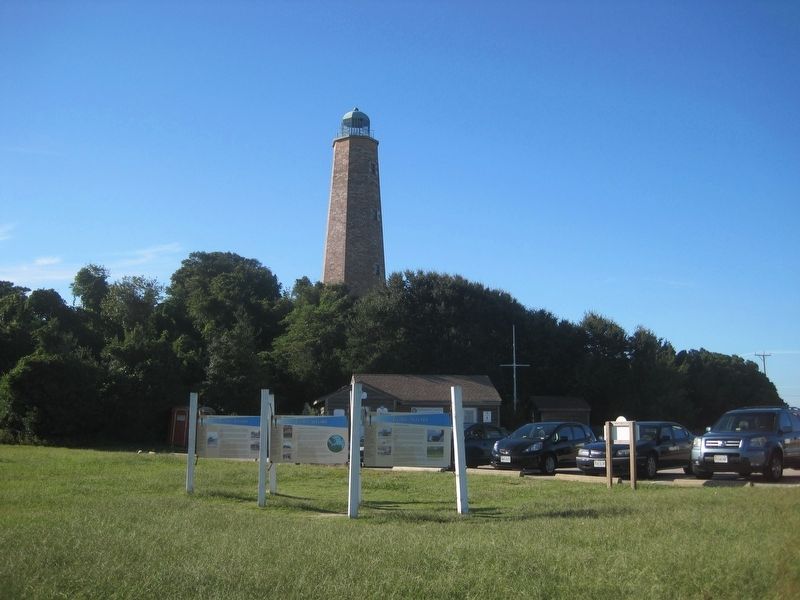
Photographed by Kevin W., September 27, 2014
3. Fort Story Marker
The first defenses stem from the construction of a fort at Jamestown by the English in 1607. Later, another fortification was built at Point Comfort. Much later, the Revolutionary War brought about a revival in coastal defense. Fort Nelson was built on the Elizabeth River near Portsmouth. A fort was also built on the Norfolk side to protect the inner harbors. While the siege of Yorktown was underway, Admiral deGrasse of the French fleet took up a position at the entrance to the Chesapeake Bay and prevented the British fleet from relieving Lord Cornwallis.
Again, against an exposed American coast, a British fleet entered the unprotected mouth of Hampton Roads in 1813. In the following year, another British fleet sailed up the Chesapeake Bay and landed the army behind Washington. After its departure, the United States started
Photographed by Devry Becker Jones (CC0), June 13, 2025
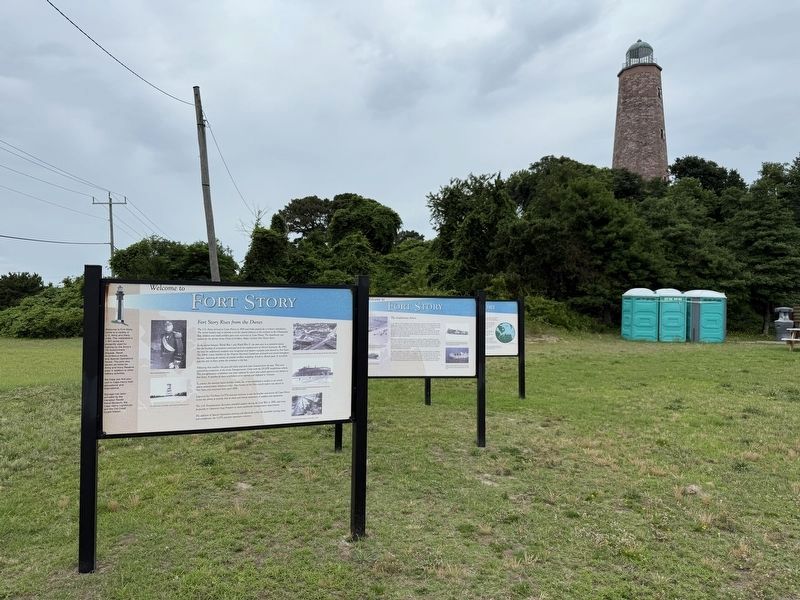
4. The three markers for Welcome to Fort Story
Following the Civil War, the defenses of the Chesapeake Bay were nonexistent until the 1880s. when more modern artillery was emplaced at Fort Monroe. With the outbreak of World War I, the area harbor defenses expanded and it was determined to project the firepower seaward to the Virginia Capes. Small caliber guns were posted at both Cape Henry and Cape Charles. Even with that, the width of the entrance made effective defense impossible. After the war, the artillery garrisons were demobilized, but development of coastal artillery continued.
With the advent of World War II, modern coast artillery was emplaced on post with guns ranging from 6-inch to the big 16-inch guns. With the new weapons and a mine filed across the bay, the Chesapeake Bay was effectively protected from an enemy. in 1942, a German submarine challenged the defense but never gained entrance.
[Captions:]
A World War I recruiting poster for the Coast Artillery Corps. The Coast Artillery largely served in fixed fortifications at most of the continental harbors and also picked up the mission of aircraft artillery.
A concrete platform of a 6-inch Model 1900 in the surf off the beach. This battery and a battery of 5-inch guns were emplaced in the dunes during World War I. They were obsolete when mounted. Additional guns were mounted on Fisherman Island at Cape Charles.
In addition to coast artillery, the principal weapon used in fixed-location seacost defense was underwater mines. This "mining casemate" was built in 1922 and controlled some of the mines set out at the entrance to the Chesapeake Bay.
[Sidebar on each side of the marker:]
Welcome to Fort Story, home to a variety of U.S. Army and Navy units. The installation's 1,451 acres are presently used for training by the Army's 7th Sustainment Brigade, Naval Amphibious forces and Special Operations forces. The post also serves as home for Army and Navy Reserve units in addition to other military activities.
We hope you find your visit to Cape Henry both educational and inspirational.
Erected by the Hampton Roads Naval Museum, the Cape Henry Lighthouse and the Old Coast Guard Station.
Topics and series. This historical marker is listed in these topic lists: Forts and Castles • Settlements & Settlers • Waterways & Vessels. In addition, it is included in the Lighthouses series list. A significant historical month for this entry is May 1969.
Location. 36° 55.509′ N, 76° 0.462′ W. Marker is in Virginia Beach, Virginia. It is in Fort Story. It is on Sicily Road. Touch for map. Marker is at or near this postal address: 583 Sicily Rd, Virginia Beach VA 23459, United States of America. Touch for directions.

Regionally, this marker is in Hampton Roads, specifically in Coastal Virginia, and in the Hampton Roads Metropolitan Area. It is also in the American South, specifically in the Upper South, in the Tidewater, and on the Eastern Seaboard. Globally, it is in the North Atlantic Region, North America, the Western Hemisphere, the Western World, and the Anglosphere. Historically, it finds itself in what was once the territory of the Mississippian Culture, one of the original Thirteen Colonies, one of the Confederate States of America, and the Antebellum South.
Other nearby markers. At least 8 other markers are within walking distance of this marker: Into the 21st Century / The Amphibians Arrive (here, next to this marker); The Guns of Fort Story / Fort Story Rises from the Dunes (here, next to this marker); "A picturesque spot which impresses all who see it" (a few steps from this marker); Expanding Military Operations at Fort Story (a few steps from this marker); The Cottages of Cape Henry at Fort Story (a few steps from this marker); Cape Henry Railroads (within shouting distance of this marker); Movement and Display of the USS Iowa Battleship Barrel at Cape Henry/Fort Story (within shouting distance of this marker); WW2 16-inch/50 Coast Defense Batteries at Fort Story (within shouting distance of this marker). Touch for a list and map of all markers in Virginia Beach.
Credits. This page was last revised on June 21, 2025. It was originally submitted on June 21, 2025, by Kevin W. of Stafford, Virginia. This page has been viewed 175 times since then and 35 times this year. Photos: 1, 2. submitted on June 21, 2025, by Devry Becker Jones of Washington, District of Columbia. 3. submitted on November 28, 2014, by Kevin W. of Stafford, Virginia. 4. submitted on June 21, 2025, by Devry Becker Jones of Washington, District of Columbia. • Devry Becker Jones was the editor who published this page.
