Gouda, South Holland, Netherlands — Northwestern Europe
Vluchtoord Gouda
⎯⎯⎯
Place of Refuge Gouda 1914-1919
Photographed by Andrew Ruppenstein, June 21, 2025
1. Vluchtoord Gouda / Place of Refuge Gouda 1914-1919 Marker

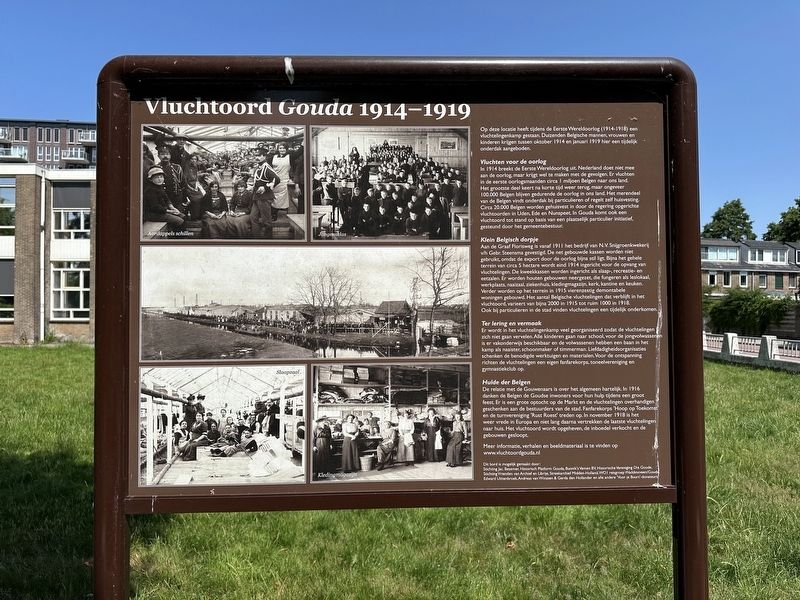
Op deze locatie heeft tijdens de Eerste Wereldoorlog (1914-1918) een vluchtelingenkamp gestaan. Duizenden Belgische mannen, vrouwen en kinderen krijgen tussen oktober 1914 en januari 1919 hier een tijdelijk onderdak aangeboden.
Vluchten voor de oorlog
In 1914 breekt de Eerste Wereldoorlog uit. Nederland doet niet mee aan de oorlog, maar krijgt wel te maken met de gevolgen. Er vluchten in de eerste oorlogsmaanden circa 1 miljoen Belgen naar ons land. Het grootste deel keert na korte tijd weer terug, maar ongeveer 100.000 Belgen blijven gedurende de oorlog in ons land. Het merendeel van de Belgen vindt onderdak bij particulieren of regelt zelf huisvesting. Circa 20.000 Belgen worden gehuisvest in door de regering opgerichte vluchtoorden in Uden, Ede en Nunspeet. In Gouda komt ook een vluchtoord tot stand op basis van een plaatselijk particulier initiatief, gesteund door het gemeentebestuur.
Klein Belgisch dorpje
Aan de Graaf Florisweg is vanaf 1911 het bedrijf van N.V. Snijgroenkwekerij v/h Gebr. Steensma gevestigd. De net gebouwde kassen worden niet gebruikt,
this page online
Ter lering en vermaak
Er wordt in het vluchtelingenkamp veel georganiseerd zodat de vluchtelingen zich niet gaan vervelen. Alle kinderen gaan naar school, voor de jongvolwassenen is er vakonderwijs beschikbaar en de volwassenen hebben een baan in het kamp als naaister, schoonmaker of timmerman. Liefdadigheidsorganisaties schenken de benodigde werktuigen en materialen. Voor de ontspanning richten de vluchtelingen een eigen fanfarekorps, toneelvereniging en gymnastiekclub op.
Hulde der Belgen
De
Photographed by Andrew Ruppenstein, June 21, 2025
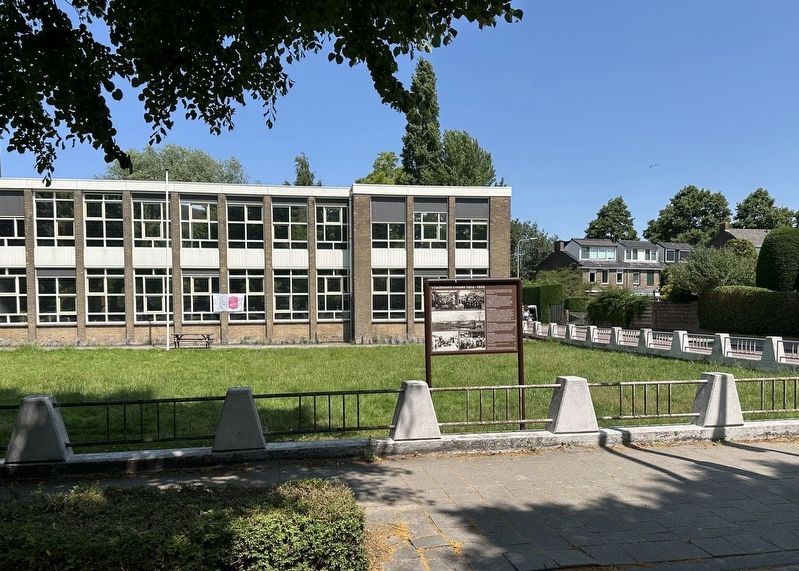
2. Vluchtoord Gouda / Place of Refuge Gouda 1914-1919 Marker - wide view
Meer informatie, verhalen en beeldmateriaal is te vinden op www.vluchtoordgouda.nl
During the First World War (1914-1918), a refugee camp stood at this location. Thousands of Belgian men, women and children were offered temporary shelter here between October 1914 and January 1919.
Fleeing the war
In 1914, the First World War broke out. The Netherlands did not participate in the war, but was confronted with the consequences. In the first months of the war, approximately 1 million Belgians fled to our country. The majority returned after a short time, but approximately 100,000
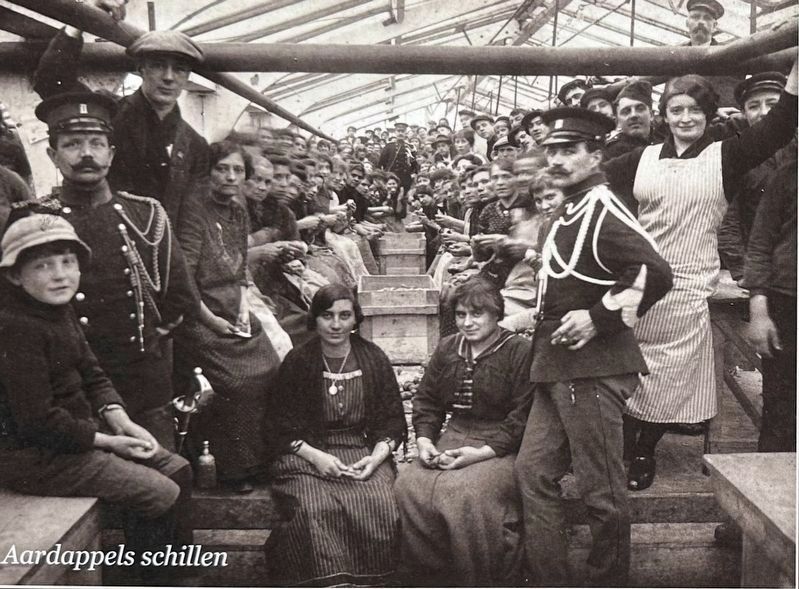
3. Marker photo : peeling potatoes
Small Belgian village
From 1911, the company of N.V. Snijgroenkwekerij v/h Gebr. Steensma was established on the Graaf Florisweg. The newly built greenhouses were not used, because exports had almost come to a standstill due to the war. Almost the entire site of approximately 5 hectares was set up for the reception of refugees at the end of 1914. The greenhouses were set up as sleeping, recreation and dining rooms. Wooden buildings were erected, which functioned as a classroom, workshop, sewing room, hospital, clothing warehouse, church, canteen and kitchen. Furthermore, sixty-four demountable houses were built on the site in 1915. The number of Belgian refugees staying in the refugee camp varied from almost 2000 in 1915 to over 1000 in 1918. Refugees
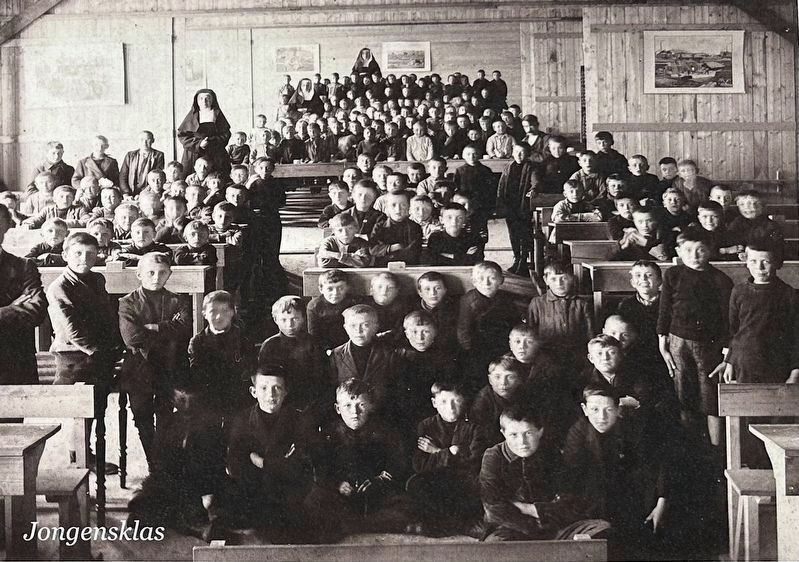
4. Marker photo: boys class
For education and entertainment
Much was organized in the refugee camp so that the refugees did not get bored. All children went to school, vocational education was available for young adults and the adults had jobs in the camp as a seamstress, cleaner or carpenter. Charities donated the necessary tools and materials. For relaxation, the refugees set up their own brass band, drama club and gymnastics club.
Tribute of the Belgians
The relationship with the people of Gouda was generally cordial. In 1916, the Belgians thanked the inhabitants of Gouda for their help during a big party. There was a big parade on the Market and the refugees presented gifts to the city administrators. Fanfare band 'Hoop op Toekomst' and the gymnastics club 'Rust Roest' performed. In November 1918, peace returned to Europe and not long after, the last refugees left for home. The refugee camp closed, the contents were sold and the buildings demolished.
More information, stories and images can be found at www.vluchtoordgouda.nl
Erected 2016 by Historisch Platform Gouda.
Topics.
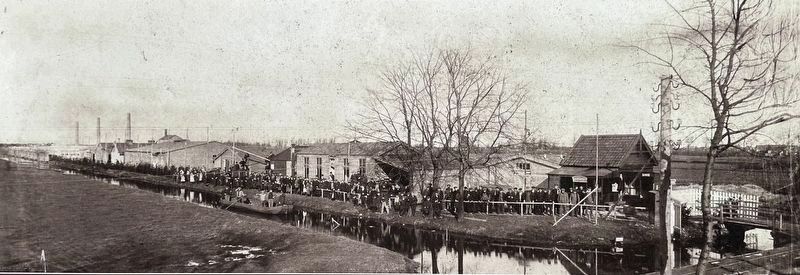
5. Marker photo: general view of the camp
Location. 52° 1.103′ N, 4° 42.94′ E. Marker is in Gouda, Zuid-Holland (South Holland). It is at the intersection of Graaf Florisweg and Willem en Marialaan, on the left when traveling east on Graaf Florisweg. Touch for map. Marker is at or near this postal address: Graaf Florisweg 77-79, Gouda, Zuid-Holland 2805, Netherlands. Touch for directions.

Regionally, it is in Europe, the European Union, Atlantic Europe, the Benelux Low Countries, the Schengen Area, Western Europe, and the Western World. Historically, it finds itself in what was once the Roman Empire and specifically also the Holy Roman Empire.
Other nearby markers. At least 8 other markers are within walking distance of this marker: Kazerne / Barracks (approx. 0.6 kilometers away); Toon Pille (approx. 0.6 kilometers away); Nathan Jacob Cats (approx. 0.6 kilometers away); Station onder vuur en een bommenregen / Station Under Fire and a Rain of Bombs (approx. 0.6 kilometers away); Agnietenkapel / Saint Agatha Chapel (approx. 0.7 kilometers away); De Sint-Jorisdoelen / The St. George Guildhall (approx. 0.7 kilometers away); De Waag / The Weighing House (approx. 0.8 kilometers away); Arti Legi (approx. 0.8 kilometers away). Touch for a list and map of all markers in Gouda.
Also see . . . Vluchtoord Gouda (Historisch Platform Gouda, in Dutch). The website about the refugee camp, as indicated on the marker. (Submitted on June 21, 2025.)
Additional keywords. informatiebord
Credits. This page was last revised on June 21, 2025. It was originally submitted on June 21, 2025, by Andrew Ruppenstein of Lamorinda, California. This page has been viewed 80 times since then and 15 times this year. Photos: 1, 2, 3, 4, 5. submitted on June 21, 2025, by Andrew Ruppenstein of Lamorinda, California.
