Gouda, South Holland, Netherlands — Northwestern Europe
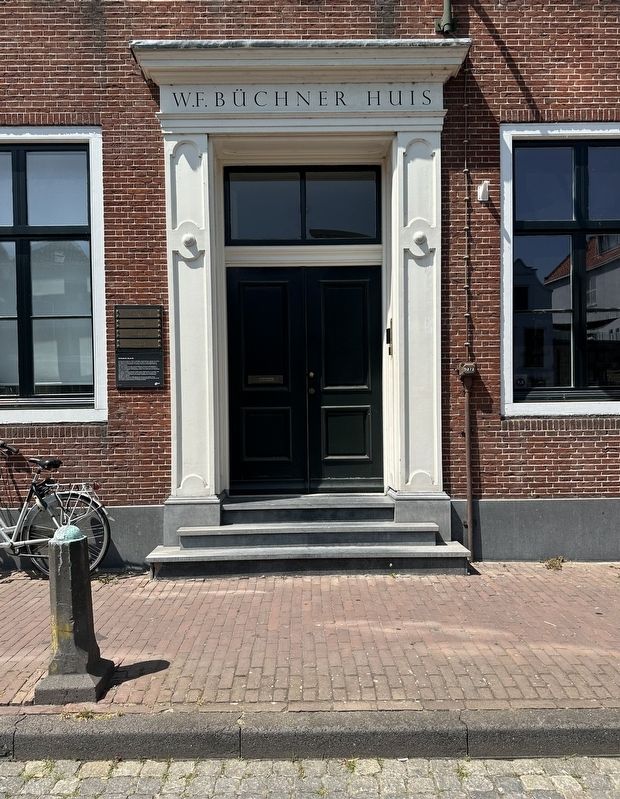
Turfmarkt 54, 54a en 56

Photographed by Andrew Ruppenstein, June 21, 2025
1. Turfmarkt 54, 54a en 56 Marker

Door 4000 kinderen in te enten met het koepokvirus wist hij de pokkenepidemie in 1831-32 te beperken tot 35 slachtoffers. In 1832 brak cholera uit en liet Büchner de kazerne als een speciaal cholerahospitaal inrichten. Toch kostte deze zeer besmettelijke ziekte nog 116 levens.
Als hygiënist bepleitte hij openbare hygiëne (zoals scheiding drink- en rioolwater), lage voedselprijzen en matiging op het vlak van seks en drank. Over de Goudse volksgezondheid schreef hij als één van de eersten in Nederland een 'Geneeskundige topografie en statistiek'.
Büchners woonhuis werd in 1965 gesloopt voor de bouw van kerkelijk centrum Het Brandpunt, behorende bij de naastgelegen gereformeerde kerk. Na sluiting van de kerk in 2001 is dit pand verbouwd tot woonhuis en kantoor.
At this site from 1806 to 1855 lived Willem Frederik Büchner, city doctor of Gouda. As a physician and politician, this German immigrant made a major contribution to the health of
this page online
By vaccinating 4,000 children with the cowpox virus, he managed to limit the smallpox epidemic in 1831-32 to 35 victims. In 1832, cholera broke out and Büchner had the barracks set up as a special cholera hospital. Nevertheless, this highly contagious disease still claimed 116 lives.
As a hygienist he advocated public hygiene (such as separation of drinking water and sewage), low food prices and moderation in sex and drink. He was one of the first in the Netherlands to write a 'Medical topography and statistics' about Gouda's public health.
Büchner's house was demolished in 1965 for the construction of the church centre Het Brandpunt, belonging to the adjacent Reformed Church. After the church closed in 2001, this building was converted into a house and office.
Erected by the ANWB. (Marker Number 17011/001.)
Topics. This historical marker is listed in this topic list: Science & Medicine. A significant historical date for this entry is August 2, 1855.
Location. 52° 0.733′ N, 4° 42.492′ E. Marker is in Gouda, Zuid-Holland (South Holland). It is on Turfmarkt, on the right when traveling south. Touch for map. Marker is at or near this postal address: Turfmarkt
Photographed by Andrew Ruppenstein, June 21, 2025
2. Turfmarkt 54, 54a en 56 Marker - wide view

Regionally, it is in Europe, the European Union, Atlantic Europe, the Benelux Low Countries, the Schengen Area, Western Europe, and the Western World. Historically, it finds itself in what was once the Roman Empire and specifically also the Holy Roman Empire.
Other nearby markers. At least 8 other markers are within walking distance of this marker: Gouda Synagogue Holocaust Memorial (within shouting distance of this marker); Voormalige synagoge / Former Synagogue (within shouting distance of this marker); Woonhuis voogd Erasmus / Home of Erasmus’ Guardian (within shouting distance of this marker); Bank de wed. Knox and Dortland / Bank of the Widow Knox and Dortland (within shouting distance of this marker); Sara van Dantzig (about 150 meters away, measured in a direct line); De Waag / The Weighing House (about 180 meters away); Het Goudse Badhuis / The Gouda Bathhouse (about 180 meters away); Agnietenkapel / Saint Agatha Chapel (about 210 meters away). Touch for a list and map of all markers in Gouda.
Also see . . . Willem Frederik Büchner (Wikipedia, in Dutch). Excerpt (in translation):
For the population of Gouda in the nineteenth century, the city doctor(Submitted on June 21, 2025.)Willem Frederik Büchner was of great significance, partly because of his fight against contagious diseases such as smallpox and cholera. He campaigned for the improvement of the living conditions, which were extremely poor at the time, especially for the working population. He was aware of the effect of the heavily polluted city canals on public health and therefore urged the improvement of drinking water.Photographed by Andrew Ruppenstein, June 21, 20253. Turfmarkt 54, 54a en 56 Marker - wider view
He was also concerned about the malnutrition of a large part of the Gouda population and fought against alcohol abuse (which was also high in Gouda at the time). He also tried to improve the working conditions of the Gouda workers. In his Contributions to the Medical Topography and Statistics of Gouda (1842) he showed that the average age of a Gouda resident - in 1840 no more than 21.4 years - was significantly lower than elsewhere in Europe.

Additional keywords. epidemiology, public health
Credits. This page was last revised on June 21, 2025. It was originally submitted on June 21, 2025, by Andrew Ruppenstein of Lamorinda, California. This page has been viewed 107 times since then and 11 times this year. Photos: 1, 2, 3. submitted on June 21, 2025, by Andrew Ruppenstein of Lamorinda, California.
