Workington in Cumberland, England, United Kingdom — Northwestern Europe (the British Isles)
Shipping Throughout the Years
Photographed by Ray Gurganus, April 11, 2025
1. Shipping Throughout the Years Marker
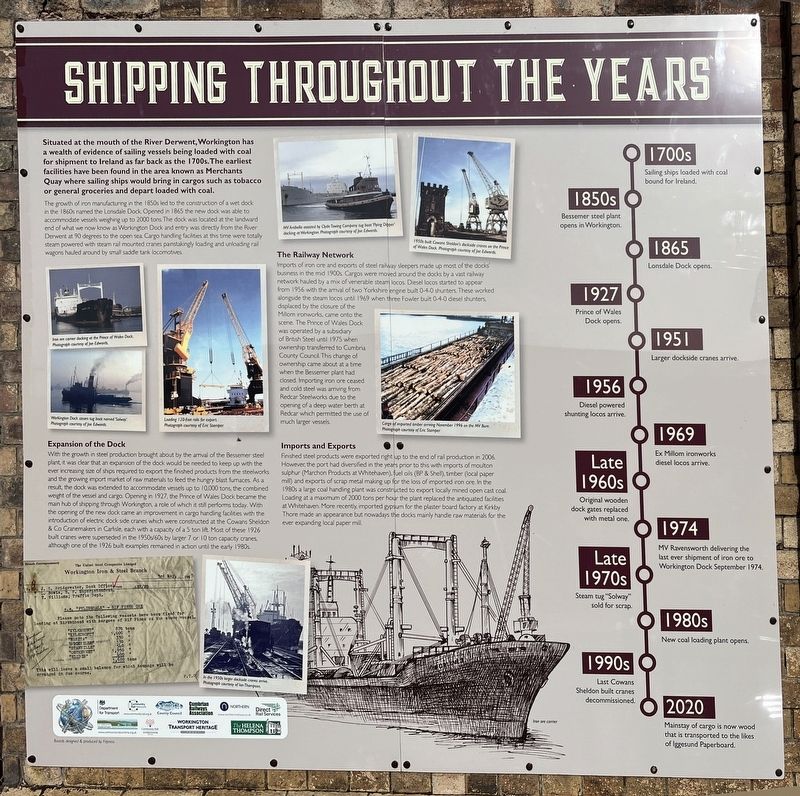
The growth of iron manufacturing in the 1850s led to the construction of a wet dock in the 1860s named the Lonsdale Dock. Opened in 1865 the new dock was able to accommodate vessels weighing up to 2000 tons. The dock was located at the landward end of what we now know as Workington Dock and entry was directly from the River Derwent at 90 degrees to the open sea. Cargo handling facilities at this time were totally steam powered with steam rail mounted cranes painstakingly loading and unloading rail wagons hauled around by small saddle tank locomotives.
Expansion of the Dock
We the growth in steel production brought about by the arrival of the Bessemer steel plant it was clear that an expansion of the dock would be needed to keep up with the ever increasing size of
this page online
The Railway Network
Imports of iron ore and exports of steel railway sleepers made up most of the docks business in the mid 1900s. Cargos were moved around the docks by a vast railway network hauled by a mix of venerable steam locos. Diesel locos started to appear from 1956 with the arrival of two Yorkshire engine built 0-4-0 shunters. These worked alongside the steam locos until 1969 when three Fowler built 0-4-0 diesel shunters, displaced by the closure of the Millom ironworks, came onto the scene. The Prince of Wales Dock was operated by a subsidiary of British Steel until 1975 when ownership transferred to Cumbria County Council. This change of ownership came about at a time when the Bessemer plant had closed. Importing iron ore ceased and cold steel was arriving from Redcar Steelworks due to the opening of a deep water berth at Redcar which permitted the use of much larger vessels.
Imports and Exports
Finished steel products were exported right up to the end of rail production in 2006. However the port had diversified in the years prior to this with imports of mouton sulphur (Marchon Products at Whitehaven), fuel oils (BP & Shell), timber (local paper mill) and exports of scrap metal making up for the loss of imported iron ore in the 1980s a large coal handing plant was constructed to export locally mined open cast coal. Loading at a maximum of 2000 tons per hour the plant replaced the antiquated faces at Whitehaven. More recently imported gypsum for the plaster board factory at Kirkby Thore made an appearance but nowadays the docks mainly handle raw materials for the ever expanding local paper mill.
Erected by Cumbria County Council.
Topics. This historical marker is listed in these topic lists: Industry & Commerce • Railroads & Streetcars • Waterways & Vessels. A significant historical year for this entry is 1865.
Location. 54° 38.694′ N, 3° 33.548′ W. Marker is in Workington, England, in Cumberland. It can be reached from Belle Isle Place. On the Workington train station platform. Touch for map. Marker is at or near this postal address: 20 Belle Isle Pl, Workington, England CA14 2XG, United Kingdom. Touch for directions.

Regionally, this marker is in North West England. Globally, it is on the Atlantic Ocean, in the North Atlantic Region, in Europe, in Atlantic Europe, on one of the British Isles, in the Western World, and in the Anglosphere. Historically, it finds itself in what was once the Roman Empire.
Other nearby markers. At least 8 other markers are within walking distance of this marker: Memories of the Bessemer (here, next to this marker); The Rails Which Circled the World (here, next to this marker); The Bessemer Impact (here, next to this marker); Workington Iron and Steel (a few steps from this marker); The Steel Making Process (a few steps from this marker); The Rail Making Process (a few steps from this marker); Decline of the Local Coal Industry (within shouting distance of this marker); A Local History of Coal Mining (within shouting distance of this marker). Touch for a list and map of all markers in Workington.
Credits. This page was last revised on June 22, 2025. It was originally submitted on June 22, 2025, by Ray Gurganus of Washington, District of Columbia. This page has been viewed 94 times since then and 18 times this year. Photo 1. submitted on June 22, 2025, by Ray Gurganus of Washington, District of Columbia. • Andrew Ruppenstein was the editor who published this page.
