Cascade Valley in Akron in Summit County, Ohio — The American Midwest (Great Lakes)
How Can Water Going Down Make A Boat Go Up?

Photographed by Ian Lefkowitz, May 24, 2025
1. How Can Water Going Down Make A Boat Go Up? Marker
Sixteen locks allow canal boats to negotiate the valley's elevation change. You are standing at Lock 14. Locks are hydraulic elevators enclosed at each end by a pair of wooden gates. By filling or draining a lock a boat would be raised or lowered through elevation changes.
This series of drawings shows how a lock works to lower a canal boat. The boat is brought into the lock and the upstream wooden gates close behind it. The small sluice gates on the downstream wooden gates would then be opened. This allows the lock to drain, lowering the boat. Once the water level lowers, the downstream wooden gates would be opened to let the boat continue on its way.
Erected by Summit Metro Parks.
Topics and series.
this page online
Location. 41° 5.45′ N, 81° 31.043′ W. Marker is in Akron, Ohio, in Summit County. It is in Cascade Valley. It is on West North Street just west of North Howard Street. Touch for map. Marker is at or near this postal address: 57 W North St, Akron OH 44304, United States of America. Touch for directions.

Regionally, this marker is in Greater Cleveland and in the Western Reserve. It is also in the American Midwest. Globally, it is in North America, the Western Hemisphere, the Western World, and the Anglosphere. Historically, it finds itself in what was once the Haudenosaunee (Iroquois) Confederacy, the territory of the Mississippian Culture, and the Northwest Territory.
Other nearby markers. At least 8 other markers are within walking distance of this marker: The Canal Basin (here, next to this marker); Where's the Actual Mill? (within shouting distance of this marker); Ferdinand Schumacher's Cascade Mills Stood Here (within shouting distance
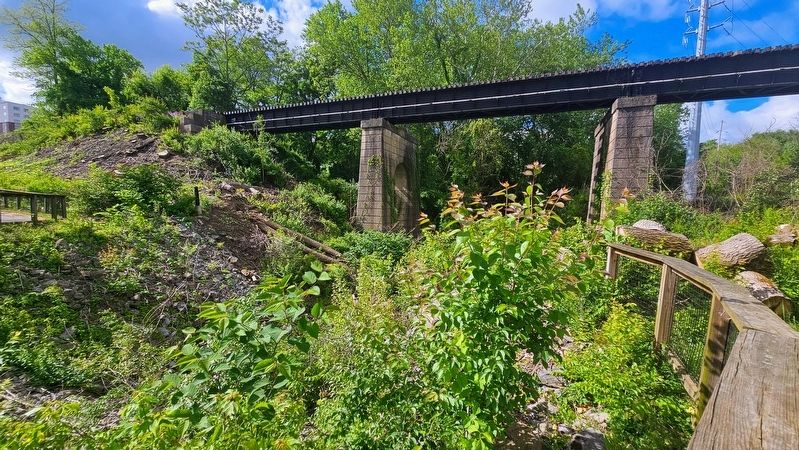
Photographed by Ian Lefkowitz, May 24, 2025
2. Cascade Locks Park
This the historic site of Lock 14, one of the locks along the Ohio & Erie Canalway.
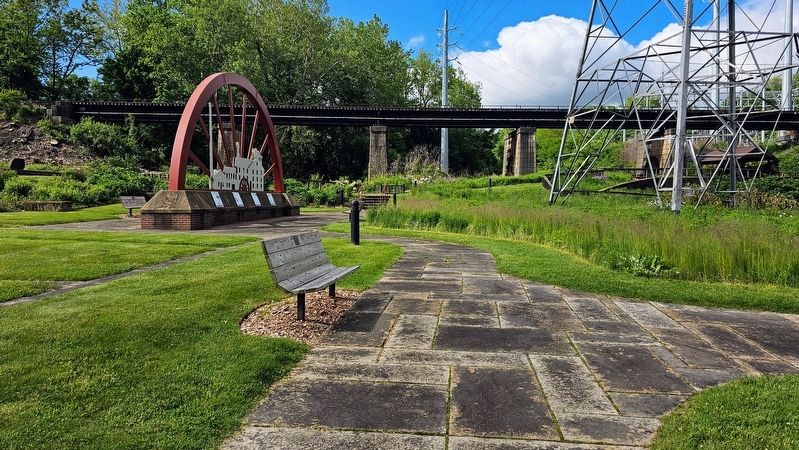
Photographed by Ian Lefkowitz, May 24, 2025
3. Cascade Locks Park
The water wheel is representative of the mill that used to exist along the Cascade Race at the canalway site.
Credits. This page was last revised on July 11, 2025. It was originally submitted on June 22, 2025, by Ian Lefkowitz of New York, New York. This page has been viewed 99 times since then and 32 times this year. Photos: 1, 2, 3. submitted on June 22, 2025, by Ian Lefkowitz of New York, New York. • Bill Pfingsten was the editor who published this page.
