Elizabeth City in Pasquotank County, North Carolina — The American South (South Atlantic)
Illegal Liquor in the Albemarle Sound Region
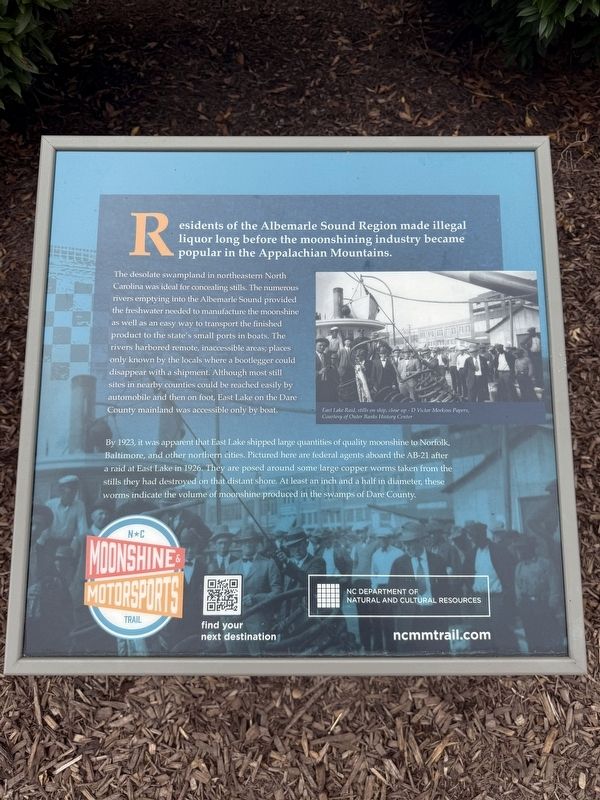
Residents of the Albemarle Sound Region made illegal liquor long before the moonshining industry became popular in the Appalachian Mountains.
The desolate swampland in northeastern North Carolina was ideal for concealing stills. The numerous rivers emptying into the Albemarle Sound provided the freshwater needed to manufacture the finished product to the state's small ports in boats. The rivers harbored remote, inaccessible areas; places only known by the locals where a bootlegger could disappear with a shipment. Although most still sites in nearby counties could be reached easily by automobile and then on foot, East Lake on the Dare County mainland was accessible only by boat.
By 1923, it was apparent that East Lake shipped large quantities of quality moonshine to Norfolk, Baltimore, and other northern cities. Pictured here are federal agents aboard the AB-21 after a raid at East Lake in 1925. They are posed around some large copper worms taken from the stills they had destroyed on that distant shore. At least an inch and a half in diameter, these worms indicate the volume of moonshine produced in the swamps of
this page online
Erected by NC Moonshine & Motorsports Trail; NC Department of Natural and Cultural Resources.
Topics. This historical marker is listed in these topic lists: Industry & Commerce • Law Enforcement. A significant historical year for this entry is 1923.
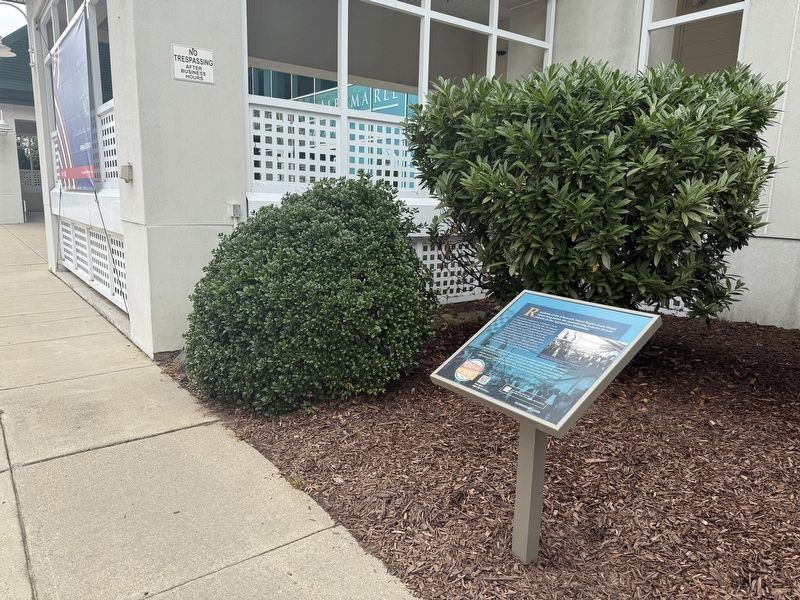
Location. 36° 17.799′ N, 76° 13.17′ W. Marker is in Elizabeth City, North Carolina, in Pasquotank County. It is on South Water Street south of East Ehringhaus Street, on the right when traveling south. Touch for map. Marker is at or near this postal address: 501 S Water St, Elizabeth City NC 27909, United States of America. Touch for directions.

Regionally, this marker is in North Carolina’s Coastal Plain. It is also in the American South, specifically in the Upper South, in the Tidewater, and on the Eastern Seaboard. Globally, it is in the North Atlantic Region, North America, the Western Hemisphere, the Western World, and the Anglosphere. Historically, it finds itself in what was once the territory of the Mississippian Culture, one of the original Thirteen Colonies, one of the Confederate States of America, and the Antebellum South.
Other nearby markers. At
Another marker is no longer nearby. Soybean Processing (was about 400 feet away but has been replaced with another marker now near it).
Credits. This page was last revised on June 22, 2025. It was originally submitted on June 22, 2025, by Devry Becker Jones of Washington, District of Columbia. This page has been viewed 110 times since then and 32 times this year. Photos: 1, 2. submitted on June 22, 2025, by Devry Becker Jones of Washington, District of Columbia.
